
Introduction
Budget scrutiny, project-based work, and unpredictable demand have fundamentally changed how smart organizations think about headcount. The question has shifted from "who do we need?" to "what's the right employment structure for this need?"
Contract staffing has moved well past its reputation as a stopgap. For financial services firms managing regulatory projects, technology companies scaling engineering teams, and PE-backed businesses operating under tight cost discipline, it's become a core workforce strategy — not a fallback.
The distinction matters. Organizations that treat contract staffing as a planned tool consistently outperform those that treat it as an emergency measure.
Still, many organizations use it reactively — scrambling to fill a gap rather than deploying it with intent.
This guide covers what contract staffing actually is, the three advantages that make it worth building into your workforce planning, the risks of relying on reactive hiring alone, and how to get the most from it when you do.
Key Takeaways
- Contract staffing places qualified workers through a staffing agency on a time-bound basis — the agency handles payroll, compliance, and HR while you direct the work day-to-day.
- Flexibility, cost efficiency, and fast access to specialized talent are the core advantages — each tied to measurable business outcomes.
- Treating contract staffing as a standing workforce strategy — rather than a reactive fix — leads to faster ramp-up, lower overhead, and reduced hiring risk.
- The temp-to-hire model lets you evaluate talent in a real work setting before committing to a permanent hire.
- Your staffing partner's industry focus directly determines candidate quality and speed.
What Is Contract Staffing?
Contract staffing is a workforce arrangement where a staffing agency places workers with a client company on a temporary or project-defined basis. The agency is the legal employer of record — managing payroll, tax withholding, benefits administration, and HR compliance — while the client directs the day-to-day work.
The American Staffing Association defines temporary help as a staffing firm hiring its own employees and assigning them to support a client workforce during busy periods, employee absences, skill shortages, or special projects. Long-term contract help — workers assigned to clients for extended engagements — falls under the same employer-of-record structure.
Where Contract Staffing Gets Used
Contract staffing fits most naturally in these situations:
- Project-based work — a defined initiative with a start and end date that doesn't justify a permanent hire
- Capacity gaps — covering workload spikes without inflating permanent headcount
- Specialized skills for a defined window — niche expertise needed for 3 to 12 months
- Hiring freezes — permanent headcount is frozen, but project needs are active
Industries where professional contract staffing is most prevalent include financial services, technology, insurance, and marketing — sectors where specialized functions, regulatory demands, and project-driven work make fixed headcount a poor fit for every need.
The Temp-to-Hire Variation
ASA defines temp-to-hire as a staffing firm employee working for a client during a trial period while both sides evaluate a permanent employment relationship. It's a risk-reduction mechanism, not a hiring shortcut.
The client assesses the contractor's real performance before committing to a full-time offer. If both parties agree, the agency converts the placement — with conversion terms and any applicable fee defined upfront.
Key Advantages of Contract Staffing
The advantages below are grounded in concrete business outcomes — cost, speed, risk, and operational efficiency. They compound when contract staffing is treated as deliberate workforce strategy rather than emergency response.
Advantage 1: Workforce Flexibility Without Long-Term Commitment
Contract staffing lets companies scale up or down in direct response to workload — project launches, seasonal demand, sudden capacity gaps — without adding permanent headcount or triggering layoff costs when the need passes.
How it works in practice: the agency activates pre-screened talent quickly, the engagement is scoped to the actual need, and the client can extend, reduce, or exit based on how the project evolves. No severance exposure. No difficult restructuring decisions when the peak passes.
Permanent hires carry fixed costs — salary, benefits, severance — regardless of whether workload justifies them. Contract staffing converts that fixed commitment into a variable cost that tracks actual demand.
SIA's 2024 contingent workforce megatrends analysis identifies economic uncertainty as a primary driver of contingent workforce adoption, with companies treating contract talent as a flexible cost management tool.
KPIs this affects:
- Labor cost as a percentage of revenue
- Workforce utilization rate
- Time-to-scale for project teams
- Severance and turnover costs
When this matters most: Growth-stage companies with unpredictable demand, PE-backed firms under investor-mandated headcount discipline, and businesses in sectors with cyclical or project-driven workloads.
Advantage 2: Cost Efficiency and Reduced Overhead
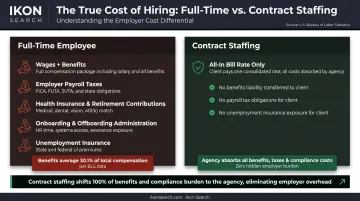
Contract staffing typically carries lower total employment costs than full-time hires because the client is not responsible for:
- Health insurance and retirement contributions
- Employer-side payroll taxes
- Onboarding and offboarding administration
- Unemployment insurance obligations
The agency absorbs these costs, employs the worker, handles tax filings, manages compliance, and invoices the client at an all-in bill rate. The client pays a predictable, project-scoped amount rather than managing variable employment cost components.
The numbers support why benefits are such a significant driver of this calculation. BLS March 2026 Employer Costs for Employee Compensation data reports that private-industry benefits average $14.01 per hour — or 30.1% of total employer compensation costs. For every dollar of wages, employers carry roughly an additional 43 cents in benefits overhead. Contract staffing shifts that burden to the agency for the duration of the engagement.
The bill rate may look higher than a comparable employee's hourly equivalent. But for short-to-medium term needs, the total cost-of-employment comparison favors the contract model once benefits, recruiting costs, and administrative overhead are factored in.
KPIs this affects:
- Cost-per-hire
- Total cost of workforce
- HR administrative burden
- Budget variance on labor
When this matters most: Organizations with hiring freezes on permanent roles but active project needs, companies managing margin pressure, and businesses that need niche expertise for a defined window without justifying a full-time salary line.
Advantage 3: Fast Access to Specialized Talent
Contract staffing gives businesses access to immediately available, highly skilled professionals — often niche specialists — without the extended timeline of a traditional permanent search. The agency maintains active talent networks and can surface qualified candidates far faster than an in-house team starting from scratch.
The speed difference is real and measurable. SIA's professional temp staffing benchmark reports a median time-to-fill by candidate acceptance of 9 days, and by candidate start date, 14 days. Compare that to the general U.S. average of 35 days to fill a vacancy — and the gap grows further for senior or specialized roles.
In fields like financial compliance, data analysis, insurance operations, or performance marketing, an experienced contractor often delivers immediate output. They arrive with domain expertise already built in, which matters when the engagement is time-sensitive.
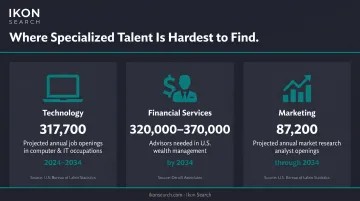
Talent shortages across high-demand professional fields reinforce how much speed of access matters:
- Technology: BLS projects approximately 317,700 annual openings in computer and IT occupations from 2024–2034
- Financial services: McKinsey projects the U.S. wealth management industry will need 320,000 to 370,000 advisors by 2034 to meet demand
- Marketing: BLS projects market research analyst employment to grow 7% through 2034, with roughly 87,200 openings annually
Specialized staffing partners with active networks in these verticals can present vetted candidates within days of receiving a brief. Ikon Search, for example, typically delivers a qualified shortlist within 2 to 3 days — compared to generalist agencies that cover broad categories without deep domain networks.
KPIs this affects:
- Time-to-fill
- Time-to-productivity
- Project delivery speed
- Team output during the engagement
When this matters most: Product launches, regulatory deadlines, client-driven project timelines, or when a key team member exits unexpectedly in a role that can't stay vacant.
What Happens When Contract Staffing Is Ignored
Companies that default exclusively to permanent hiring — even when contract arrangements would better fit the need — tend to accumulate costs and friction they often attribute to other causes.
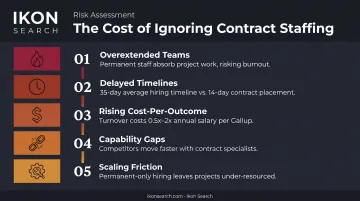
The common consequences:
- Overextended permanent teams absorb project work outside their core function, leading to burnout and quality degradation
- Delayed timelines because permanent hiring for specialized roles takes weeks when the need is immediate. SIA's median start-date figure for professional temp placements is 14 days; the general U.S. hiring average is 35 days — and specialized permanent searches often run longer
- Rising cost-per-outcome when a full-time hire is retained long after peak demand passes, or when a bad permanent hire must be unwound. Gallup estimates voluntary turnover costs U.S. businesses roughly $1 trillion annually, and replacing an individual employee can cost 0.5x to 2x their annual salary
- Capability gaps that widen when competitors bring in contract specialists on short notice — and move faster because of it
- Scaling friction during growth phases, where permanent-only hiring forces a choice between over-hiring or leaving critical projects under-resourced
None of these outcomes are fixed. They follow predictably when permanent hiring is applied to temporary needs — and they disappear just as quickly when the right staffing model is in place.
How to Get the Most Value from Contract Staffing
Contract staffing delivers its best outcomes when it's treated as a deliberate workforce tool, not an emergency response. A few principles that separate high-value engagements from costly placeholders:
- Define the scope before engaging. The agency needs to understand the role, required expertise, duration, and how success will be measured. Vague briefs produce mismatched candidates.
- Structure temp-to-hire intentionally. If there's a realistic path to permanent hire but uncertainty about the right person, set up the engagement as temp-to-hire from the start — and agree on conversion terms, including any applicable fee, upfront.
- Review at agreed checkpoints whether to extend, convert, or close. Letting contracts drift without review is how temporary arrangements become expensive indefinitely.
- Match your staffing partner to your industry, not your calendar. A boutique firm with dedicated practice leads in financial services, insurance, technology, or marketing will outperform a generalist agency on candidate quality and speed. Ikon Search's specialized divisions typically deliver a qualified shortlist within 2 to 3 days — which translates directly to faster time-to-productivity for the contractor.
Conclusion
Contract staffing delivers real value when it aligns workforce capacity with actual demand — keeping labor costs variable, protecting budget from fixed employment overhead, and putting specialized talent in place faster than a traditional full-time search allows.
Those advantages hold when contract staffing is treated as an ongoing workforce option rather than a fallback. Clear scoping, active management, and scheduled reviews are what keep engagements productive rather than just convenient.
That said, the partner you choose matters as much as the decision to use contract staffing at all. Industry expertise, candidate quality, and response speed separate a strategic engagement from an expensive placeholder. Ikon Search's specialized divisions — spanning insurance, technology, risk, marketing, and corporate services — are built around exactly those criteria, with qualified shortlists typically delivered within 2-3 days and every candidate vetted through structured interviews, technical assessments, and reference checks. The result is faster ramp-up, tighter role fit, and less time managing the placement.
Frequently Asked Questions
What is contract staffing and how does it work?
Contract staffing is an arrangement where a staffing agency places workers with a client company on a temporary or project basis. The agency acts as the legal employer of record — managing payroll, tax compliance, and HR obligations — while the client directs the day-to-day work. Clients get the skilled output without taking on the employment obligations.
What are the requirements for contract staffing?
From the client side: define the role scope and duration, agree on a bill rate with the agency, and sign a staffing agreement covering classification, payment terms, and any conversion provisions. The agency, as employer of record, handles worker classification and tax compliance.
What is the difference between contract staffing and permanent hiring?
Permanent hires are long-term employees with full benefits and ongoing salary obligations. Contract staff are time-bound placements managed by a staffing agency — offering lower total overhead and workforce flexibility without a long-term employment commitment.
What industries use contract staffing the most?
Financial services, technology, insurance, and marketing are among the most active users — typically for project-based roles, specialized functions, or capacity management during peak demand periods. These industries combine niche skill requirements with project-driven or cyclical workloads.
Can a contract employee be converted to a full-time hire?
Yes — this is the temp-to-hire model. A contractor works a defined trial period, after which the client can convert them to permanent employment for a conversion fee agreed upfront. According to the ASA, one-third of contract workers receive a permanent offer, and two-thirds of those accept.
How quickly can contract staff be placed?
Timelines vary by role complexity. SIA benchmarks put professional temp staffing at a median of 9 days to candidate acceptance and 14 days to start date. Boutique firms with active talent networks — like Ikon Search — typically present qualified candidates within 2 to 3 days of receiving a brief.