Introduction
Making the leap from founder-led marketing to hiring a dedicated marketing executive is a transition few startups get right. Get it right, and a great CMO accelerates your go-to-market, builds the brand, and aligns marketing directly to revenue. Get it wrong, and you've burned six to twelve months of runway on a mis-hire that leaves your pipeline worse than before.
The challenge is that most hiring advice treats the CMO role as interchangeable across company stages. It isn't. A startup CMO operates in a different environment than their enterprise counterparts — no established team, no proven playbook, and a product that may still be shifting under their feet. Résumés from well-known brands rarely signal readiness for that kind of ambiguity.
This guide draws on placement experience from Ikon Search's marketing leadership practice — which specializes in CMO and VP Marketing searches for Series A-C startups and PE-backed firms — to cover when to hire, what separates strong candidates from costly ones, and where most searches go wrong.
Key Takeaways
- Hiring a CMO before product-market fit burns runway — timing matters as much as candidate quality
- The right startup CMO is a builder who can execute, not just a strategist who delegates
- Define the marketing gap you need to fill before writing a job description
- Stage-appropriate experience outweighs brand-name employer history every time
- A specialized search partner shortens your timeline, filters out weak fits early, and reduces costly mis-hires
What Does a CMO Actually Do at a Startup?
CMO vs. VP of Marketing: The Distinction That Matters
Many founders use these titles interchangeably. They're not the same role.
A VP of Marketing owns execution — campaigns, pipeline, demand generation, and channel performance. They work within a defined marketing function and report upward. A CMO operates at the executive level, owning brand strategy, budget allocation, organizational design, and the company narrative that supports both revenue and fundraising.
At a startup, that distinction gets even sharper. The CMO isn't just setting strategy — they're often building the entire marketing function from scratch while simultaneously executing campaigns, hiring a team, and establishing the metrics framework.
Core CMO Responsibilities at a Startup
According to Andreessen Horowitz's CMO hiring framework, a startup CMO is accountable for growing users, customers, revenue, engagement, and retention — not just brand. That scope makes the role closer to a business owner than a traditional marketing head.
In practice, startup CMO responsibilities typically include:
- Customer acquisition strategy — defining channels, messaging, and go-to-market sequencing
- Team hiring and structure — building the marketing org from the first hire up
- Budget accountability — owning marketing spend and defending ROI at the C-suite level
- Cross-functional alignment — keeping sales, product, and marketing moving toward the same priorities
- Fundraising narrative — ensuring the company's positioning and metrics story holds up under investor scrutiny
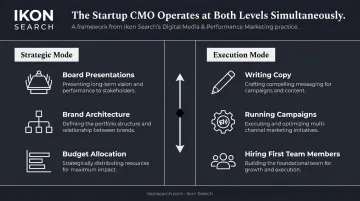
Operating at Two Levels: Strategy and Execution
The startup CMO role demands two modes at once. One week they're presenting brand strategy to the board; the next they're writing landing page copy because the team is short-staffed. Candidates who've only ever operated in one mode — purely strategic or purely tactical — consistently struggle in early-stage environments. The best hires have a track record of doing both, often within the same quarter.
When Is the Right Time to Hire a Startup CMO?
The ARR-Based Framework
SaaStr's 2026 guidance on startup CMO timing lays out a clear ARR-based framework that most experienced recruiters use as a starting point:
| ARR Stage | Right Marketing Leader |
|---|---|
| $0–$3M | Founder-led marketing + individual contributors |
| $3M–$20M | VP of Marketing / Head of Demand Gen |
| $20M–$30M | Transition zone — evaluate if demand gen engine is working |
| $30M+ | True CMO, when brand and category strategy become critical |
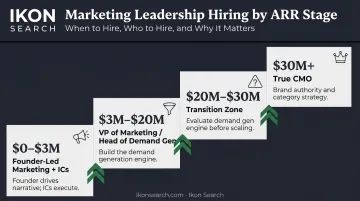
The $20M–$30M range is a conditional threshold. A CMO hire at this stage only makes sense if the demand generation engine is already running. If you're still figuring out your repeatable acquisition channels, you need a demand gen operator — not a CMO.
B2B vs. B2C Timing
The framework above skews toward B2B SaaS. B2C startups often need marketing leadership earlier because brand and consumer acquisition are central to growth from day one. B2B startups should generally establish a repeatable sales motion — quota-carrying reps hitting numbers, a defined ICP, a working pipeline — before elevating to CMO-level marketing strategy.
Operational Signals That It's Time
Beyond ARR, watch for these indicators:
- Growth has plateaued despite clear product-market fit
- The marketing team is executing without strategic direction
- Competitors are visibly winning on brand awareness and category positioning
- Investors are asking harder questions about marketing ROI and growth strategy
Financial Readiness
The CMO hire costs more than the salary line. Budget, headcount, and tooling to execute their vision come with the package. Bringing on a strong CMO without funding their roadmap is a setup for failure — and a fast path to expensive turnover.
Key Criteria for Evaluating Startup CMO Candidates
Stage-Appropriate Experience Over Brand Names
A CMO who scaled a 200-person marketing team at a Fortune 500 has built very different muscles than one who built a marketing function from zero at a Series B company. The skills don't transfer cleanly.
Prioritize candidates who have:
- Built marketing functions at companies of comparable size and stage
- Operated with constrained budgets and lean teams
- Generated concrete, measurable growth outcomes — not just managed large programs
CRV's hiring guidance flags candidates who have only worked with large teams and large budgets as a red flag for startup searches. Big-company résumés can look impressive and still represent a poor fit.
Builder vs. Manager Orientation
This is the single most predictive differentiator in a startup CMO search. Ask directly:
- "Walk me through the last campaign you personally built from brief to execution."
- "What marketing work are you still doing yourself, rather than delegating?"
- "How hands-on were you when your team was at three people versus thirty?"
Candidates who default to "I lead the team that does X" without concrete personal examples are showing you their orientation. At a startup with a small team, that orientation becomes a liability quickly.
CMO Archetype Alignment
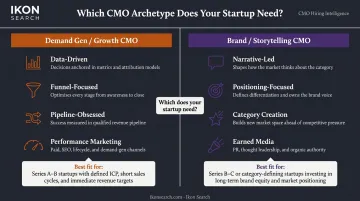
CMOs generally fall into two broad profiles:
- Demand Gen / Growth CMO — data-driven, funnel-focused, pipeline-obsessed, comfortable in performance marketing and revenue attribution
- Brand / Storytelling CMO — narrative-led, positioning-focused, strong in category creation and earned media
Which profile you need depends on the gap your startup has to fill right now. A B2B SaaS company at Series A with weak pipeline needs the first; a consumer brand trying to break into a crowded category needs the second. Getting this wrong before you start interviewing wastes months.
Data Fluency and KPI Ownership
The startup CMO must build the metrics framework, not inherit one. Strong candidates can articulate:
- How they've defined and tracked MQLs, SQLs, pipeline contribution, and CAC in resource-constrained environments
- What they'd measure in the first 90 days at your company specifically
- How they've communicated marketing ROI to non-marketing executives
Gartner's 2025 CEO/CFO survey found that only 22% of senior executives report significant clarity from their CMO on marketing accountabilities. That ambiguity is a firing risk — and it starts at the hiring stage when accountability isn't defined upfront.
CEO Alignment and Authority
Strong data fluency won't save a CMO whose relationship with the CEO is built on unclear expectations. CMO tenure at tech companies averages around 18 months, according to a16z's experience. Much of that turnover traces back to misalignment on authority, trust, and how success is measured.
Before making an offer, be explicit about:
- Which marketing decisions the CEO will retain versus delegate
- What success looks like at 6 months, 12 months, and 24 months
- How marketing ROI will be evaluated at the board level
Probe this in reference calls: ask previous managers and colleagues how the candidate navigates disagreements with leadership and whether they've thrived with constrained authority.
Common Mistakes Startups Make When Hiring a CMO
Hiring Before Product-Market Fit
A CMO cannot build a go-to-market engine from scratch without a stable message to amplify. If the product is still being validated, marketing spend at the CMO level gets absorbed without traction. Use the pre-PMF period for founder-led content, direct customer development, and lightweight demand gen experimentation — not executive marketing hires.
Writing a Vague or Overloaded Job Description
The typical startup CMO job description lists every marketing skill imaginable and attracts the wrong candidates: either generalists who can't go deep, or big-company executives who don't fit the stage. A sharper approach: define the two or three specific marketing problems the CMO must solve in their first 90 days. That focus makes evaluation cleaner and signals to strong candidates that you've actually thought through the role.
Hiring the Big-Company CMO Who Can't Operate Lean
This is one of the most consistent mis-hire patterns in startup recruiting. A candidate with an impressive résumé from a well-known company may have spent years operating with large teams, established brand equity, and marketing budgets that dwarf your entire operating budget.
The transition to writing your own copy, managing a two-person team, and justifying every dollar is a bigger operational shift than most founders anticipate.
Not Defining Success Metrics Upfront
Bringing on a CMO without clear, pre-agreed success metrics is a structural problem that plays out slowly and painfully. Before making an offer, align on:
- Pipeline contribution targets and revenue attribution expectations
- Brand benchmarks and awareness milestones
- Team buildout timelines and budget authority
The CEO must also be prepared to genuinely delegate marketing decision-making. CMOs who are micromanaged lose impact fast, and strong candidates will surface this risk during the interview process regardless.
Each of these mistakes is avoidable with the right process upfront — defining the role precisely, screening for stage fit, and agreeing on success metrics before day one.
How Ikon Search Helps Startups Find the Right CMO
Ikon Search's Digital Media & Performance Marketing division handles CMO and senior marketing leadership searches specifically for startups, FinTech/SaaS companies, and PE-backed portfolio companies — with documented placements from seed stage through Series C.
One example: Ikon worked with a Prop-Tech startup in NYC that was ready for its first CMO. The role required a rare combination of insurance sector knowledge, prop-tech experience, and a track record of building marketing teams from scratch.
The placement came down to two finalists. The selected candidate stayed with the company for four years and opened the door for additional placements across technology and corporate services.
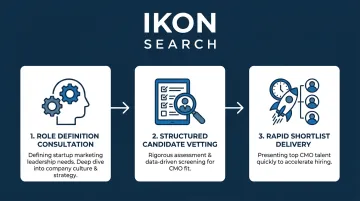
Three things shape how Ikon runs CMO searches differently:
- Starts with a direct conversation with the Head of Performance Marketing Recruitment to define what the CMO must own at one, two, and five years out — not just a job description review
- Vets candidates through structured interviews, reference checks, and technical assessments focused on builder orientation, data fluency, and results at comparable company stages
- Delivers a qualified shortlist within 2 to 3 days through a proprietary candidate network and 40+ combined years of search experience — compared to weeks when a generalist recruiter builds from scratch
Those process strengths carry across all three engagement models Ikon supports:
- Retained Search — for confidential, strategic placements where deep market mapping matters
- Full-time Permanent — for founders who need qualified candidates faster
- Fractional/Interim — through Ikon's contract staffing model, for startups that need marketing leadership before committing to a full-time C-suite hire
If you're trying to define which CMO archetype fits your current stage before starting a search, reach out to the Ikon team at info@ikonsearch.com for an initial consultation.
Frequently Asked Questions
What does a CMO do in a startup?
A startup CMO owns marketing strategy, demand generation, brand positioning, and building the marketing team — often from scratch. Unlike a VP of Marketing who focuses on execution and pipeline, the CMO operates at the executive level, managing budget, org design, and the company narrative that supports both revenue and investor relations.
When should a startup hire its first CMO?
Most startups are ready for a true CMO search around Series A or when ARR approaches $20M–$30M, assuming product-market fit is established and a demand gen motion is already running. Before that point, a strong VP of Marketing or Head of Demand Gen is usually the better fit.
How much does a CMO make at a startup?
Base salaries for startup CMOs typically range from $180K–$250K at Series A and can exceed $300K at Series B+, combined with equity. Compensation scales with stage, scope, and funding level. Tools like Pave or a specialized recruiter provide current market ranges by vertical and geography.
How much equity should a CMO get in a startup?
CRV's data on C-level hires at companies valued between $10M–$25M post-money shows equity ranges of roughly 0.18% to 0.73% of fully diluted shares. Equity is a critical alignment and retention tool for cash-constrained startups, and the range widens at earlier stages where salary may be below market.
What's the difference between a VP of Marketing and a CMO for a startup?
A VP of Marketing owns execution and pipeline; a CMO operates at the strategic level, owning brand, category positioning, budget, and org structure. The title difference signals a meaningful shift in scope — and hiring for CMO-level accountability before the company is ready for it often leads to misaligned expectations on both sides.
Should startups hire a full-time CMO or a fractional CMO?
Fractional CMOs work well for early-stage startups that need strategic marketing leadership but can't yet support a full C-suite salary. A full-time CMO makes sense when marketing is a primary growth driver and the company is ready to invest in building out a complete marketing organization — usually signaled by consistent pipeline demand, a defined ICP, and budget to hire 3–5 marketing team members beneath the CMO.