
The challenge: "marketing manager" is a broad title covering wildly different specialties, seniority levels, and skill sets. Most hiring mistakes happen before the first interview — in the goal-definition and job-description phase.
This guide walks through how to determine when you're ready to hire, which type of marketing manager fits your goals, what skills actually predict success, where to find strong candidates, and how to structure an offer once you've found the right person.
Key Takeaways
- Your growth strategy should dictate which type of marketing manager you hire — digital, content, brand, or product.
- Define marketing goals before writing a job description to avoid hiring for the wrong seniority or specialty.
- Analytical ability, strategic thinking, and cross-functional communication predict success better than channel experience alone.
- Niche communities and specialist recruiters surface better candidates than generic job boards.
- Structured interviews and reference checks sharply reduce costly mis-hire risk.
When Is the Right Time to Hire a Marketing Manager?
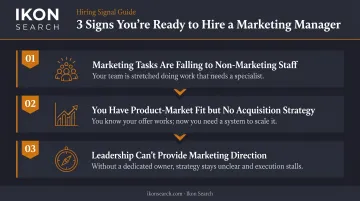
Most companies wait too long — or move too fast. Three signals consistently indicate you're ready:
- Marketing tasks are falling to non-marketing staff — when founders, operations leads, or salespeople are writing copy and running ads, execution quality suffers.
- You have product-market fit but no acquisition strategy — growth is stalling not because the product is weak, but because there is no real plan for customer acquisition.
- Leadership can no longer provide meaningful marketing direction — if nobody in the room can evaluate a campaign plan or set coherent marketing KPIs, the function has outgrown its oversight.
Two Common Timing Mistakes
Hiring too early wastes money. If there isn't enough strategic marketing work to fill a full-time role, a manager will either underperform or leave within the year. A fractional CMO or marketing consultant often serves early-stage companies better.
Hiring too late is the more expensive error. Poor or absent marketing compounds over time — damaged brand perception, weak pipeline, and wasted ad spend are hard to reverse quickly.
If you're uncertain, consider a contract or temp-to-hire arrangement. It lets you pressure-test the role scope before committing to a permanent hire. Ikon Search's Digital Media & Performance Marketing division places vetted candidates in exactly these flexible engagements — often presenting a qualified shortlist within 2–3 days.
Types of Marketing Managers: Choosing the Right Fit
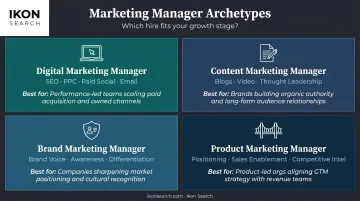
The title "marketing manager" covers four genuinely different roles. Hiring the wrong type — even a strong candidate — won't move your specific metrics.
Digital Marketing Manager
Owns online channels: SEO, PPC, paid social, email, and website performance. If digital acquisition is your primary growth driver and you need to scale inbound lead volume, this is typically your first marketing hire.
Content Marketing Manager
Builds brand authority through blogs, video, podcasts, and gated assets. Companies pursuing thought leadership or product-led growth — where educating the market drives pipeline — are the natural home for this hire. As the team scales, this role pairs better alongside a separate demand generation function rather than trying to own both.
Brand Marketing Manager
Responsible for brand identity, voice, messaging consistency, and awareness campaigns. Once your product is stable and you're competing in a crowded market, brand differentiation becomes the priority — and this is where this hire earns its keep. In most cases, you'll want a digital or content marketer already in place first.
Product Marketing Manager
This role bridges product, sales, and marketing: positioning, competitive intelligence, and sales enablement all fall under its scope. Bring this person in after product-market fit is confirmed, when the sales team needs sharper marketing support to close deals.
Key Skills to Look for in a Marketing Manager
Strong candidates share five core competencies — whether you're hiring for a B2B SaaS team, a PE-backed brand, or a growth-stage startup.
Strategic Thinking and Goal Alignment
The best marketing managers translate business objectives into coherent plans with clear KPIs — not just a list of tactics. Ask candidates how they've historically set quarterly goals and what frameworks they've used to prioritize budget and effort. Vague answers here are a red flag.
Analytical Proficiency
Modern marketing is measurement-driven. Research from McKinsey shows that smart analytics can recover up to 20% of lost ROI. Candidates should be comfortable in platforms like Google Analytics, HubSpot, or Salesforce. More importantly, they should independently interpret conversion rates, customer acquisition cost (CAC), and pipeline contribution — not require coaching on what the numbers mean.
Communication and Cross-Functional Collaboration
Marketing managers coordinate with sales, product, leadership, agencies, and vendors simultaneously. Weak communication leads directly to misaligned campaigns and wasted spend. Look for evidence of structured stakeholder reporting and cross-team project coordination — not just "good with people."
Creativity and Campaign Judgment
Creativity here isn't about design instinct — it's about messaging judgment and the willingness to test unconventional ideas. Ask candidates to walk through a campaign they owned from concept to execution: what worked, what flopped, and what they'd do differently. How they answer reveals more than any portfolio.
Project Management Skills
A marketing manager typically juggles multiple campaigns, vendors, and deadlines at once. Look for demonstrated experience with tools like:
- Asana, Monday.com, or Trello for campaign tracking
- Shared briefs and timelines to coordinate across teams
- Clear escalation habits when deadlines slip
The goal isn't tool proficiency — it's evidence they've kept complex initiatives on track without letting quality slip.
How to Source Marketing Manager Candidates
Active Sourcing Strategies
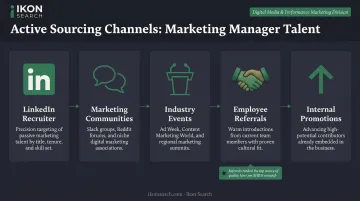
The strongest candidates are often passive — not browsing job boards. Effective channels include:
- LinkedIn Recruiter for direct outreach to passive candidates
- Marketing communities like Superpath (content marketing) and OnlineGeniuses (digital marketing)
- Industry events such as Content Marketing World or MozCon
- Employee referral programs — SHRM research consistently identifies referrals as a top source for quality hires
- Internal promotions from marketing coordinator or specialist roles
Writing a Targeted Job Posting
Generic postings attract generic applicants. An effective marketing manager job posting should:
- Lead with the specific problem the hire is being asked to solve
- Name the marketing stack and budget they'll manage
- Reference team structure and reporting lines honestly
- Include the tools and channels relevant to the role (Google Analytics, HubSpot, paid social)
SHRM research shows pay transparency increases the quality of applicants. Include a compensation range — it filters out mismatches before the first phone screen.
Partnering with Specialist Recruiters
For companies that need to move quickly or lack recruiting bandwidth, working with a firm that specializes in marketing and digital media talent is often the fastest path. Ikon Search's Digital Media & Performance Marketing division places candidates across demand generation, SEO/SEM, lifecycle, and content roles — typically delivering a qualified shortlist within 2-3 days.
Interviewing and Evaluating Marketing Manager Candidates
Structured Interview Questions That Reveal Real Competency
Rehearsed answers are easy to spot. These questions tend to expose actual capability:
- "Walk me through a marketing campaign you built from strategy to results — what worked and what didn't?"
- "How have you built or managed a marketing budget?"
- "How do you measure and report on the ROI of your marketing efforts?"
- "Describe a time a campaign underperformed — how did you diagnose the problem and adapt?"
- "How do you align marketing activity with sales pipeline goals?"
Structured interviews consistently outperform unstructured conversations at predicting on-the-job performance. A candidate who can't answer these questions concretely likely lacks the depth the role requires.
Evaluating the Full Candidate Picture
Skills and experience matter, but weigh them alongside:
- Communication clarity — can they explain their past work to a non-marketer?
- Curiosity about the business — do they ask smart questions about the product and market?
- Coachability — how do they respond when challenged on their approach?
A candidate with a shorter resume who communicates clearly and asks sharp questions often outperforms a more experienced candidate who can't articulate how their work drove results.
Always conduct reference checks with former managers. Ask specifically about strategic contributions, team impact, and how the candidate handled campaigns that underperformed.
Red Flags to Watch For
- Cannot cite specific metrics or outcomes from past campaigns
- Positions themselves as a generalist with no meaningful depth in any area
- Shows no curiosity about your product or market
- Becomes defensive when challenged during the interview
Making and Structuring the Offer
Strong marketing talent receives multiple offers. Move quickly once you've decided. Structure the offer to include:
- Competitive base salary adjusted for role type, seniority, and geography — Indeed reports the average US marketing manager salary at approximately $80,510, though senior and specialized roles command significantly more
- Clear 90-day performance expectations — set SMART goals before day one to accelerate ramp time
- Any equity, bonus, or commission components clearly documented
Frequently Asked Questions
How much does it cost to hire a marketing manager?
Salary varies by experience, specialization, and geography. The BLS reports a median annual wage of $157,620 for advertising and marketing managers; Indeed's broader data shows averages closer to $80,510 for mid-level roles. Budget additional costs for benefits, tools, and recruiter fees on top of base salary.
Is it worth hiring a marketing manager?
For most businesses past early product-market fit, yes. A dedicated marketing manager improves lead generation, brand consistency, and campaign efficiency. The cost of not having one typically shows up as missed pipeline and wasted ad spend — often exceeding the cost of the hire itself.
How do you hire a marketing manager?
Start by defining your marketing goals and the type of manager you need, then write a targeted job description, source through niche channels, interview with structure, and move quickly on an offer. Skipping goal-definition is the most common cause of mis-hires.
What is the difference between a marketing manager and a marketing director?
A marketing manager typically oversees campaign execution, team coordination, and channel performance. A marketing director sets broader strategy, manages larger budgets, and reports to C-suite leadership. The right choice depends on your company's stage and existing team structure.
Should I hire a full-time marketing manager or work with an agency?
A full-time hire suits companies needing ongoing strategy, deep brand knowledge, and internal team leadership — an agency works better for project-based work that doesn't justify a full-time salary. Contract or temp-to-hire arrangements bridge the gap while you define the role's scope.