
Contract-to-hire is often framed as a compromise. It isn't. It's a structured risk management tool that gives employers real performance data before making a permanent commitment, preserves cost flexibility during uncertain periods, and gets specialized talent in front of you faster than a traditional search.
This post breaks down three concrete reasons contract-to-hire delivers more value in 2026 than it did even a few years ago — and what you need to do to get the most out of it.
Key Takeaways
- Contract-to-hire gives employers weeks or months of on-the-job behavioral data before any permanent commitment is made
- During the contract period, workforce costs stay flexible — no permanent salary lock-in while performance is still being evaluated
- Specialized staffing partners deliver pre-vetted candidates in days, not the six-plus weeks a direct search takes
- Skipping contract-to-hire exposes companies to costly mis-hires, compounding rehiring costs, and permanent headcount decisions made under pressure
- Works best as a structured evaluation with clear performance criteria set from day one, not a placeholder arrangement
What Is Contract-to-Hire Staffing?
The American Staffing Association defines temp-to-hire as a staffing firm employee working for a client during a trial period while both the employee and client consider a permanent employment relationship. In plain terms: a candidate joins on a fixed-term contract, typically employed by the staffing agency, with an explicit option — but not an obligation — to convert to permanent at the end.
That's the key distinction from the other two common models:
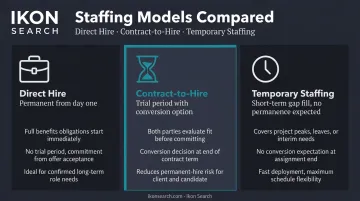
- Direct hire places the candidate permanently from day one, with full benefits and employer obligations starting immediately
- Temporary staffing fills a short-term gap with no expectation of permanence on either side
- Contract-to-hire sits between them — the intent from day one is to evaluate for a full-time role, but the commitment comes after the trial period, not before
The contract window is an active, two-sided evaluation. The employer assesses whether the candidate performs and fits the culture; the candidate assesses whether the role and organization are right for them. A staffing partner like Ikon Search handles vetting, compliance, and candidate alignment upfront, so by the time the trial period ends, both parties can make a confident, informed decision on permanence.
3 Benefits of Contract-to-Hire Staffing in 2026
In a climate where Gallup reports employee replacement can cost 0.5x to 2x annual salary, the stakes of getting a permanent hire wrong are real and measurable. These three benefits are tied to outcomes, not hiring theory.
Benefit 1: Reduced Hiring Risk Through Real-World Evaluation
No interview process gives you what three months on the job does.
Contract-to-hire provides a structured trial period where employers observe how a candidate actually performs — their technical execution, communication under pressure, decision-making, and how they fit with the team. The candidate is doing real work, interacting with real stakeholders, and generating behavioral data that no interview can replicate.
Why this matters now:
Leadership IQ research found that 46% of new hires failed within 18 months — and only 19% were considered unequivocal successes. The failures weren't primarily technical. The top causes were coachability (26%), emotional intelligence (23%), motivation (17%), and temperament (15%). Technical competence ranked last at 11%.
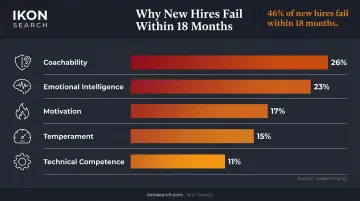
Those are exactly the qualities a contract period reveals — and an interview masks.
The Work Institute's 2025 Retention Report adds another layer: up to 40% of all employee turnover happens within the first year. For companies making permanent hiring decisions under pressure — tight timelines, budget scrutiny, prolonged approval chains — that early-exit risk is precisely what contract-to-hire is designed to reduce.
When this advantage is highest:
- Filling senior or specialized roles in financial services, insurance, risk and compliance, or fintech where a poor fit in a technical or client-facing seat has outsized downstream effects
- Replacing a role that's turned over recently — where the company needs confidence before committing again
- Entering a new market or building out a new team structure where cultural dynamics are still being established
KPIs this directly impacts: 90-day voluntary turnover, 12-month retention rates, time-to-productivity, and rehiring costs on failed placements.
Benefit 2: Workforce Flexibility and Cost Control
Committing to permanent headcount before performance is validated is a fixed cost you can't easily reverse. Contract-to-hire delays that commitment until you have enough evidence to make it confidently.
During the contract period, the staffing agency typically acts as the employer of record — managing payroll, taxes, and compliance. The client company pays a bill rate and retains the option, but not the obligation, to convert. That structure keeps fixed workforce costs lower until the contract period concludes and conversion is confirmed.
The operational case in 2026:
SIA's March 2025 US staffing forecast projects the industry growing to $188.7 billion, and a separate SIA survey found 65% of companies plan to increase their use of contingent workers — a direct reflection of how organizations are managing headcount in an uncertain environment.
For PE-backed portfolio companies and growth-stage startups managing burn rate, the arithmetic is straightforward. Staffing up key functions — marketing leadership, compliance, financial operations — without locking in full-time salaries until performance is validated is a meaningful lever when managing cost per headcount against revenue milestones.
When this advantage is highest:
- Post-acquisition integration, where new functions need to be staffed but long-term org design is still being finalized
- Growth phases where hiring needs are accelerating but budget approval cycles lag behind operational demand
- Restructuring periods where team composition is in flux and permanent commitments carry more risk than usual
KPIs this directly impacts: Cost-per-hire, total headcount cost, employer payroll burden, and conversion rate from contract to permanent.
Benefit 3: Faster Access to Specialized, Pre-Vetted Talent
Specialized roles don't fill fast through traditional permanent searches. The vacancy cost while a seat sits empty — stalled projects, work absorbed by overstretched colleagues, client-facing gaps — accumulates quickly.
Working with a staffing partner for contract-to-hire placements means tapping into a pool of candidates who are pre-screened, available now, and already assessed for compensation fit and skills alignment before a single interview is scheduled.
The speed gap is significant:
SHRM's 2025 recruiting benchmarking data puts average time-to-fill at approximately six weeks. LinkedIn reports average time-to-hire at 41 days. For niche roles in risk and compliance, insurance underwriting, or fintech operations, those timelines often run longer — not shorter.
Ikon Search's Contract Services team typically presents qualified candidates within 2–3 days for contract roles. This reflects active relationships with contingent talent across financial services, insurance, marketing, and corporate services, combined with a candidate pool Ikon actively sources and qualifies before a specific role opens — so vetting is already done when the need arrives.

ManpowerGroup's 2026 global talent shortage survey of 39,000 employers across 41 countries found 72% report difficulty filling needed roles. In that environment, the difference between presenting candidates in two days versus six weeks isn't administrative — it's operational.
When this advantage is highest:
- Roles that are revenue-generating or directly client-facing, where vacancy duration carries immediate business consequences
- Niche positions where internal HR teams lack deep domain knowledge to source and vet candidates independently
- Any situation where the position has been open for weeks and a traditional search hasn't produced results
KPIs this directly impacts: Time-to-fill, vacancy duration cost, candidate quality at hire, and interview-to-offer conversion rate.
What Happens When Companies Skip Contract-to-Hire
Companies that default to permanent hiring for every role — particularly in specialist functions or during uncertain periods — often follow a predictable pattern.
The mis-hire gets made, performance concerns surface weeks or months in, and the search restarts under worse conditions: the role has been visibly empty or underperforming, the team has absorbed the workload, and the hiring pressure is now higher than before.
SHRM reports the average cost-per-hire at nearly $4,700, and that figure doesn't include the productivity loss and team disruption that pile on around a failed placement.
A SHRM survey found CFOs named degraded staff morale (39%) and productivity loss (34%) as the top consequences of bad hires. Those aren't abstract risks — in a senior or specialized role, a single mis-hire can set back a team's output for quarters.
The fallout tends to follow the same trajectory:
- Permanent headcount commitments made under hiring pressure tend to prioritize speed over due diligence
- Compliance and risk functions have low tolerance for performance gaps while a replacement search runs
- Each failed hire resets the 90-day onboarding clock, and the team absorbs the cost every time
How to Get the Most Value from Contract-to-Hire
Contract-to-hire delivers its full value when it's treated as a structured evaluation — not a stopgap — with clear criteria and a defined timeline from day one.
What employers should do from the start:
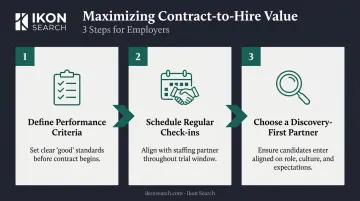
- Define specific performance and fit criteria before the contract begins. Vague evaluation standards produce vague conversion decisions — decide what "good" looks like upfront, not retroactively.
- Schedule regular check-ins with your staffing partner throughout the contract window. Surfacing concerns early gives both sides room to course-correct before conversion decisions are made.
- Choose a partner who invests in discovery before placing anyone. Candidates entering the trial period should already understand the role expectations, culture fit, and what success looks like.
Ikon Search's Contract Services team, led by Kristin Lutz, starts every engagement by mapping culture fit, compensation benchmarks, and long-term hiring goals — so alignment happens before the contract begins, not during it.
When the evaluation is structured this way, the conversion decision at the end of the contract period becomes straightforward. Both sides arrive at it having already built the evidence they need to move forward with confidence.
Conclusion
In 2026's hiring environment, contract-to-hire gives employers performance data they can't get from interviews, cost flexibility they can't get from permanent commitments, and candidate access they can't match with traditional searches.
The three benefits reinforce each other: reduced mis-hire risk leads to better permanent placements, cost flexibility enables smarter headcount decisions, and faster access to pre-vetted talent shortens vacancy windows.
Employers who build contract-to-hire into their standard hiring approach — rather than treating it as a last resort when a permanent search stalls — end up with stronger teams and fewer costly restarts. That's the structural advantage worth building for.
Frequently Asked Questions
How does a contract-to-hire work?
A candidate is placed on a fixed-term contract, typically employed by the staffing agency, and works on assignment at the client while both sides assess performance and cultural fit. At the end of the contract period, the client has the option to convert the candidate to a permanent employee — but no obligation to do so.
What is the typical contract-to-hire timeline?
Most contract-to-hire arrangements run anywhere from 90 days to 6 months, with conversion decisions made at or before the end of that window. Both parties can reach a decision earlier if performance and fit are clear before the formal end date.
How does contract-to-hire differ from direct hire?
Direct hire places the candidate permanently from day one, with full salary, benefits, and employer obligations beginning immediately. Contract-to-hire starts with a trial period — giving the employer time to evaluate real performance before any permanent commitment is made.
What happens if a company decides not to convert?
If the client chooses not to convert, the contract simply ends on its agreed terms. There's no permanent hiring obligation — the arrangement closes according to the notice period in the original agreement.
Is contract-to-hire cost-effective compared to permanent hiring?
The bill rate during the contract period is often higher than an equivalent permanent salary, but weigh that against the cost of a mis-hire — replacement, rehiring, and team disruption. For specialized or senior roles, the math typically favors contract-to-hire.
What types of roles are best suited for contract-to-hire?
Roles where fit is hard to assess through interviews alone benefit most. This includes specialized and senior positions across financial services, insurance, risk and compliance, fintech operations, marketing leadership, and corporate services.