The consequences aren't just administrative. A supervising attorney who employs a non-compliant paralegal faces potential ethical violations under California's Rules of Professional Conduct. That's a significant risk to ignore.
This guide covers everything California law firms need to know: what paralegals can and cannot do, the qualification pathways under Business and Professions Code §6450, salary benchmarks by region, a step-by-step hiring process, and where to find qualified candidates.
Key Takeaways
- California's §6450 defines who legally qualifies as a paralegal—employers must verify compliance before hiring
- Paralegals must complete 8 hours of MCLE every two years (4 ethics + 4 general/specialized law)
- The supervising attorney bears ethical responsibility for the paralegal's work product
- California pay transparency law requires salary ranges in job postings for firms with 15+ employees
- Specialists in litigation, real estate, or corporate law command higher rates but cut ramp-up time considerably
What Does a Paralegal Do—and What Can't They Do?
Core Functions
According to the ABA's current definition, a paralegal performs specifically delegated substantive legal work for which a lawyer is responsible. In practice, that means:
- Legal research and case law analysis
- Drafting pleadings, motions, and correspondence
- Organizing and managing case files
- Tracking deadlines and court calendars
- Client communication under attorney supervision
- Trial preparation support, including exhibit organization
Each of these tasks frees attorney time for higher-stakes work—the cleaner the delegation, the more productive the practice.
What They Cannot Do
California's unauthorized practice of law statute (BPC §6125) draws a firm line: only active State Bar licensees may practice law. For paralegals, that means the following are off-limits:
- Giving legal advice to clients
- Establishing an attorney-client relationship
- Representing clients in court
- Setting or negotiating legal fees
- Signing legal documents on behalf of a client
Violations constitute unauthorized practice of law—a misdemeanor in California carrying up to one year in county jail or a $1,000 fine under BPC §6126.
Why the Line Between Roles Matters
California's Business and Professions Code §6454 treats "paralegal," "legal assistant," "attorney assistant," "freelance paralegal," "independent paralegal," and "contract paralegal" as synonymous terms. In practice, though, the roles carry different informal expectations across firms.
Misusing a paralegal (pushing them to give legal advice, for instance) doesn't just harm clients. Under California Rule of Professional Conduct 5.3, the supervising attorney is directly responsible for a paralegal's conduct—and if the paralegal crosses a line the attorney knew or should have known about, the attorney faces disciplinary exposure.
Define the role clearly before you post the job.
California's Unique Paralegal Qualification Requirements
The Four Qualifying Pathways Under §6450
California is one of a small number of states with statutory paralegal qualifications codified in law. Employers are responsible for verifying that every person they hire as a paralegal meets one of these four pathways:
| Pathway | Requirements |
|---|---|
| ABA-Approved Program | Certificate of completion from an ABA-approved paralegal program |
| Accredited Institution | Certificate from a postsecondary institution requiring at least 24 semester units in law-related courses, from a nationally/regionally accredited school or BPPE-approved institution |
| Bachelor's Degree + Experience | Bachelor's or advanced degree in any subject + at least 1 year of law-related experience under a California attorney who has been an active licensee for 3+ years, plus a written attorney declaration |
| High School Diploma + Experience | High school diploma or GED + at least 3 years of law-related experience under attorney supervision, plus a written attorney declaration |
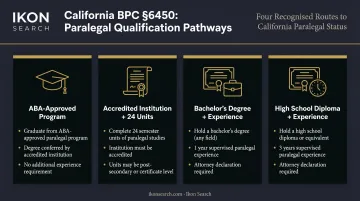
The experience-based pathways are common among candidates who entered legal work before formal paralegal education was widely available. They're legitimate—but the written attorney declaration is mandatory, not optional.
Mandatory Continuing Education
Every California paralegal must certify completion every two years of:
- 4 hours of MCLE in legal ethics
- 4 hours of MCLE in general law or a specialized area of law
Certification is made with the supervising attorney—meaning the attorney is actively responsible for tracking it. When interviewing candidates, ask directly when they last completed their MCLE requirement and request documentation.
Attorney Supervision in Remote and Hybrid Settings
Section 6450 requires paralegal work to be performed "under the direction and supervision" of an active California State Bar licensee. California Rule 5.3 requires supervisors to make reasonable efforts to ensure a paralegal's conduct is compatible with the attorney's professional obligations.
These obligations don't disappear in remote or hybrid arrangements — now standard practice for many California firms. "Direct supervision" doesn't require physical proximity, but it does require:
- Regular check-ins and work product review
- Clear communication channels for questions
- Documented oversight practices that demonstrate active engagement
- Attorney review of all work product before it goes to clients or courts
Without a documented remote supervision policy, attorneys expose themselves to disciplinary risk under Rule 5.3.
California Paralegal Salary Benchmarks
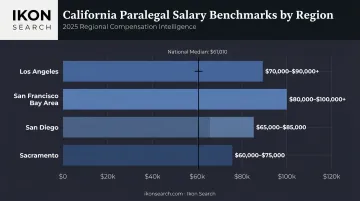
California paralegal salaries run well above the national median of $61,010 (BLS, May 2024). In the Los Angeles–Long Beach–Anaheim metro, BLS data put the mean annual wage at $78,720 ($37.84/hour) as of May 2023.
General regional benchmarks for planning purposes:
- Los Angeles: $70,000–$90,000+ annually for experienced paralegals
- San Francisco Bay Area: $80,000–$100,000+ (higher cost of living, competitive market)
- San Diego: $65,000–$85,000
- Sacramento: $60,000–$75,000
Senior paralegals with specialized expertise in litigation, corporate/M&A, or IP in major metros frequently exceed these ranges. For firms managing budget constraints, contract and temp-to-hire arrangements provide a practical path to accessing that caliber of talent without a full-time salary commitment from day one.
Types of Paralegals to Consider for Your California Firm
Employment Model Options
| Model | Best Fit |
|---|---|
| Full-time permanent | Mid-size and large firms with consistent, predictable paralegal workload |
| Part-time | Solo practitioners or small firms with irregular matter volume |
| Contract / freelance | Firms covering a specific matter, trial period, or workload surge |
| Temp-to-hire | Firms wanting to evaluate fit before committing to a permanent offer |
Solo practitioners and small California firms often benefit from contract or temp-to-hire arrangements: lower upfront commitment, faster onboarding, and easier to adjust as practice area needs evolve.
Once you've settled on an engagement model, the next decision is whether your work demands a generalist or a specialist.
Generalist vs. Specialist
California's legal market is diverse enough that specialization matters. Common specialist tracks include:
- Litigation — discovery management, case chronologies, and trial prep
- Real estate transactions (title review, escrow coordination, closing documents)
- Immigration (visa petitions, case tracking, USCIS correspondence)
- Family law (financial disclosures, custody documentation, court filings)
- Corporate/M&A (due diligence, entity formation, contract review support)
- Intellectual property: patent prosecution support and trademark docketing
Specialists cost more. They also require significantly less ramp-up time, which matters when a deal or litigation deadline is driving the hire.
Experience Tiers
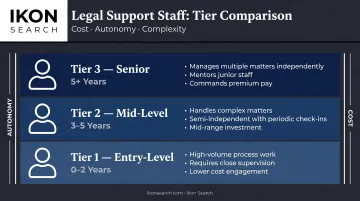
| Experience | What to Expect |
|---|---|
| Entry-level (0–2 years) | Lower cost; needs close supervision; best for high-volume, process-driven work |
| Mid-level (3–5 years) | Semi-independent; handles complex matters with periodic check-ins |
| Senior (5+ years) | Manages multiple matters independently; mentors junior staff; commands premium pay |
Step-by-Step: How to Hire a Paralegal in California
Step 1: Define Your Firm's Needs Before You Post
Map out specifically what the paralegal will own before writing a single job requirement:
- Which practice area(s) are involved?
- What's the expected workload volume per week?
- What tasks are currently falling through the cracks or consuming attorney time?
- Full-time, part-time, or contract?
Skipping this step produces misaligned hires. A litigation paralegal placed in a transactional practice, or a contract hire in a role that needs permanent coverage, costs more to unwind than the original search.
Step 2: Write a California-Compliant Job Description
A strong California paralegal job description must include:
- The qualifying pathway you require under §6450 (state it explicitly)
- Practice area and specific task ownership
- Supervision structure (in-office, hybrid, remote)
- Any preferred certifications (NALA CP or NFPA RP)
- Salary range — California's SB 1162 requires employers with 15 or more employees to include the pay scale in job postings. Confirm current obligations with the California DIR before posting
- Application instructions and required documentation
Step 3: Screen Résumés for §6450 Compliance
Work through this checklist on every application:
- Does the candidate's education and experience match one of the four §6450 pathways?
- Is there evidence of MCLE completion within the past two years?
- Do they hold NALA CP or NFPA RP credentials? (These signal commitment, not §6450 substitute)
- Are descriptions of actual work product specific, or vague and title-heavy?
Candidates who claim "paralegal experience" without specifying tasks, matters, or the supervising attorney's role need closer scrutiny.
Step 4: Conduct a Structured Interview Process
Stage 1 — Phone screen (30 minutes):
- Verify qualifications and pathway
- Assess communication clarity
- Gauge practice area familiarity
Stage 2 — In-person or video interview:
Scenario-based questions reveal more than résumés:
- "Walk me through how you'd manage three overlapping discovery deadlines."
- "How would you handle a client who asks for legal advice directly?"
- "Describe a complex case file you organized from start to finish."
Client-facing professionalism matters as much as technical skill. If the paralegal will communicate with opposing counsel or appear at court, assess demeanor directly.
Step 5: Check References and Make the Offer
When speaking with former supervising attorneys, ask:
- How reliable was this paralegal under deadline pressure?
- How would you describe the quality of their written work product?
- Did they ever operate outside their defined paralegal scope?
- Would you hire them again?
Strong reference answers should give you the confidence to move quickly — California's paralegal market is competitive. Structure the offer to reflect California benchmarks, not national averages.
Include continuing education support — MCLE completion is a legal obligation the firm shares responsibility for tracking.
What to Look for When Vetting Paralegal Candidates
Verifying §6450 Compliance
Don't rely on self-reported credentials. Request:
- Official transcripts or diploma
- Certificate of completion from the paralegal program (and confirm ABA approval or BPPE accreditation if relevant)
- Written attorney declaration for experience-pathway candidates
- MCLE completion documentation
Firms that accept credential representations without documentation hire at their own risk—and the supervising attorney bears the ethical liability.
Certification vs. Certificate: The Distinction Matters
Many candidates confuse these two credentials:
- Certificate of Completion — Finished a paralegal training program. No exam required.
- NALA Certified Paralegal (CP) — Requires passing a 120-question knowledge exam plus a written skills component. Valid for 5 years; renewal requires 50 CLE hours including 5 in legal ethics.
- NFPA Registered Paralegal (RP/PACE) — Requires passing a 200-question exam over 4 hours. Demonstrates advanced competency.
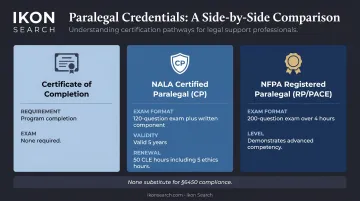
Neither national credential substitutes for §6450 compliance, but both signal that a candidate has invested in professional development beyond the baseline requirement.
Soft Skills That Separate Good from Great
- Writes clearly and precisely — pleadings and correspondence reflect directly on the firm
- Tracks deadlines without prompting — missed court dates carry real consequences
- Handles confidential information with discretion as a matter of habit
- Adjusts quickly when California caseloads shift direction
- Maintains appropriate tone with courts and opposing counsel under pressure
Red Flags to Watch For
- Unexplained gaps in legal employment
- Inability to name specific work product or matters they handled
- Vague descriptions of how their supervising attorney was involved
- Any history of operating outside their defined paralegal scope
- References that are difficult to reach or who give non-specific answers
Where to Find Qualified Paralegals in California
California-Specific Resources
Start with organizations that already serve the professional paralegal community in California:
- Los Angeles Paralegal Association (LAPA) — Career center with local, pre-connected candidates
- San Francisco Paralegal Association (SFPA) — NALA-affiliated nonprofit with a dedicated job board
- California Alliance of Paralegal Associations (CAPA) — Statewide advocacy organization with member association network
These organizations surface candidates who are already engaged in their professional community—a meaningful quality signal.
National Platforms with California Filters
LinkedIn, Indeed, NALA's job board, and NFPA's career center all reach California paralegals. Optimize postings with California-specific keywords:
- "California Business and Professions Code §6450"
- Your city (Los Angeles, San Francisco, San Diego, Sacramento)
- Practice area (e.g., "litigation paralegal California," "real estate paralegal Los Angeles")
The more specific your posting, the less time you spend screening out candidates unfamiliar with California's statutory requirements.
Working with a Legal Staffing Firm
For firms that need to move quickly—or want pre-vetted candidates without spending attorney time on screening—a specialized legal staffing firm is worth considering. Ikon Search's Contract / Corporate Services division places paralegals and legal assistants across permanent, contract, and temp-to-hire arrangements — typically delivering a qualified shortlist within 2–3 days. For California firms navigating §6450 compliance, that pre-vetting layer reduces the risk of bringing on a candidate who falls short of the statutory threshold.
Frequently Asked Questions
How much do paralegals cost in California?
California paralegal salaries run $65,000–$100,000+ annually depending on experience level, practice area, and region—well above the national median of $61,010. San Francisco and Los Angeles command the highest rates. Contract and temp-to-hire arrangements offer cost flexibility for firms that aren't ready to commit to a full-time salary.
Can you hire a paralegal without a lawyer?
No. California law requires every paralegal to work under the direct supervision of an active State Bar licensee. They cannot serve the public independently, open their own practice, or perform legal services without attorney oversight—under both §6450 and California's unauthorized practice statutes.
What are three things a paralegal cannot do?
The three core prohibitions are: (1) give legal advice to clients, (2) represent a client in court or establish an attorney-client relationship, and (3) set or negotiate legal fees. All three constitute unauthorized practice of law under California BPC §6125.
Does California require paralegals to be certified?
California does not require NALA CP or NFPA RP certification, but it does require paralegals to meet specific education and experience criteria under §6450, plus 8 hours of MCLE every two years. These statutory requirements apply regardless of whether a candidate holds a voluntary certification credential.
What is the difference between a paralegal and a legal assistant in California?
Legally, there isn't one—California §6454 treats both terms as synonymous. That said, §6450 sets specific qualification requirements for anyone holding out under either title, so employers should state explicitly in job postings that §6450 compliance is required.
Should I hire a full-time paralegal or use a staffing agency?
Full-time hires make sense for firms with steady, predictable paralegal workload. Staffing agencies offer faster turnaround and pre-vetted candidates—a strong option when you're covering a workload spike, scaling quickly, or can't afford the time a full search requires.