Introduction
Startups operate under a specific kind of pressure that most companies never face: tight runway, unpredictable demand, and the constant tension between hiring for growth and protecting cash. Every full-time hire is a fixed commitment — salary, benefits, employer taxes, severance risk — made before the business model is fully proven. Get it wrong, and you're either burning cash on headcount you don't need or scrambling to backfill after a damaging exit.
Flexible staffing is often framed as a cost-cutting move. That framing undersells it. For startups, it's a structural advantage that shapes hiring outcomes across the entire growth curve:
- How fast you can staff a product launch
- Whether you can access a compliance specialist without adding permanent headcount
- How much hiring risk you carry when the market shifts
Startup Genome's foundational research found that 74% of high-growth internet startup failures were linked to premature scaling — with team size among the most common dimensions where startups over-extended before they were ready. Flexible staffing is a direct counter to that pattern.
This article breaks down what flexible staffing is, the specific advantages it delivers, and how startups can extract maximum value from it.
Key Takeaways
- Flexible staffing covers contract, temp-to-hire, and short-term professional engagements — without permanent employment obligations
- It converts fixed labor costs into variable spend, protecting runway during uncertain growth phases
- Startups can scale headcount up or down quickly, without waiting out a full recruitment cycle
- Specialized skills — from software developers to compliance experts — become accessible for specific projects, with no permanent hire required
- Temp-to-hire arrangements let startups assess real on-the-job performance before committing to a full-time offer
What Is Flexible Staffing?
Flexible staffing is a hiring model that uses contract, temporary, or temp-to-hire workers — either alongside or instead of permanent employees — matched to specific business needs and defined timeframes rather than open-ended employment.
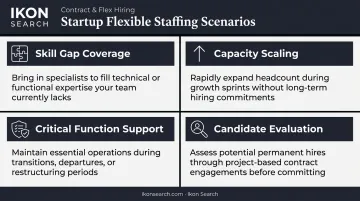
For startups, it typically shows up in four scenarios:
- Skill gap coverage: Bringing in a specialist for a product launch, technical sprint, or niche project
- Capacity scaling: Adding headcount during a growth spike or new market entry without permanent commitments
- Critical function support: Handling finance, compliance, or HR needs during a specific cycle such as fundraising or a regulatory filing
- Candidate evaluation: Testing a hire through a temp-to-hire engagement before extending a permanent offer
That said, flexible staffing is a workforce strategy, not a hiring shortcut. The goal is to match labor capacity to business reality — giving startups control over cost and output without committing to fixed headcount before demand justifies it.
Key Advantages of Flexible Staffing for Startups
The advantages below map to metrics startups actually track: burn rate, hiring speed, team performance, and growth capacity.
Advantage 1: Cost Efficiency Without Sacrificing Talent Quality
Full-time hires carry a cost load that goes well beyond salary. According to December 2025 BLS data, private-industry employers paid an average of $46.15 per hour in total compensation — $32.36 in wages plus $13.79 in benefits. That means benefits alone add 42.6% on top of wages, before factoring in recruiting costs, equipment, onboarding time, or severance exposure.
Flexible staffing separates talent access from that fixed cost structure. A startup hires a contract financial analyst for a 90-day fundraising prep cycle, gets full output during the window that matters, then releases the engagement — no ongoing payroll, no benefits obligation, no HR complexity.
Why this matters for early-stage companies:
- Every dollar of fixed overhead that doesn't go toward product, sales, or customer acquisition slows growth
- Labor becomes a variable cost tied to output rather than a fixed liability on the balance sheet
- Reducing headcount in a slow quarter without layoffs protects culture, reputation, and team morale
Metrics to watch: Monthly burn rate, cost per hire, total labor cost as a percentage of revenue, payroll overhead ratio.
This advantage is most pronounced pre-Series A, when runway is finite and investors are watching burn multiples closely. It also matters during revenue uncertainty — when projections shift, fixed payroll doesn't.
Advantage 2: Speed and Scalability When Opportunity Moves Fast
Startups win or lose based on execution speed. A product launch delayed by three weeks, a major client contract requiring rapid team expansion, a market entry that requires specialized skills on a tight timeline — these aren't abstract risks. They're the specific moments where staffing speed becomes a competitive variable.
Traditional hiring cycles create a direct gap between opportunity and execution. SHRM's 2025 talent data found that 69% of organizations had difficulty recruiting for full-time roles — with low applicant volume, employer competition, and candidate ghosting as the primary bottlenecks. For startups without established employer brands, those numbers are typically worse.
Flexible staffing closes that gap. Pre-vetted candidates through a specialized staffing partner can be placed within days. Ikon Search, for example, typically presents a qualified shortlist within 2–3 days of engaging on a search across its Technology, Marketing, Risk & Compliance, and Corporate Services divisions — compared to the weeks or months a direct permanent hire requires.
One Series A startup that had just secured funding needed to fill approximately 20 engineering roles quickly to support its product roadmap. Ikon worked closely with the founding team to tighten the hiring process and structure competitive offers — filling two-thirds of those roles in a fraction of the time a traditional direct-hire pipeline would have required.
KPIs this affects: Time-to-hire, time-to-productivity, project delivery timelines, headcount elasticity relative to revenue.
Speed matters most during product launches, new market entries, seasonal demand surges, and rapid contract-driven scaling — the exact moments when traditional hiring simply can't keep up.
Advantage 3: Access to Specialized Skills and Reduced Hiring Risk
Startups rarely need every specialized skill permanently. A compliance expert for a regulatory filing. A UX designer for a product overhaul. A data analyst for a market entry assessment. Flexible staffing makes it possible to bring in exactly that expertise — for the duration it's actually needed — without adding permanent headcount.
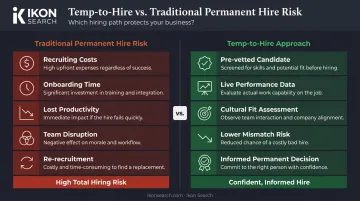
Temp-to-hire arrangements add another layer of value on top of access: they let startups evaluate a candidate's actual performance, cultural fit, and working style in a live environment before extending a permanent offer.
This matters because bad permanent hires are disproportionately damaging to startups. SHRM estimates the average cost-per-hire at nearly $4,700 — and that figure doesn't capture the downstream costs when a hire fails: lost productivity, team disruption, re-recruitment, and onboarding lag for a replacement. For a startup with a small team, one misaligned senior hire can set back operations by months.
Additional value from contract professionals:
- They've typically worked across multiple companies and industries, often bringing processes, tools, or frameworks the startup's internal team hasn't encountered
- Knowledge transfer happens naturally during the engagement
- Startups make permanent hiring decisions with real performance data, not just interview impressions
What to track: 90-day retention rate, cost of bad hires, time to full productivity for permanent staff, quality of output per project.
Technically specialized roles, senior hires with cultural implications, and unfamiliar territory — a new market, a new product category, or a compliance-heavy environment — are where this advantage delivers the clearest return.
What Happens When Startups Skip Flexible Staffing
Startups that default to permanent-only hiring lock in fixed labor costs before validating whether those roles are truly needed at scale. When growth slows or a pivot forces a rethink, the team is too expensive to maintain and too embedded to restructure quickly.
Startup Genome's research found that prematurely scaling startups often had teams 3x larger than their consistent-scaling peers at the same stage. Those extra hires don't disappear cleanly — they create drag on cash, culture, and decision-making.
The fallout compounds quickly:
- Skill gaps go unfilled for weeks or months while permanent recruitment drags on, stalling product development or client delivery
- Small teams burn out covering gaps, leading to higher voluntary turnover — which triggers more expensive emergency hiring
- Bad hires made under pressure — without a temp-to-hire option — cost time, money, and team morale to correct
- Market windows close because the team couldn't scale fast enough to execute on a time-sensitive opportunity
Each of these plays out the same way: a workforce strategy built entirely around permanent headcount has no shock absorbers. When conditions change — and in a startup, they always do — there's nothing to flex.
How to Get the Most Value from Flexible Staffing
Flexible staffing delivers its full value when it's treated as an ongoing operational tool, not a crisis response. Startups that plan for it in advance — building relationships with staffing partners, identifying recurring skill gaps, mapping seasonal or project-based needs — consistently extract more than those who engage it only when the pressure is already on.
Operational practices that maximize returns:
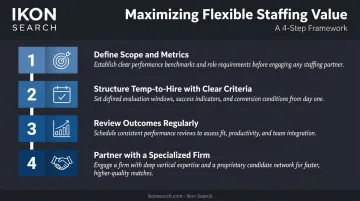
Define scope and success metrics before each engagement begins. Contract workers perform best when they know exactly what they're being measured on and what a successful outcome looks like. Ambiguous engagements produce ambiguous results.
Use temp-to-hire with a defined timeline and conversion criteria. Both the startup and the candidate should know upfront what the evaluation period looks like and what triggers a permanent offer.
Review outcomes regularly. Track cost per engagement against output, gather feedback on contractor fit, and use that data to refine future sourcing decisions. Treat each engagement as an input into a smarter next one.
Work with a partner that understands your industry and invests time upfront. Volume staffing firms fill seats; specialized boutique firms fill roles that fit. Ikon Search, for example, takes a structured intake approach — spending time with startup leadership to understand technical requirements, company culture, and long-term trajectory before sourcing begins. That process typically gets qualified candidates in front of decision-makers within two to three days. Ikon also provides compensation benchmarking support for startups working through the contract-versus-permanent decision when the right engagement model isn't clear.
Conclusion
For startups, flexible staffing isn't a fallback position when permanent hiring feels too slow. It's a deliberate strategic choice that converts workforce management from a fixed cost into a controlled, scalable capability.
Cost efficiency, execution speed, and reduced hiring risk don't operate in isolation — they reinforce each other. Managing burn through contract staffing preserves the runway to pursue growth opportunities. Staffing a product sprint within days means you don't lose the window. And evaluating candidates through temp-to-hire leads to better permanent decisions when the time comes.
Build flexible staffing into the operational model early and treat it as a long-term tool rather than an emergency lever. Startups that do this navigate market shifts with less friction — and when the moment arrives to make permanent hires, they make them from a position of clarity rather than pressure.
Frequently Asked Questions
What are the three types of staffing?
The three primary types are temporary staffing (short-term, project-based engagements), contract staffing (fixed-duration placements for specific roles or skills), and temp-to-hire (a trial period that can convert to permanent employment). Most startups draw on all three at different stages of growth.
How is flexible staffing different from hiring a full-time employee?
Flexible staffing involves engaging workers for defined periods or projects without permanent employment commitments, benefits obligations, or long-term payroll exposure. The startup pays for specific output during a defined window — without taking on the fixed costs of permanent headcount.
When should a startup consider using a staffing agency?
A staffing agency adds the most value when speed and precision matter. Consider one when you need to hire quickly, fill a specialized role, access pre-vetted candidates, or evaluate someone through temp-to-hire before making a long-term commitment.
What roles can startups fill through flexible staffing?
Almost any professional role can be filled this way — developers, DevOps engineers, financial analysts, marketing specialists, compliance professionals, HR and talent support, and executive assistants, among others. It's particularly common in technology, financial services, and insurance startups.
How does temp-to-hire work for startups?
A professional is placed on a contract basis for a defined trial period, during which both the startup and the candidate evaluate fit. If the engagement meets expectations, the startup extends a permanent offer — reducing the risk of a costly long-term mismatch based on interview impressions alone.
What should startups look for in a flexible staffing partner?
Prioritize partners with deep expertise in your sector and a track record of fast, qualified placement — ideally within days, not weeks. The best partners invest time upfront to understand your culture, team dynamics, and hiring goals before sourcing begins, rather than simply matching resumes to job descriptions. Ikon Search, for example, typically delivers a qualified shortlist within 2-3 days across its specialized divisions in technology, financial services, insurance, and marketing.