
Introduction
Businesses today are caught between two uncomfortable realities: demand cycles that don't follow a predictable pattern, and a talent market where 69% of US employers report difficulty finding the skills they need, according to ManpowerGroup's 2026 Global Talent Shortage report. Carrying full-time headcount to cover every possible need isn't financially viable. Leaving critical roles unfilled while running a permanent search isn't operationally acceptable either.
Contract staffing sits between those two options — and for many businesses, it's become a permanent part of how they manage their workforce rather than an emergency measure.
What follows is a concrete breakdown of what contract staffing actually delivers — in cost, speed, and capability — and where it creates the most measurable value.
Key Takeaways
- Contract staffing lets businesses expand or reduce headcount around real demand — without severance costs or permanent over-hiring
- Benefits burden alone accounts for 30%+ of total compensation for full-time employees, per BLS data — a cost contractors don't carry
- Qualified contract candidates can be sourced in days — compared to the 41+ days a typical permanent search requires
- The strongest ROI comes in financial services, insurance, technology, and compliance — fields where specialized talent is genuinely scarce
- Temp-to-hire arrangements give hiring teams a structured, low-risk way to evaluate fit before committing to a permanent offer
What Is Contract Staffing
Contract staffing is the practice of engaging professionals for a specific project, duration, or business need — rather than bringing them on as permanent, benefit-eligible employees. The engagement is scoped upfront: defined start date, defined objectives, defined end or evaluation point.
It applies across a wide range of scenarios:
- Short-term project coverage — filling a skills gap during a system migration, regulatory project, or M&A integration
- Specialist engagements — bringing in a domain expert whose skill set isn't needed full-time but is critical for a bounded period
- Temp-to-hire arrangements — evaluating a professional's performance and cultural fit before making a permanent offer
The distinction matters. Contract staffing is a deliberate tool for matching labor supply to business demand. Used strategically, it gives organizations control over headcount, cost, and capability in ways that permanent hiring alone cannot replicate.
Key Advantages of Contract Staffing
The advantages below reflect what businesses actually experience operationally when contract staffing is used well. Each one connects to a specific cost, speed, or risk outcome.
Workforce Flexibility That Matches Business Reality
A company identifies a short-term need — a regulatory deadline, a new product launch, an M&A integration. It engages a contractor through a staffing partner, the work gets done, and the engagement closes. No severance negotiation. No benefits wind-down. No months-long HR process tied to a permanent separation.
That's the operational reality of workforce flexibility through contract staffing. Businesses can surge capacity when demand spikes and reduce it when the project is complete — without the legal and financial complexity that comes with permanent headcount changes.
The data reflects how widespread this has already become. According to Deloitte, contingent workers already make up 30–50% of overall workforces across many organizations — and in sectors like technology, that figure reaches 40–50%. SIA data shows buyers expect contingent workforce share to grow from 21% today to 26% over the next decade.
Where this advantage is highest:
- Project-driven environments: technology implementations, consulting engagements, regulatory compliance projects
- Industries with cyclical or seasonal demand — financial services during reporting periods, insurance during open enrollment
- Any organization facing unpredictable demand cycles where permanent over-hiring carries real financial risk
KPIs directly affected:
- Labor cost as a percentage of revenue
- Headcount utilization rate
- Speed of response to new business opportunities
Meaningful Cost Efficiency Without Sacrificing Quality
Full-time employment carries costs that go well beyond salary. According to the BLS Employer Costs for Employee Compensation report (March 2026), private-industry employer compensation averaged $46.60 per hour, with benefits representing $14.01 — or 30.1% of total compensation. Health insurance, retirement contributions, PTO, workers' compensation, payroll taxes: these costs accrue whether the employee is productive or not.
Contract staffing changes that equation. Businesses pay for productive output during the engagement period only — no idle-time cost, no benefits burden between projects, and no long-term compensation escalation tied to tenure.
Beyond the benefits burden, SHRM data puts the average cost per hire at nearly $4,700 — with total hiring and onboarding costs potentially reaching 3–4 times a position's annual salary for a $60,000 role. That's before accounting for turnover: Gallup estimates replacing a technical professional costs roughly 80% of their annual salary, while replacing a manager or leader can run 200%.
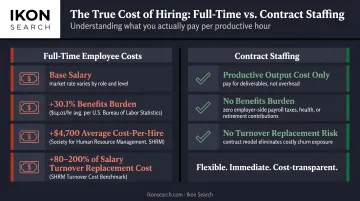
Contract staffing avoids most of that exposure — particularly for roles where the need is bounded, specialized, or temporary.
One concern worth addressing directly: quality. Contract professionals in specialized fields typically contribute from day one — they've done comparable work before and don't carry the productivity lag of a permanent hire building context from scratch. The cost savings don't come at the expense of output.
Where this advantage is most pronounced:
- SMEs where every labor dollar directly affects margins
- PE-backed portfolio companies managing EBITDA targets
- Organizations in restructuring or rapid scaling phases where cost discipline is non-negotiable
Immediate Access to Specialized Talent
Certain skills are genuinely scarce. Information security analysts are projected to grow 29% through 2034, according to the BLS Occupational Outlook Handbook. Financial examiners: 19% growth with only ~5,700 openings per year. Actuaries: 22% growth with roughly 2,400 annual openings nationally. These aren't roles where a general job posting produces a strong candidate pool.
Traditional permanent hiring for specialized roles moves slowly. SHRM data shows the average time-to-fill across all roles fell to 41 days in 2024 — and that's the average, not the timeline for niche technical or compliance-specific positions.
A staffing partner with deep industry networks operates on a different clock. Ikon Search, for example, typically presents qualified contract candidates within 2–3 business days across financial services, insurance, technology, and marketing — drawing on a proprietary database of pre-vetted professionals and years of relationship-building within those verticals.
Speed matters, but timing is the real lever. An expert engaged ahead of a compliance deadline, during a system migration, or at the start of a new market entry prevents delays and errors that often cost far more than the engagement itself.
Where this advantage is highest:
- Hard deadlines driven by regulatory requirements, client commitments, or product launches
- Skill sets narrow enough that permanent hiring pipelines don't have relevant candidates readily available
- Geographic constraints that limit the permanent hiring pool for on-site roles
What Happens When Contract Staffing Is Overlooked
Businesses that rely exclusively on permanent headcount face a predictable set of problems:
Overstaffing during slow cycles. Permanent headcount that can't be reduced without significant cost and legal process creates bloated labor expenses relative to output — particularly damaging when margins are under pressure.
Understaffing during peaks. Teams stretched thin leads directly to burnout. SHRM research found 44% of US employees feel burned out at work, and burned-out workers are nearly 3x more likely to be actively job-searching. The productivity and retention cost of chronic understaffing compounds quickly.
Extended time-to-fill for critical roles. Without a contract talent pipeline, businesses default to permanent searches — leaving projects stalled or dependent on internal resources who don't have the required expertise.
Rising long-term hiring risk. Every permanent hire carries the cost of a bad fit. Turnover, re-recruitment, and the productivity loss of an extended vacancy are costs contract staffing eliminates by providing a structured evaluation period before any long-term commitment.
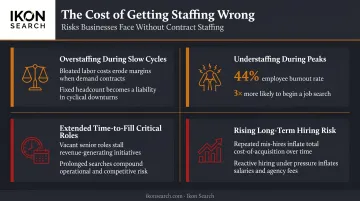
Each of these risks is preventable — but only when contract staffing is treated as a deliberate workforce strategy from the start, not a fallback when permanent hiring stalls.
How to Get the Most Value from Contract Staffing
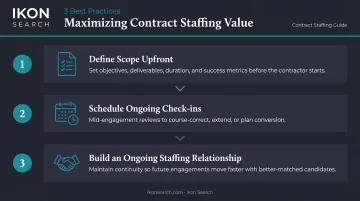
Businesses that treat contract staffing as a deliberate strategy — not a last-minute fix — consistently get stronger results. Clear scope, defined expectations, and an ongoing staffing relationship are what separate high-value engagements from reactive ones that cost more and deliver less.
Practical conditions for strong outcomes:
Set role objectives, deliverables, duration, and success metrics before the contractor arrives — not after. Contractors who start with a clear mandate contribute from day one and spend far less time figuring out what's expected of them.
Schedule check-ins during the engagement, not just at the end. Ongoing reviews give you the visibility to course-correct early, extend a strong performer, or plan a conversion to permanent — instead of discovering a mismatch when it's too late to act.
Treat the staffing relationship as ongoing. Ikon Search invests time upfront to understand each client's culture, compensation benchmarks, and hiring goals — so the next engagement moves faster, candidates are better matched, and you're not rebuilding context from scratch every time a need surfaces.
The temp-to-hire pathway is worth highlighting for senior or culturally sensitive roles. A structured contract-to-permanent arrangement lets you evaluate real on-the-job performance before committing — a practical safeguard when the role's full scope isn't fully defined at the start.
Conclusion
Contract staffing delivers on three fronts simultaneously: workforce flexibility, cost discipline, and faster access to specialized talent. Few permanent hiring strategies offer all three at once.
These aren't one-time gains. They build over time as businesses develop the internal processes, staffing partnerships, and contractual frameworks that make contract staffing a reliable part of their workforce strategy. The businesses that extract the most value treat it as a planned capability, built into their workforce strategy from the start rather than reached for only when permanent hiring stalls.
Frequently Asked Questions
Do contract staffing employees get benefits?
In most cases, contractors placed through a staffing agency receive benefits — if any — through the agency, not the client company. Businesses working with agency-placed contractors are typically not responsible for health insurance, PTO, or retirement contributions, which is one of the primary cost advantages of the model.
What is the difference between contract staffing and temp-to-hire?
Contract staffing involves a defined engagement with no expectation of permanent employment. Temp-to-hire is a structured arrangement where strong performance can lead to a full-time offer, making it a practical option for roles where cultural fit matters as much as skill.
How quickly can a contract staffing agency fill a position?
Timelines vary by role complexity and agency network depth, but specialized firms with strong industry pipelines can often present qualified candidates within 2–5 business days. Ikon Search's typical time-to-qualified-shortlist is 2–3 business days across its core verticals.
What industries benefit most from contract staffing?
Industries with project-driven workloads, regulatory deadlines, or specialized skill requirements see the strongest results — including financial services, insurance, technology, risk and compliance, and marketing. These are sectors where specialized talent is genuinely scarce in the permanent market.
How does contract staffing reduce legal and compliance risk for employers?
Agency-placed contract workers are typically employed by the staffing agency, which handles payroll taxes, workers' compensation, and compliance obligations, reducing the client company's direct legal exposure. Proper worker classification must still be maintained throughout the engagement.
When should a business consider converting a contractor to a full-time employee?
Conversion makes sense when the role's scope has expanded beyond the original engagement, the contractor has demonstrated strong cultural and performance fit, and the underlying work is ongoing rather than project-based.