
Introduction
At a certain point, a growing business hits a financial inflection point. The bookkeeper who handled everything in year two can't keep up with multiple revenue streams, expanding headcount, and tightening compliance requirements in year five. Month-end close starts slipping. Leadership gets pulled into accounting issues they shouldn't be touching. Numbers that should be reliable start feeling uncertain.
Nearly 40% of CFOs don't completely trust their organization's financial data, according to BlackLine's 2024 survey. The gap is rarely in the tools — it's in who's owning the financial function.
A financial controller fills that gap. This guide covers how to recognize when you need one, what qualifications matter, how to run a hiring process , and how to think about compensation and structure.
Key Takeaways
- A financial controller owns day-to-day accounting operations (AR, AP, payroll, reporting, compliance) — not the same as a CFO
- Common hiring triggers include rapid growth, M&A activity, upcoming audits, or a month-end close that consistently runs late or produces errors
- The strongest candidates combine GAAP expertise and CPA/CMA credentials with leadership and communication skills
- A structured hiring process with clear job criteria, behavioral interviews, and reference checks meaningfully improves hire quality
- Compensation ranges vary significantly by company size and geography; fractional arrangements are a viable option for smaller businesses
What Does a Financial Controller Do?
A financial controller owns the day-to-day mechanics of a company's finance function. Where a CFO focuses on strategy, investor relations, and capital allocation, the controller ensures the books are accurate, timely, and compliant — and that the accounting team makes it happen reliably.
According to Robert Half's 2026 Corporate Controller profile, the role typically spans:
- Accounts payable and receivable
- Payroll oversight
- Financial statement preparation and reporting
- GAAP/IFRS compliance
- Tax schedule preparation
- Budgeting and forecasting
- Month-end and year-end close efficiency
- Managing and developing the accounting team
Controller vs. CFO: The Key Distinction
The IMA defines the CFO as managing a broader team that includes controllers. That distinction matters for hiring: if you need someone to own day-to-day financial operations and manage the accounting team, you need a controller. If you need someone navigating investor relations, M&A strategy, or board-level financial planning, that's a CFO mandate.
In practice, at smaller or early-stage companies, these responsibilities often overlap, with a controller carrying some strategic weight by necessity. As you scale, the roles separate.
Types of Controllers
Once you're clear on what you need from the role, the next step is identifying which controller profile fits. Getting this right before you start recruiting saves significant time:
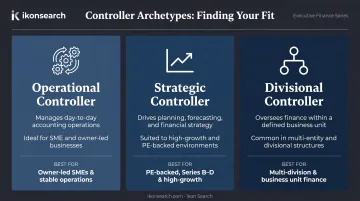
- Operational controller — Day-to-day financial oversight, best suited for SMEs and companies that need process rigor without a heavy strategic layer
- Strategic controller — Involved in planning and analysis beyond core accounting, suited for high-growth or PE-backed companies
- Divisional controller — Oversees a specific business unit's financials within a larger organization
Signs It's Time to Hire a Financial Controller
There's no universal revenue or headcount threshold that triggers this hire. What matters is whether your finance function can actually support the decisions your business needs to make. These are the clearest signals it can't.
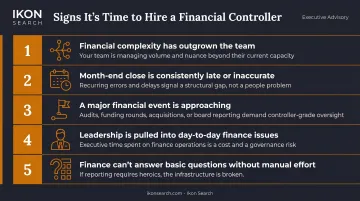
Financial Complexity Has Outgrown Your Team
Multiple revenue streams, new business lines, expanded headcount, or entry into new markets create reconciliation and reporting demands that a bookkeeper or staff accountant can't reliably manage alone. When the work starts outpacing the role, accuracy suffers.
Month-End Close Is Consistently Late or Inaccurate
50% of finance teams still take more than a week to close the books, according to 2025 data from CFO.com. A delayed or error-prone close doesn't just create reporting lag — it creates downstream risk for every decision made from those numbers.
A Major Financial Event Is Approaching
Fundraising rounds, PE investment, M&A activity, and audits all require clean, audit-ready financials and a point person who can manage the process and interface with external parties. Walking into due diligence without a controller is a significant risk.
Other Signals Worth Taking Seriously
- The CEO or CFO is regularly pulled into day-to-day finance problems that should have a dedicated owner
- A key finance team member leaving tomorrow would expose the business — no documented processes, no backup
- Finance can't answer basic questions (cash runway, margin by product line, burn rate) without manual effort
What to Look for in a Financial Controller
Technical Qualifications
The baseline expectations are well established. According to the IMA and Robert Half's 2026 benchmarks:
- Education: Bachelor's degree in accounting or finance at minimum; many controllers hold an MBA or a master's in accounting
- Experience: Robert Half's Corporate Controller profile typically requires 10 years in finance and accounting, with 5 of those in a managerial capacity; Divisional Controller roles generally require 8+ years
- Certification: Controllers are generally expected to hold CPA credentials; CPA, CGMA, or CMA are listed as preferred by Robert Half for corporate controller roles
- GAAP proficiency: Required for every candidate — it's the baseline, not a point of distinction
The compensation premium for certification is real. IMA's 2023 Global Salary Survey found that CMAs earn 21% higher median total compensation globally than non-certified peers.
Software and ERP Proficiency
A controller who already knows your tech stack will have faster impact. Look for hands-on experience across:
- ERP platforms: QuickBooks, NetSuite, SAP, or Sage
- Reporting tools: Power BI or Tableau — the IMA flags both as increasingly expected at the controller level
Industry-Specific Knowledge
Domain experience directly affects how quickly a new hire gets up to speed. A controller coming from a PE-backed company understands sponsor reporting cadences and covenant compliance. One from financial services may bring SEC reporting or fund accounting experience. Mismatched industry experience slows ramp time significantly — and that gap shows up fast.
Leadership and Communication
Controllers who manage accounting teams need more than technical competence — they need to develop staff, delegate effectively, and translate financial data into language that non-finance stakeholders can act on. In interviews, probe specifically for examples of both.
How to Build a Strong Hiring Process
Senior finance hires move quickly, and delays are costly. Robert Half's 2023 survey of 2,175 U.S. hiring managers found that 83% missed out on a good hire in the prior year — and 29% attributed it directly to taking too long to make an offer. Senior leader roles can take up to 11 weeks to fill. A structured process from the start compresses that timeline — the four steps below are where it begins.
Writing the Job Description
A well-written job description does two things: it sets clear expectations and it markets the opportunity to candidates who have options. Include:
- Role summary and reporting structure
- Prioritized responsibilities (not an exhaustive list of everything that could possibly apply)
- Required vs. preferred qualifications
- Compensation range and any equity or bonus structure
- A genuine pitch — growth path, mission, what makes the company worth joining
In a tight candidate market, a generic job description loses good candidates before the first call.
Sourcing Candidates
The strongest controller candidates are often not actively searching. Effective sourcing channels include:
- LinkedIn and direct outreach to passive candidates
- CPA society networks and finance associations
- Industry-specific job boards
- Referrals from your existing finance and accounting network
Working with a specialized executive search firm can compress the timeline significantly. Firms like Ikon Search — which places finance and accounting talent across PE-backed portfolio companies, financial services firms, hedge funds, and established corporations — typically deliver a vetted shortlist within days, not weeks. That speed matters when an open controller seat creates real operational risk.
Interviewing and Evaluating Candidates
Structured interviews — where all candidates answer the same competency-based questions — produce more consistent and reliable evaluations. Effective questions for controller candidates include:
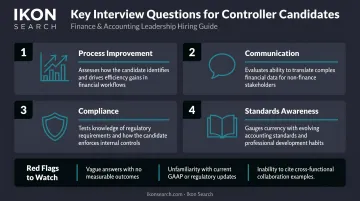
- Walk me through how you've improved a financial close process. What was the baseline, what did you change, and what was the result?
- Describe a time you had to communicate a complex financial issue to a non-finance executive. How did you approach it?
- How have you handled a significant compliance challenge — what was the situation and how did it resolve?
- How do you stay current on accounting standards and regulatory changes?
Red flags to watch for:
- Vague or unquantifiable answers about past contributions
- Short tenures with no clear explanation
- Inability to articulate the measurable impact of their work
- Poor communication during the interview itself — a sign of what board presentations and leadership updates will look like
Checking References
Go beyond the references a candidate provides. Seek out former supervisors and, where possible, former direct reports. Ask specifically about:
- Accuracy under pressure
- How they handled competing priorities during close or audit periods
- Their response to difficult feedback or internal conflict
- Their response to difficult feedback or internal conflict
- Whether they'd hire or work with this person again — and why
These conversations routinely surface information that structured interviews don't.
Compensation and Making the Offer
Current Salary Benchmarks
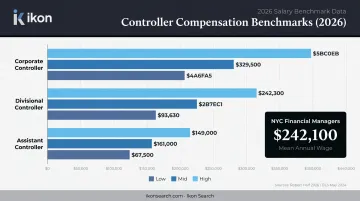
Controller compensation varies significantly by role type, company size, industry, and geography. Per Robert Half's 2026 Salary Guide:
| Role | Low | Mid | High |
|---|---|---|---|
| Corporate Controller | $152,000 | $185,000 | $213,250 |
| Divisional Controller | $118,750 | $161,750 | $176,250 |
| Assistant Controller | $94,000 | $122,500 | $142,000 |
The BLS reports a median annual wage of $161,700 for Financial Managers (the broader category that includes controllers) as of May 2024. Geography moves the number substantially — the annual mean wage for Financial Managers in New York-Newark-Jersey City was $242,100 as of May 2023.
Structuring the Offer
Base salary is only one component. When building an offer, consider:
- Short-term incentive bonuses — common for senior finance roles
- Long-term incentives — equity or profit-sharing, especially common at PE-backed firms
- Benefits and flexibility — increasingly part of the total compensation conversation
- Full-time vs. fractional — for smaller businesses or companies in a transitional period, a fractional or contract controller can provide senior-level financial oversight without the full-time cost
The client advisory services market — which encompasses outsourced and fractional accounting functions — reported 17% median growth in 2024, according to the CPA.com and AICPA PCPS CAS Benchmark Survey. For businesses weighing full-time vs. fractional, that growth signals a mature market with experienced talent available on both tracks.
Frequently Asked Questions
How much does it cost to hire a controller?
Compensation varies by company size, industry, and location. Robert Half's 2026 benchmarks put Corporate Controller salaries between $152,000 and $213,250, with the BLS reporting a $161,700 median for Financial Managers broadly. Fractional or outsourced controllers are a cost-effective alternative for businesses not yet ready for a full-time hire.
What is the role of a controller?
A financial controller oversees the company's accounting operations — financial reporting, budgeting, compliance, close, and often team management. It's the operational core of the finance function, distinct from the CFO's broader strategic responsibilities.
When should a business hire a financial controller?
The right time is typically when financial complexity has outgrown existing staff capacity. Common triggers include rapid revenue growth, M&A activity, an approaching audit or investor due diligence round, or persistent gaps in reporting accuracy or timeliness.
What qualifications should a financial controller have?
At minimum, a bachelor's degree in accounting or finance, 7-10 years of relevant experience, strong GAAP knowledge, and CPA or CMA certification. ERP proficiency and industry-specific experience are also meaningful factors depending on your company's context.
Should I hire a full-time or fractional financial controller?
Full-time controllers suit companies with ongoing, complex financial management needs. Smaller businesses, early-stage companies, and organizations in transition — whether between hires or working through post-acquisition integration — are typically better served by a fractional or contract arrangement.
How long does it take to hire a financial controller?
A typical search runs 4 to 8 weeks from job posting to accepted offer, though senior leader roles can stretch to 11 weeks. Working with a specialized executive search firm compresses that timeline by surfacing pre-vetted candidates faster — often within days of engagement.