
Introduction
Running a business or managing a high-profile career in New York leaves almost no margin for operational friction. Executives at investment banks coordinate across global time zones. Private equity principals juggle portfolio meetings and personal obligations simultaneously. UHNW families manage staff, properties, and complex logistics — all while their schedules compress further each quarter.
For many of these professionals, a personal assistant isn't a perk. It's how they protect their time.
This guide gives you a practical framework for hiring the right person — covering role definition, candidate qualities, the hiring process, and what to expect on cost. Whether you go direct or work with a firm like Ikon Search, you'll finish with a clear path forward.
Key Takeaways
- New York PAs manage calendars, travel, correspondence, errands, and confidential information — often simultaneously
- Hybrid PAs who handle both professional and personal affairs are the most in-demand type in NYC
- Expect base salaries ranging from roughly $18 to $49 per hour based on scope and experience
- Employer costs extend beyond salary: payroll taxes, benefits, and potential overtime raise the true total materially
- A specialized staffing firm compresses time-to-hire and delivers pre-vetted candidates for a role with direct access to your daily life
What Does a Personal Assistant Do in New York?
A PA functions as an operational extension of the person they support. The goal is simple: remove friction from the principal's day so they can focus on decisions that actually require their attention.
The scope varies by role, but most New York PAs handle some combination of the following.
Scheduling and Calendar Management
NYC PAs typically own the principal's calendar end-to-end. In practice, that covers scheduling and confirming meetings, managing conflicts, and coordinating across time zones — standard in finance and global business. When priorities shift, a strong PA adjusts proactively without waiting to be told.
Travel Coordination and Logistics
Travel management in New York's business culture often involves short-notice changes. A strong PA handles all of it:
- Books flights and arranges private car services
- Secures hotel accommodations and restaurant reservations
- Builds complete itineraries — then rebuilds them when plans change at 6 PM
Correspondence and Communication Management
For executives in financial services, investment banking, or consulting, email and call volume is relentless. PAs handle inbox triage, draft responses on behalf of the principal, screen calls, and act as a gatekeeper — protecting the principal's attention from lower-priority demands.
Personal Errands and Household Coordination
The personal side of the role includes sourcing vendors, coordinating deliveries, managing household staff schedules, handling gifting, and generally ensuring the principal's personal life doesn't become a second job. In New York, where everything requires coordination and follow-up, this alone can be a full workload.
Confidentiality as a Core Function
For high-net-worth individuals, C-suite executives, and principals at private equity or family office firms, confidentiality is non-negotiable. PAs routinely sign NDAs and are trusted with sensitive financial, personal, and business information. Discretion isn't a nice-to-have in this market — it's the baseline expectation from day one.
Types of Personal Assistants to Hire in NYC
Not all PA roles look the same. Before hiring, identify which type fits your actual needs.
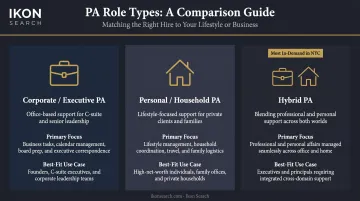
| Type | Primary Focus | Best For |
|---|---|---|
| Corporate / Executive PA | Office-based, business-focused tasks; overlaps with EA responsibilities | Senior executives needing dedicated in-office administrative support |
| Personal / Household PA | Lifestyle management, family coordination, household operations | HNW families, estate management, and personal logistics |
| Hybrid PA | Both professional and personal affairs simultaneously | NYC principals who can't separate work and personal life — the most in-demand model |
EA vs. PA: Where the Lines Blur
In New York's financial district, private equity firms, and asset management shops, the distinction between Executive Assistant and Personal Assistant is frequently blurry. The cleaner way to think about it: EAs are office-and-business-focused while PAs extend into personal life management. Many senior roles in NYC require both, which is why the hybrid model has become the default expectation at the principal level.
Engagement Models Available
Your hiring structure should match your actual workload patterns:
- Full-time permanent — Best for ongoing, high-volume support needs
- Part-time — Suits lighter or project-specific demands
- Contract / temporary — Covers gaps, leaves, or seasonal surges
- Temp-to-hire — Allows you to evaluate fit before committing permanently; especially common in family offices and private household roles where trust is a prerequisite
If you're unsure which model fits, start with how predictable your workload is — steady and high-volume points to full-time; variable or project-driven workloads are better served by contract or temp-to-hire arrangements.
Key Qualities to Look for in a New York Personal Assistant
New York's pace filters candidates quickly. The qualities below separate functional PAs from exceptional ones.
Five qualities consistently distinguish strong candidates from average ones:
- Proactivity — A strong PA anticipates needs, resolves problems before they escalate, and operates independently. If you're constantly directing their attention, something is off.
- Discretion and integrity — Non-negotiable, and legally nuanced in New York. The NYC Fair Chance Act restricts criminal-history inquiries until after a conditional offer; New York's Clean Slate Act, effective November 16, 2024, seals many eligible convictions from employer review. Work with a firm that knows these rules. Beyond compliance, strong professional references remain your best signal of real-world discretion.
- Technical proficiency — Expect competency across scheduling tools (Google Calendar, Outlook), communication platforms, travel booking systems, and standard productivity software. Set specific benchmarks during vetting — don't assume proficiency.
- Composure under pressure — Last-minute upheavals, competing priorities, and high-stakes situations are routine in New York. The right candidate handles this without losing effectiveness or needing reassurance.
- Industry familiarity — A PA supporting a hedge fund principal needs different contextual knowledge than one backing a media executive or tech founder. Matching background to your industry cuts ramp-up time and improves support quality from day one.
How to Hire a Personal Assistant in New York
The Self-Directed Route
You write a job description, post it on professional platforms, filter applicants, run interviews, conduct background checks, and manage onboarding yourself. You have full control, but in a competitive market like New York, this process routinely takes several weeks and produces inconsistent candidate quality. For a role this close to your daily operations, that timeline creates real exposure.
Working with a Specialized Staffing Firm
A specialized firm pre-screens candidates against your requirements and delivers a curated shortlist, compressing the entire sourcing phase. Ikon Search's Corporate Services team, for example, places Personal Assistants, Executive Assistants, and Estate Managers for clients ranging from family offices and hedge funds to private equity firms and UHNW principals. Their typical time-to-qualified-shortlist across placements is two to three days.
The value isn't just speed — it's candidate quality. Passive candidates — experienced PAs who aren't actively job searching — rarely appear on job boards. Firms with established networks are the primary way to reach them.
A Structured Hiring Process (Regardless of Method)
Whether you hire directly or through an agency, the process should include these steps:
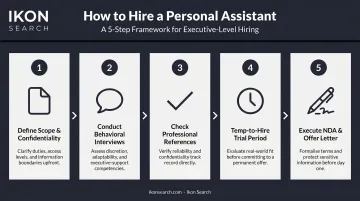
- Define scope and confidentiality requirements before writing a job description, including hours, travel expectations, NDA requirements, and any personal or lifestyle-specific duties
- Conduct behavioral interviews that test for discretion and problem-solving, not just logistics competency
- Check professional references rigorously — at least two to three direct supervisors or principals the candidate has supported
- Start with a temp-to-hire arrangement where possible to evaluate real-world fit before a permanent commitment
- Execute an NDA and offer letter covering duties, compensation, hours, benefits, and separation terms before the first day
The final decision is as much about cultural and interpersonal fit as it is about skills. PAs work in close daily proximity to their principals, so communication style, working rhythm, and personal compatibility carry real weight alongside any resume.
How Much Does It Cost to Hire a Personal Assistant in New York?
Base Salary Benchmarks
PA compensation in New York varies significantly based on scope, experience, and whether the role is personal, corporate, or hybrid.
- Indeed's NYC personal assistant salary data (updated June 2026, based on 162 salaries): $29.84/hour average, with a range of $18.06 to $49.29/hour
- BLS data for Executive Secretaries and Executive Administrative Assistants in the New York-Newark-Jersey City metro (the closest official comparable): $39.00 mean hourly / $81,120 mean annual wage
Expect roles with significant personal lifestyle management, or those supporting UHNW principals, to land at the higher end of the range.
Additional Cost Factors
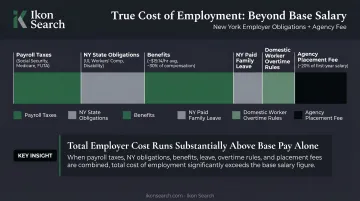
Beyond base salary, New York employers take on meaningful additional costs:
- Payroll taxes: Federal Social Security (6.2% employer share), Medicare (1.45% employer share), and FUTA on the first $7,000 in wages
- New York state obligations: Unemployment insurance applies if you pay $500 or more in cash wages in a calendar quarter; workers' compensation and disability insurance are also required
- Benefits: BLS Employer Costs for Employee Compensation data from March 2026 shows benefits averaging $19.14/hour in the New York metro area — roughly 30% of total compensation
- NY Paid Family Leave: Employee-funded at 0.432% of gross wages in 2026, but administratively the employer's responsibility to manage
- Domestic worker rules: If the PA works in a household capacity, New York DOL requires overtime after 40 hours per week (44 hours for live-in workers), one day of rest per calendar week, and at least three paid days off after one year
- Agency placement fees: For direct-hire placements, staffing industry benchmarks put the most common fee at approximately 20% of first-year salary
Is the Agency Fee Worth It?
The upfront placement fee compares favorably against the SHRM-reported cost of a bad hire — which can reach three to four times the position's annual salary when you account for disrupted operations and re-hiring costs. For a PA role, that risk is amplified.
A personal assistant has access to your schedule, home, financial information, and personal life. A poor hire carries consequences that extend well beyond job performance.
Common Mistakes to Avoid When Hiring a PA in NYC
Rushing the Hire Under Time Pressure
The close, confidential nature of the PA role means a poor hire creates risks beyond job performance — privacy breaches, schedule disruption, and reputational exposure. Time pressure is not a valid reason to skip reference checks or bypass the NDA.
Writing a Vague Job Description
Unclear postings attract unqualified applicants and create misaligned expectations before the person even starts. A precise, honest posting should cover:
- Day-to-day duties and scope of responsibility
- Hours, including after-hours responsiveness expectations
- Travel availability and lifestyle demands
- NDA requirements and confidentiality standards
Skipping Structured Onboarding
Even experienced PAs need onboarding that covers your preferences, communication protocols, key contacts, and any household or office systems they'll manage. Principals who invest a week in proper onboarding consistently report months of smoother operations afterward.
Frequently Asked Questions
What is the difference between a personal assistant and an executive assistant in New York?
Executive assistants focus on office-based, business-related tasks — meeting coordination, correspondence, and operational support within a corporate environment. Personal assistants extend that support into the principal's personal and lifestyle management. In NYC, many senior roles blend both functions, which is why the hybrid PA model is common.
How much does it cost to hire a personal assistant in New York City?
Base pay typically ranges from around $18 to $49 per hour depending on experience and scope, with averages near $30/hour per Indeed's 2026 NYC data. Factor in payroll taxes, benefits, potential overtime, and any agency placement fees — total employer cost runs substantially higher than base pay alone.
How long does it take to hire a personal assistant in New York?
Self-directed hiring typically takes several weeks from posting to offer. Working with a specialized staffing firm like Ikon Search compresses the process significantly — qualified, vetted shortlists are often presented within two to three days, allowing you to focus on evaluating fit rather than sourcing.
Do personal assistants in New York sign confidentiality agreements?
NDAs are standard practice in the NYC PA market, particularly for high-net-worth individuals and senior executives. Reputable staffing agencies also vet candidates for their professional history of discretion before presenting them — so discretion is assessed well before you meet a shortlist.
Should I hire a personal assistant on a full-time or part-time basis?
It depends on volume and consistency. Part-time or contract works for project-based or seasonal needs; full-time suits ongoing, high-volume support where the PA is embedded in your daily operations. For any close-access role, temp-to-hire lets you evaluate fit before committing.
What industries in New York commonly hire personal assistants?
Financial services, private equity, investment banking, asset management, law, technology, and media all hire PAs regularly. High-net-worth households and family offices are also significant hirers — often through specialized firms running retained, discreet searches.