
Introduction
Hiring is expensive — and paying a recruiter upfront with no guarantee of results adds financial risk most companies can't justify. For teams scaling quickly or filling mid-level roles on tight timelines, that commitment can stall decisions entirely.
Contingent recruitment solves this directly. It's a model where a recruiting agency is paid only when a candidate they sourced is successfully hired — sometimes called "pay-for-performance" recruiting. If no one gets hired, the fee doesn't apply.
This article covers how the process works step by step, what the benefits are, where the limitations lie, and what to look for when choosing a contingent recruiting partner.
Key Takeaways
- Contingent recruiters are paid only on a successful hire — no upfront retainer, no risk if the search yields nothing
- According to Staffing Industry Analysts, the most common direct-hire fee is 20% of the placed candidate's first-year salary
- Contingent recruitment is best suited for mid-level roles, volume hiring, or time-sensitive positions
- Engaging multiple agencies simultaneously is permitted, widening candidate coverage without exclusivity constraints
- Agency quality — vetting rigor and industry specialization — is what separates a strong hire from a high-volume miss
What Is Contingent Recruitment?
Contingent recruitment is an arrangement where a company partners with an external recruiter or agency to source candidates, with payment triggered only by a successful hire. It sits in the middle of the recruiting model spectrum:
| Model | Payment Structure | Best For |
|---|---|---|
| Contingent | Fee paid only on successful hire | Mid-level, volume, time-sensitive roles |
| Retained | Upfront retainer + success fee | Executive, senior, or highly specialized roles |
| RPO | Flat fee for outsourced recruiting function | Ongoing, high-volume hiring at scale |
Companies in financial services, insurance, technology, and marketing commonly use contingent recruitment for mid-level and specialist roles. Recruiter fees typically run 15–25% of the placed candidate's first-year salary — charged only when the hire is made.
How Does Contingent Recruitment Work? Step-by-Step
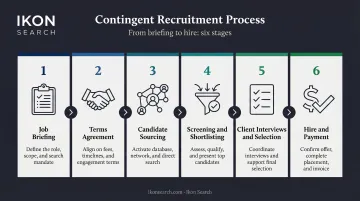
Step 1: Job Briefing
The employer shares the job description and candidate requirements with the agency. The quality of this brief matters more than most hiring managers expect.
Agencies that invest time understanding team dynamics, culture, and what "success in this role" actually looks like — beyond the formal job description — produce meaningfully better shortlists.
Step 2: Terms Agreement
Both parties agree on the fee structure (typically a percentage of first-year salary), timeline expectations, and any replacement guarantee period. This agreement typically covers:
- Fee percentage and payment trigger (usually the candidate's start date)
- Timeline expectations for shortlist delivery
- Whether the company engages one agency exclusively or runs multiple simultaneously
Step 3: Candidate Sourcing and Outreach
The agency taps its network, candidate databases, and sourcing tools to identify qualified candidates: both active job seekers and those not currently looking. Strong agencies combine broad networks with targeted outreach, rather than recycling the same candidate pool with generic messaging every time.
Step 4: Screening and Shortlisting
The recruiter screens candidates through interviews, assessments, and reference checks before presenting a curated shortlist. This step is where the gap between strong and weak agencies becomes obvious. SIA notes that recruiters tend to lean either toward swift identification or meticulous vetting — balancing both is what separates quality firms from volume shops.
Step 5: Client Interviews and Selection
The employer reviews the shortlist, conducts their own interviews, and makes a hiring decision. A good contingent recruiter stays involved here — providing candidate insights, flagging concerns, and managing offer negotiations through to acceptance.
Step 6: Hire and Payment
With an accepted offer and a start date confirmed, the company pays the agreed fee. Most contingent agreements include a replacement guarantee — commonly 30–90 days — if the hire doesn't work out within that window.
Key Benefits of Contingent Recruitment
No-Risk Financial Model
Companies pay only when a hire is made. No upfront retainer. No payment if the search comes up empty. For companies that need recruiting support but can't commit significant budget without certainty of results, this structure lowers the barrier considerably.
Speed and Motivation
Because contingent agencies earn nothing without a successful placement, they're structurally motivated to move fast and present strong candidates quickly. SHRM describes contingency search as "much faster" than retained search, particularly for early-to-mid-career roles where speed matters. SHRM's 2025 benchmarking data shows the average time to fill an open role fell from 48 days in 2023 to 41 days in 2024 — contingent agencies on performance incentives routinely beat that benchmark.
Access to Passive Talent
Speed matters less if you're only reaching candidates who are already looking. Top professionals in specialized fields — insurance underwriting, cybersecurity, financial compliance, performance marketing — rarely browse job boards. Contingent recruiters maintain active networks and know how to reach people who aren't in the market. That vertical depth is what separates a fast shortlist from a good one.
At Ikon Search, specialist recruiters in insurance, technology, risk and compliance, and digital marketing maintain networks built specifically for those markets, not repurposed generalist databases.
Scalability and Flexibility
Key benefits for growing businesses include:
- No ongoing commitment — engage for one role or ten, then step back
- Ability to test multiple agency partners simultaneously
- Suited for PE-backed companies scaling quickly across new verticals
- Works for one-off executive support roles as well as bulk hiring projects
No Long-Term Obligation
Unlike RPO arrangements, contingent recruitment carries no contractual lock-in. Companies can switch agencies between roles, run parallel searches, or end the relationship without penalty — full control stays with the employer.
Limitations to Be Aware Of
Contingent recruitment works well in the right context, but there are real trade-offs worth understanding before engaging.
Three trade-offs come up most often:
- Volume over fit: The most common complaint is agencies sending large candidate pipelines quickly rather than deeply vetting each profile. Because placement equals revenue, the incentive to submit more candidates exists — which makes agency selection a meaningful decision, not a routine one. Look for firms that cap submissions and explain their screening criteria upfront.
- Divided attention: SHRM notes that contingency recruiters typically carry many more open job orders than retained recruiters. Your role competes for their time, especially if another client is filling a higher-margin position simultaneously.
- Partial process ownership: Contingent recruitment covers sourcing and initial screening. The interview process, final selection, and onboarding remain the employer's responsibility — so internal hiring resources are still required.
Contingent vs. Retained Recruitment: Which Is Right for You?
In retained search, the company pays an upfront fee to secure the agency's dedicated focus, with the balance due on placement. Retained search typically runs fees around 33% of total first-year compensation — higher than contingent, but it buys exclusivity and deeper commitment to the search.
The right model depends on the role, the urgency, and what level of agency commitment you need.
Choose contingent recruitment when:
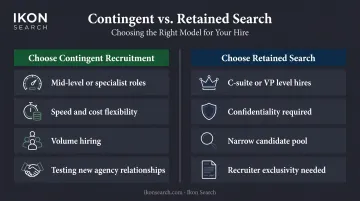
- Filling mid-level or specialist roles with a defined candidate market
- Speed and cost flexibility are priorities
- Running volume hiring across multiple similar roles
- Testing new agency relationships before committing to retained partnerships
Choose retained search when:
- Hiring at the C-suite, VP, or board level
- The role requires deep confidentiality or market mapping
- The candidate pool is genuinely narrow and requires proactive headhunting
- Recruiter dedication and exclusivity are non-negotiable
Some firms operate exclusively in one model. Ikon Search runs both contingent and retained searches, matching the engagement style to the specific role — from mid-level specialist placements in insurance, technology, and marketing to executive searches across PR, communications, and risk and compliance.
What to Look for in a Contingent Recruiting Agency
Industry Specialization
A recruiter who doesn't know your industry well will struggle to source meaningfully, assess accurately, or sell the opportunity compellingly to candidates. Look for agencies with dedicated practice areas rather than generalists covering every vertical.
Ikon Search, for example, structures its practice into six divisions — Insurance, Technology, Risk & Compliance, Digital Media & Marketing, PR & Communications, and Contract Services — each led by recruiters with direct experience in that market. That specialization shows in both the quality of sourcing and how the role gets positioned to candidates.
Vetting Rigor
Ask directly: what does the screening process involve before a candidate is submitted? Structured interviews, competency-based assessments, and reference verification all reduce the risk of a poor hire. Agencies that skip these steps to move faster are optimizing for their pipeline, not your outcome.
Speed and rigor aren't mutually exclusive — but the best agencies are upfront about both. That brings us to the third thing worth evaluating.
Transparency and Speed
A reliable contingent agency should be able to tell you:
- How long it typically takes to present qualified candidates
- What the shortlist criteria are
- How they'll communicate if the search isn't gaining traction
Ikon Search typically presents pre-screened, qualified candidates within 2–3 days of engagement. That turnaround comes from active network depth and vertical-specific sourcing, not cold outreach built from zero.
Frequently Asked Questions
What is a contingent recruiting agency?
A contingent recruiting agency sources and places candidates for open roles, earning a fee only when a hire is made. This makes it a low-risk option for employers who want professional recruiting support without committing budget upfront.
What is the contingent recruiting fee?
The standard fee is typically around 20% of the hired candidate's first-year base salary, according to Staffing Industry Analysts. Fees can range from 15%–25% depending on role seniority, industry, and agency specialization.
What types of roles are best suited for contingent recruitment?
Contingent recruitment works well for mid-level, specialist, and volume roles where there's a defined candidate market. Highly senior or niche positions — particularly C-suite hires requiring discretion and deep market mapping — often benefit more from retained search.
How is contingent recruitment different from retained search?
The core difference is payment timing. Contingent recruiters are paid only on a successful hire; retained recruiters receive an upfront fee for dedicated focus.
Can a company use multiple contingent recruiters at the same time?
Yes — and many companies do. Engaging multiple contingent agencies simultaneously broadens candidate coverage, though it also means agencies compete with each other and with your internal sourcing efforts.
How long does contingent recruitment typically take to fill a position?
Timelines vary by role complexity and market conditions. SHRM's 2025 data puts the average time-to-fill at 41 days across all methods. Contingent agencies, motivated by placement fees, tend to move faster — quality firms often deliver initial shortlists within days of a briefing.