
Staff augmentation offers a practical middle ground. Rather than hiring permanently or handing a process to an outside vendor, you bring in a qualified professional on a flexible basis — embedded in your team, following your workflow, managed by your people.
This guide covers what staff augmentation actually is, how it compares to other staffing models, the key benefits, when it makes sense to use it, and what to look for in a staffing partner.
Key Takeaways
- Staff augmentation embeds external professionals in your team on a contract basis — you retain full management control
- It delivers faster access to specialized skills without permanent headcount commitments
- It differs from outsourcing in a critical way: you direct the work, set the priorities, and keep accountability in-house
- The WEF projects 39% of core worker skills will change by 2030 — flexible access to expertise is no longer optional
- Choosing a specialist staffing partner over a generalist firm delivers faster, higher-quality placements
What Is Staff Augmentation?
Staff augmentation is the practice of supplementing your internal team with external professionals on a temporary, contract, or project basis — while you retain full control over direction, workflow, and day-to-day management.
How It Works in Practice
A staffing partner identifies, vets, and places a qualified professional with your team. That professional works within your processes, uses your tools, attends your meetings, and reports to your internal managers. The division of responsibility is clear:
- Staffing partner: Sourcing, candidate vetting, compliance, payroll administration
- Client organization: Work direction, task assignment, performance management, workflow integration
Who Uses It — and for What
Staff augmentation is not exclusively an IT strategy, despite that reputation. It's used across:
- Financial services (risk analysts, compliance specialists, derivatives support)
- Insurance (claims analysts, underwriters, program managers)
- Technology (software engineers, DevOps, cloud infrastructure)
- Marketing (performance marketing, demand generation, SEO/SEM)
- Corporate services (HR, accounting support, legal assistants, operations)
The scale of this market reflects how mainstream the model has become. The US staffing market is projected to reach $180.2 billion in 2026, according to Staffing Industry Analysts — a figure that signals this model has moved well beyond contingency planning into core workforce strategy for companies of all sizes.
Staff Augmentation vs. Other Staffing Models
Each staffing model serves a different need. Knowing the distinctions helps you choose the right approach from the start.
Staff Augmentation vs. Managed Outsourcing
| Dimension | Staff Augmentation | Managed Outsourcing / BPO |
|---|---|---|
| Process ownership | Client owns the process | Vendor owns the process |
| Worker integration | Embedded in client team | Operates separately |
| Management | Client manages day-to-day | Vendor manages delivery |
| Accountability | Client-side | Vendor-side |
| Best use case | Defined skill gap, team integration needed | Repeatable function the client wants to offload |
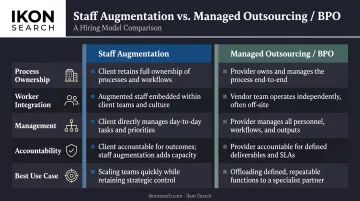
The core distinction is control. Augmentation means an embedded professional working inside your team, following your processes. Outsourcing means handing off a function entirely and receiving a delivered output.
Staff Augmentation vs. Traditional Temp Staffing
Traditional temp staffing typically serves high-volume, lower-skill needs — think surge capacity in administrative or light industrial roles, often placed with minimal screening. Staff augmentation focuses on skilled, often specialized professionals placed through a more rigorous vetting process. The engagement depth, candidate quality, and time-to-placement expectations are meaningfully different as a result.
The Temp-to-Hire Model
Temp-to-hire is a bridge arrangement: a professional is engaged on a contract basis with a structured option to convert to permanent employment if the fit proves strong. It's particularly useful when:
- Role seniority is high — cultural and leadership alignment matter as much as technical skill
- Stakes of a poor permanent hire are significant — the trial period de-risks a long-term commitment
- Both sides benefit from a structured evaluation window before full commitment
Key Benefits of Staff Augmentation
Flexibility Without the Overhead
Organizations can expand or contract their workforce in response to project demands, seasonal pressures, or market conditions — without the legal and administrative complexity of permanent hiring or layoffs. If a regulatory project ends, the engagement ends. If project scope expands, additional contractors can be added.
This agility is especially valuable for PE-backed firms in growth or restructuring phases, startups scaling rapidly across new functions, and established businesses navigating headcount freezes.
Access to Specialized Expertise on Demand
Some skills aren't worth hiring for permanently. Consider roles like:
- A compliance analyst needed for one regulatory cycle
- A derivatives specialist for a six-month trading desk build-out
- A performance marketing specialist for a campaign launch
Augmentation delivers the right expertise when it's needed, without the time investment of a traditional search.
Deloitte reports that 66% of managers say recent hires weren't fully prepared due to experience gaps. Contract professionals placed through specialist staffing partners typically bring deep, immediately applicable experience — no lengthy ramp-up required.
Cost Efficiency vs. Full-Time Hiring
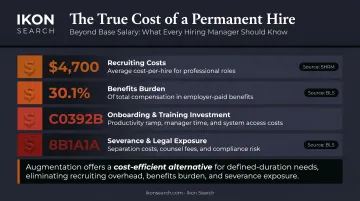
A permanent hire carries costs well beyond base salary:
- Recruiting costs (SHRM puts average cost-per-hire at nearly $4,700)
- Benefits burden (BLS data shows benefits represent 30.1% of employer compensation costs)
- Onboarding and training investment
- Severance and legal exposure if the hire doesn't work out
For defined-duration or project-specific needs, augmentation often delivers better total value — particularly when the engagement length doesn't justify the full employer burden of a permanent hire.
Speed to Productivity
With a specialist staffing partner maintaining pre-built candidate networks and rigorous vetting, qualified professionals can often be placed within days rather than weeks. Ikon Search's contract services team, led by Kristin Lutz, runs a structured five-step intake-to-submission process that typically delivers a vetted shortlist within 2–3 days across financial services, insurance, technology, and marketing.
That turnaround compresses the hiring timeline considerably against the 41-day average for traditional full-time searches.
Reduced Hiring Risk
If an augmented professional isn't the right fit, the engagement can be adjusted or replaced without the legal and financial complexity of terminating a permanent employee. This matters significantly when:
- Entering a new project domain where requirements may shift
- Operating under headcount uncertainty or budget constraints
- Evaluating a candidate before committing to a permanent offer (temp-to-hire)
When Staff Augmentation Makes Sense
Staff augmentation fits specific situations well. Knowing when it applies — and when it doesn't — saves time and budget.
Use it when:
- The project has a clear start and end — a product launch, systems implementation, regulatory compliance initiative, or M&A due diligence exercise all fit this model naturally.
- A specialized skill — data analytics, cloud architecture, regulatory compliance — is needed now but doesn't justify a permanent hire. Augmentation closes that gap fast.
- Headcount or budget constraints are in play. Contract arrangements let organizations access senior expertise — for six months or six weeks — without permanent additions to the org chart.
- You want to evaluate before committing. Temp-to-hire reduces long-term hiring risk, especially for roles where culture fit matters as much as credentials.
It's a poor fit when:
- The role requires years of institutional context and relationship-building
- The work is genuinely ongoing without a defined scope
- You need the professional to manage sensitive internal processes with long-term ownership
Types of Staff Augmentation Engagements
Short-Term Contract
Professionals engaged for a defined brief period — typically days to a few months — to address an immediate, specific need. Common for covering planned leave, handling a one-time project, or providing surge capacity during peak periods.
Long-Term Contract
Extended engagements of several months to over a year for ongoing needs that don't justify a permanent hire. Particularly common in financial services and insurance, where the work is continuous but headcount approval is restricted or scope remains bounded. Typical roles include:
- Risk analysts and compliance specialists
- Technology project leads and enterprise architects
- Contract corporate services and operations support
Temp-to-Hire
A contract engagement with a structured option to convert to full-time employment. Both client and professional can evaluate fit before committing. Most useful for senior roles where alignment with company culture, leadership style, and long-term goals matters as much as technical skill. A poor permanent hire at that level is expensive to reverse — this model reduces that risk before either side commits.
How to Choose the Right Staff Augmentation Partner
The quality of your partner matters more than the model itself. Before signing anything, evaluate these five areas:
Define Your Needs First
Role type, skill depth, engagement duration, timeline, and integration level all affect which partner fits. Vague briefs produce mismatched placements — nail this before you approach anyone.
Vet the Vetting Process
Ask how they screen candidates. Do they conduct interviews, technical assessments, and reference checks — or rely mostly on resume review? Find out how they handle placements that aren't working before you're in that situation.
Prioritize Specialization Over Breadth
A generalist firm may have wide reach but limited depth in your sector. For roles in financial services, insurance, technology, or marketing, a boutique partner with dedicated division leads will deliver stronger candidates faster.

Ikon Search operates six specialized divisions, each led by practitioners with direct market experience — meaning the person sourcing a compliance analyst understands regulatory frameworks, not just job titles.
Understand the Full Cost Structure
Get clarity on what's included in the rate. Who carries worker classification liability? What IP and NDA protections apply? Hidden costs — onboarding time, management overhead, technology licensing — affect total engagement value in ways the headline rate won't show.
Verify Track Record Independently
Client testimonials and references from organizations similar to yours carry more weight than a firm's own marketing. Ask about average time-to-placement, how underperformance is handled, and retention rates for placed professionals.
Frequently Asked Questions
What are staff augmentation services?
Staff augmentation services involve supplementing your internal team with skilled external professionals on a contract or project basis, managed directly by your organization. The model applies across industries — from financial services and insurance to technology and marketing — for roles spanning mid-level specialists to senior-level experts.
What is an example of staff augmentation?
A financial services firm engages a contract compliance analyst for a six-month regulatory remediation project through a staffing partner. The analyst works within the firm's team, follows internal processes, and is managed by the firm's Compliance Director — while the staffing partner handles sourcing and payroll.
How do I choose a staff augmentation provider?
Focus on four things: clarity about your role requirements, rigor of the provider's vetting process, depth of expertise in your specific sector, and a verifiable track record with similar clients. Provider size matters less than specialization — a boutique firm with deep domain knowledge in your industry will typically deliver better results than a generalist firm with broad but shallow coverage.
What is the difference between staff augmentation and outsourcing?
In staff augmentation, you manage the augmented professional directly within your team and processes. In outsourcing, you transfer process ownership and delivery accountability to a vendor. The key distinction is control — augmentation keeps it with you; outsourcing transfers it.
What industries benefit most from staff augmentation?
Technology and software development are the most common use cases, but financial services, insurance, risk and compliance, and performance marketing are increasingly relying on augmentation for specialized, time-sensitive needs — driven by rapid skills change and tightening headcount budgets.
How quickly can augmented staff be onboarded?
Boutique staffing firms with pre-built talent networks in specific sectors can typically present a vetted shortlist within 2-3 days. That contrasts sharply with traditional full-time hiring, where the average time to fill sits at 41 days — before onboarding even begins. Role complexity and provider specialization are the main variables.