The wrong model has real consequences. Choose direct hire for a newly created function and you risk a costly permanent commitment before the scope is clear. Choose contract-to-hire for a senior leadership role and your best candidates walk before you can interview them.
This guide covers both models — how they work, what they cost, when each one is the right tool, and a practical framework for making the call.
Key Takeaways
- Contract-to-hire places a worker on the staffing agency's payroll for a trial period before the employer decides on permanent conversion.
- Direct hire means the candidate joins your payroll on day one as a full-time permanent employee.
- Contract-to-hire reduces the risk of a costly mis-hire by letting you evaluate real performance before committing.
- Direct hire is the preferred path for passive candidates and roles requiring long-term ownership from day one.
- Your choice hinges on four factors: role permanence, timeline pressure, headcount constraints, and hiring risk tolerance.
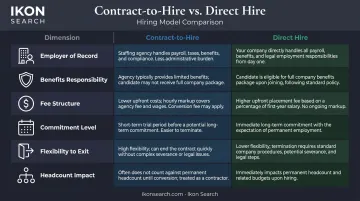
Contract-to-Hire vs. Direct Hire: Quick Comparison
Here's how the two models compare across the dimensions that matter most to hiring managers.
| Dimension | Contract-to-Hire | Direct Hire |
|---|---|---|
| Who employs the worker | Staffing agency payroll during trial period | Employer payroll from day one |
| Benefits responsibility | Staffing agency carries payroll and benefits costs | Employer provides full benefits package |
| Fee structure | Hourly bill rate (pay rate + statutory costs, benefits, admin, margin) | One-time placement fee (typically ~20% of first-year base salary) |
| Commitment level | Defined trial period; conversion is optional | Permanent from the start |
| Flexibility to exit | Either party can end before conversion with no severance implications | Termination carries standard employment obligations |
| Headcount impact | Contract workers typically sit outside permanent FTE counts | Counts against permanent headcount immediately |
One Misconception Worth Clearing Up
Contract-to-hire is not the same as hiring an independent contractor. When a candidate is placed through a staffing agency on this basis, they are a W-2 employee of that agency — the employer takes on no payroll tax exposure or misclassification risk during the trial period. That distinction matters when legal and compliance teams review the engagement.
What Is Contract-to-Hire?
Contract-to-hire is a structured trial arrangement. A candidate works for a defined period (typically 3 to 12 months) on the staffing agency's payroll. At the end of that period, the employer can convert them to a permanent employee, extend the contract, or end the engagement.
SHRM notes that organizations use this model as a trial run before hiring permanently, and that it can reduce the risk of costly and time-consuming bad hiring decisions. The mechanics support that: you're evaluating real performance in real working conditions, which is a far more reliable signal than any interview process.
How Billing Works
During the contract period, the employer pays an hourly bill rate, not the worker's direct pay rate. That bill rate reflects the worker's pay plus statutory costs, benefits, compliance administration, and the agency's margin. Upon conversion to permanent status, a conversion fee applies, typically expressed as a percentage of first-year base salary and often lower than a standard direct hire placement fee.
The total acquisition cost can exceed a direct hire fee if conversion happens quickly. The tradeoff is a significantly lower risk of making the wrong permanent call.
When Contract-to-Hire Isn't the Right Fit
- Roles requiring deep institutional knowledge from day one
- Senior leadership positions where authority and credibility depend on permanent standing
- Passive candidates who will only engage with a permanent offer
- Licensed or fiduciary roles where regulatory obligations make a contingent arrangement operationally complex
Use Cases at Ikon Search
Contract-to-hire tends to work best in situations like:
- Scope is still being defined and a permanent build-out feels premature
- Headcount is frozen but work demand isn't
- The company has made previous costly permanent mistakes in a specific function
In Ikon Search's experience, this model is particularly common in Corporate Services — Executive Assistants, Personal Assistants, Estate Managers — as well as Marketing leadership and HR/Talent Acquisition roles. For example, an insurance carrier might bring in a data analyst during a system migration to evaluate fit before committing to a permanent team build-out. A fintech firm takes a similar approach when it needs a compliance analyst to map regulatory workflow gaps first — and only formalizes the full-time function once the scope is clear.
What Is Direct Hire?
Direct hire means a candidate is sourced, screened, selected, and placed directly onto the employer's payroll as a full-time permanent employee. The staffing agency's role ends at placement. The employer pays a one-time placement fee rather than an ongoing hourly bill rate.
According to Staffing Industry Analysts, direct hire is defined as a staffing-agency service that helps an organization obtain an employee to work on the organization's payroll — as opposed to temporary staffing where the worker is typically on the staffing firm's payroll.
The Fee Structure
The most common direct hire placement fee is 20% of first-year base salary, with 42% of staffing firms reporting that fee level according to SIA's benchmark data. Most reputable agencies include a guarantee period: if the placed candidate departs within a defined window, the agency conducts a replacement search.
SHRM reports that the average cost per hire is nearly $4,700 — and that many employers estimate total hiring cost at three to four times the position's salary when time, lost productivity, and ramp-up are factored in. Viewed that way, a direct hire placement fee is often the cheaper path.
The Passive Candidate Advantage
Direct hire is the only viable model for recruiting passive candidates — professionals succeeding in current roles who aren't browsing job boards. A permanent offer with full benefits, career trajectory, and organizational standing is often what moves them. A contract-to-hire arrangement, by contrast, tends to narrow the candidate pool for senior roles because many experienced professionals won't engage with anything short of a permanent offer.
When Direct Hire Is Non-Negotiable
- Client-facing roles where relationships compound over years
- Leadership positions requiring immediate authority
- Licensed, fiduciary, or regulated roles (FINRA-registered, insurance-licensed, control functions such as risk, compliance, and internal audit)
- Any seat where long-term retention directly drives revenue or compliance outcomes
Use Cases at Ikon Search
For financial services and insurance clients, Ikon Search's direct hire placements concentrate in roles where continuity directly affects outcomes:
- Head of Underwriting
- Chief Compliance Officer
- Director-level Risk & Compliance
- Senior Corporate Services leadership
For PE-backed portfolio companies, direct hire is typically the only option. Professionals who understand a 5–7 year PE timeline won't engage on a contract basis — they want equity in the outcome.
Ikon's approach starts with time invested upfront: understanding culture, team dynamics, and long-term organizational goals before presenting a shortlist. In niche markets, that groundwork is what surfaces the right senior candidate — not a high volume of submissions.
Which Model Fits Your Hiring Need?
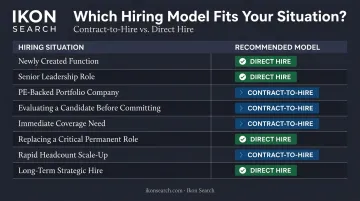
Rather than declaring one model universally superior, experienced recruiters work through four diagnostic questions before recommending a path.
Factor 1: Role Permanence
If the role is indefinite and requires long-term ownership, direct hire is almost always the right call.
When scope is still evolving — or the business case for a permanent seat hasn't fully closed — contract-to-hire keeps the work moving while the organization figures out what it actually needs.
Factor 2: Timeline and Urgency
Direct hire searches, done thoroughly, typically take four to eight weeks. When a project is live and every vacant week has a measurable productivity cost, speed becomes a genuine business variable — not just a nice-to-have.
Ikon Search's model is built for speed: a qualified shortlist typically within 2–3 days across both engagement types. But contract-to-hire placements can move faster overall because the candidate pool is broader and candidates enter with a lower barrier to commitment.
Factor 3: Headcount and Budget Constraints
Contract workers typically fall outside permanent FTE counts. During a hiring freeze, this isn't a workaround — it's a deliberate strategic choice. Work that needs to get done gets staffed. The permanent headcount position resolves when it resolves.
This is a legitimate use of the contract model, and it's one reason PwC notes that contingent workers can represent 10–30% of the workforce at some financial institutions — often to access specialized skills and scale with demand while managing governance requirements.
Factor 4: Hiring Risk Tolerance
| Situation | Recommended Model |
|---|---|
| Established role with a clear success profile | Direct hire with rigorous process |
| Newly created function; scope still being defined | Contract-to-hire |
| Highly technical role; previous retention struggles | Contract-to-hire |
| Senior leadership; requires immediate authority | Direct hire |
| Headcount frozen; work demand isn't | Contract-to-hire |
| Passive candidate required | Direct hire |
| Licensed/fiduciary/regulatory role | Direct hire |
| PE-backed company; culture-fit investment needed | Direct hire |
Choose contract-to-hire when flexibility, speed, or risk reduction matters more than permanence. Choose direct hire when the role demands long-term ownership, passive talent access, or the economics of a tenure beyond two years favor the permanent model.
Conclusion
Contract-to-hire and direct hire are both useful — which one fits depends entirely on the role, the risk tolerance, and the timeline. The hiring managers who get this right are the ones who match the model to the situation rather than reaching for whichever approach is most familiar.
If you're working through this decision on a specialized role in financial services, insurance, technology, or corporate services, Ikon Search's team can help you determine the right path and typically shortlist qualified candidates within 2–3 days once the model is clear. Reach out at info@ikonsearch.com or connect with our offices in NYC, Chicago, or Philadelphia.
Frequently Asked Questions
Is direct hire better than temp-to-hire?
Neither is universally better. Direct hire offers immediate permanence and long-term cost efficiency, while temp-to-hire (contract-to-hire) reduces the risk of a costly permanent mistake by building in a performance-based trial period. The right choice depends on the role's permanence, urgency, and the employer's tolerance for hiring risk.
What is the difference between contract-to-hire and direct hire?
The key difference is when the permanent employment relationship begins. Direct hire places the candidate on the employer's payroll from day one. Contract-to-hire keeps them on the staffing agency's payroll through a defined trial period, with conversion to permanent employment happening afterward — if both parties agree.
How long does a contract-to-hire arrangement typically last before conversion?
Most contract-to-hire periods run 3 to 12 months, with 90 days being a common conversion point. The timeline is agreed upon at the start of the engagement and depends on the complexity of the role and how quickly performance can be assessed.
Who pays benefits during a contract-to-hire period?
During the contract period, the staffing agency carries the worker's payroll and benefits obligations. That cost is reflected in the hourly bill rate charged to the employer — it's built into the rate rather than billed separately.
Can a contract-to-hire engagement end before the conversion decision?
Yes — either party can end the engagement before conversion. This avoids the severance and unemployment implications that come with terminating a permanent employee — a meaningful advantage over standard direct hire.
What is a typical conversion fee when moving from contract-to-hire to permanent?
Conversion fees are typically a percentage of first-year base salary and run lower than standard direct hire placement fees. Many agencies reduce or waive the fee after a candidate has served a substantial portion of the contract period, since the employer has been paying a bill rate throughout. Confirm the conversion fee structure upfront before the engagement starts.