According to Harvard Business Review, 50–60% of executives fail within their first 18 months of being hired or promoted. That failure rate doesn't exist in a vacuum — it's shaped by how thoroughly candidates were sourced, vetted, and matched to the role before anyone accepted an offer.
This article breaks down exactly how retained and contingent search models work, where each belongs, and how to make the right call based on your specific role and organizational context.
Key Takeaways
- Contingent search = no upfront cost, paid only on successful placement; best for mid-level and specialist roles
- Retained search = fees paid in installments upfront; designed for senior leadership, confidential, or specialized hires
- Retained firms work exclusively on your search and pursue passive candidates; contingent firms split focus across multiple client searches simultaneously
- Choosing the right model depends on role seniority, confidentiality needs, and vetting depth — not budget alone
Retained vs. Contingent: Quick Comparison
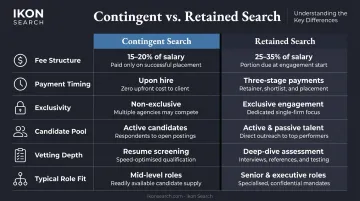
| Factor | Contingent | Retained |
|---|---|---|
| Fee structure | 20–25% of first-year salary, paid on hire only | ~30–35% of first-year total comp, paid in installments |
| Payment timing | No hire, no fee | One-third at launch, one-third at midpoint, one-third at placement |
| Exclusivity | Non-exclusive; client may use multiple firms | Exclusive; one firm per search |
| Candidate pool | Primarily active job seekers and existing databases | Primarily passive candidates via direct outreach |
| Vetting depth | Technical screening; client handles deeper assessment | Behavioral, competency-based interviews + reference checks before shortlist |
| Typical role fit | Mid-level, specialist, high-volume roles | Director, VP, C-suite, confidential, or niche roles |
| Timeline | Faster to first resume submission | 90–120 days from kickoff to offer acceptance |
What Is Contingent Executive Search?
Contingent search is straightforward: the recruiter is paid nothing unless you hire someone they present. No placement, no fee.
That fee-on-success structure shapes everything about how the model operates. According to AESC, contingent recruiters are motivated to get many resumes in front of many clients as quickly as possible — and have little incentive to keep pushing if a search isn't gaining traction. The economics reward speed and volume, not depth.
How Contingent Search Actually Works
In practice, contingent recruiters typically manage multiple active searches simultaneously across different clients. They draw from databases of active job seekers and candidates who have responded to postings. Submissions come quickly, but the candidate pool is largely limited to people who are actively looking — a minority of the total talent market.
LinkedIn data shows that only 25% of the employed workforce is actively seeking a new role. The remaining 75% — including the 60% who aren't looking but would consider the right opportunity — won't show up in a contingent firm's active pipeline.
Vetting is lighter by design. AESC notes that contingent recruiters generally handle the front end — screening for technical qualifications and compensation alignment — leaving deeper assessment to the client. That means cultural fit, leadership capability, and organizational alignment are yours to evaluate.
When Contingent Search Makes Sense
Contingent works well when:
- The role sits below Director level or under approximately $150K in total compensation
- You're filling multiple similar positions simultaneously
- Time-to-hire matters more than exhaustive vetting
- The candidate profile is well-defined and the talent pool is large
For these scenarios, working with multiple contingent firms simultaneously can speed up candidate volume without added risk. Ikon Search's contingent practice operates across financial services, insurance, technology, and marketing — placing specialist and mid-level roles where defined candidate profiles and fast turnaround matter most.
What Is Retained Executive Search?
Retained search is an exclusive engagement. A single firm is contracted to run your search from start to finish, paid in installments regardless of whether a hire has been made yet. That structure changes the incentives entirely.
Because the firm is already compensated for its time, it's accountable for quality — not just speed. Retained search consultants aren't racing to submit resumes before a competing firm does. They're building a thorough picture of the market and approaching the right people directly.
How Retained Search Sources Candidates
The core difference is who gets contacted. Retained firms do the majority of their work through direct outreach to executives who are currently employed, performing well, and not on any job board. These candidates would never appear in a contingent recruiter's database.
The best CFO, Chief Underwriting Officer, or Head of Compliance for your role probably isn't refreshing their LinkedIn profile. They're running a team somewhere else — and the only way to reach them is through a direct, credible approach from a firm with genuine relationships in that space.
What the Vetting Process Looks Like
Before a retained firm presents anyone, candidates typically go through:
- Structured behavioral and competency-based interviews
- Role-specific assessments aligned to the client's leadership criteria
- Reference checks (often before the shortlist stage, not after)
- Written candidate summaries documenting qualifications, motivations, and fit
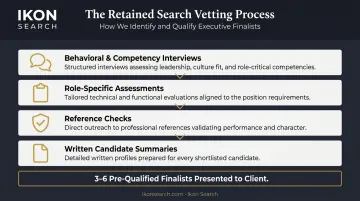
The result: clients typically interview 3–6 deeply pre-qualified finalists rather than sorting through 20+ resumes. That alone compresses a search that might otherwise drag for months into a focused, manageable process.
Where Ikon Search's Retained Practice Fits
Ikon Search's retained practice serves financial services firms, insurance carriers, PE-backed portfolio companies, and technology businesses — sectors where the cost of a wrong leadership hire tends to be unusually high. The founding team brings 25+ years of executive search experience to each engagement.
Every engagement starts with a detailed consultation to understand not just the role spec, but the company's culture, strategic direction, and the specific qualities that separate a good hire from the right one.
Market mapping and compensation benchmarking are built into the retained engagement, with verified market data informing candidate outreach strategy before the first call is made.
When Retained Search Is the Right Call
Use a retained firm when:
- The role is Director, VP, or C-suite level
- The hire is a confidential replacement or newly created leadership position
- The role requires rare or highly specialized expertise
- Diversity of the leadership pipeline is a strategic priority
- The wrong hire would have broad organizational consequences
For PE-backed companies scaling post-acquisition, insurance carriers building underwriting or actuarial leadership, or technology firms filling C-suite gaps, retained search provides the structure and accountability those searches demand.
Which Model Fits Your Hiring Need?
The decision comes down to four factors.
1. Role Seniority
The clearest signal. Director and above: retained. Below Director: contingent is typically sufficient. This isn't arbitrary. Senior candidates require a different sourcing approach, more rigorous vetting, and a higher degree of market discretion than mid-level hires.
2. Strategic Impact
Ask: what happens if this hire doesn't work? For revenue-critical or culture-defining roles, a shallow search that misses the passive candidate pool is an expensive risk. SHRM reports the average cost of a bad hire is roughly 30% of first-year earnings. That figure understates the leadership-level impact — factor in team disruption, damaged customer relationships, and lost time-to-productivity, and the number climbs fast.
3. Confidentiality Requirements
Leadership transitions — replacing an underperforming executive, conducting a confidential backfill — require discretion that the contingent model structurally can't provide. When Ikon Search handled an urgent leadership transition for a boutique MGA after their Chief Underwriting Officer departed and took the entire underwriting team with them, the engagement required immediate market mapping, targeted passive candidate outreach, and careful management of how the situation appeared externally to brokers. That kind of work demands a retained partnership.
4. Timeline Expectations
Retained searches typically run 90–120 days from kickoff to offer acceptance. That's not a flaw. It's what a thorough leadership search actually takes. If the primary constraint is getting qualified resumes quickly for a mid-level role, contingent firms will move faster.
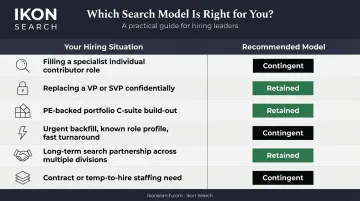
A Practical Decision Guide
| Your Situation | Recommended Model |
|---|---|
| Filling 3 specialist roles in Q1 | Contingent |
| Replacing a VP of Risk quietly | Retained |
| Series A startup hiring a Head of Growth | Contingent |
| PE-backed firm building a new C-suite | Retained |
| Adding 5 underwriters across two offices | Contingent |
| Insurance carrier seeking a new CUO | Retained |
The Case for Working With a Firm That Offers Both
Organizations with varied hiring needs — a common situation for growing companies and PE-backed firms — benefit from a search partner who can recommend the right model for each role rather than defaulting to one approach. Ikon Search's flexibility across retained and contingent engagements means clients get objective guidance: retained search for the Chief of Staff hire, contingent placement for the three marketing managers coming on board the same quarter.
Frequently Asked Questions
What is a retained executive search?
Retained executive search is an exclusive, fee-based engagement where a firm is paid in installments to conduct a dedicated search for a senior leadership role. The firm targets primarily passive candidates and delivers a pre-vetted shortlist — typically 3–6 finalists — before client interviews begin.
How do retained executive search firms get paid?
Retained firms typically charge 30–35% of the placed executive's first-year total compensation, paid in three installments: one-third at search launch, one-third at a midpoint milestone, and the final third upon placement or at an agreed contractual date.
What is the difference between contingency search and retained executive search?
Three core differences set the models apart:
- Payment: Contingent fees are due only on hire; retained fees are paid in installments upfront
- Exclusivity: Contingent is non-exclusive; retained is a single-firm partnership
- Depth: Contingent focuses on active candidates and speed; retained provides passive candidate access and comprehensive vetting
How long does a retained executive search typically take?
Retained searches typically take 90–120 days from kickoff to offer acceptance. The first half covers market research and direct candidate outreach; the second half covers structured interviews, assessment, and selection. That timeline is what rigorous vetting at the executive level actually requires.
Can a company use both retained and contingent search for different roles?
Most organizations benefit from using both models simultaneously — contingent for mid-level or volume hiring, retained for senior leadership roles. Working with Ikon Search, which handles both models across its retained and contingent practices, removes the need to manage multiple search relationships.
Is retained search worth the upfront cost for a growing or PE-backed company?
For PE-backed companies and scaling organizations, yes. When a single leadership hire directly affects operational outcomes and valuation, retained search's deeper vetting, passive candidate access, and post-placement accountability cost far less than a mis-hire at the executive level.