Introduction
Most growing businesses hit the same wall: they need senior marketing leadership to drive real growth, but a full-time CMO salary averaging $373,841 according to Salary.com is hard to justify when you're not generating 40 hours per week of strategic marketing work.
That's exactly the gap a fractional CMO fills — and it's why Harvard Business Review reports that part-time senior leadership is increasingly common across startups, SMBs, and nonprofits alike.
If you're considering this path, the decision is only as good as your hiring process. This guide walks you through how to recognize when your business is ready, the step-by-step hiring process, what to look for in a candidate, and the mistakes that derail most engagements before they start.
Key Takeaways
- A fractional CMO provides executive-level marketing strategy without the full-time cost or headcount commitment
- You're likely ready to hire when growth has stalled, marketing lacks clear ownership, or a major business event is on the horizon
- Vet for strategic process and leadership depth, not just an impressive resume
- Set KPIs and reporting cadence before day one or the engagement will drift
- Specialist search firms reach passive senior candidates faster than LinkedIn searches alone
What Is a Fractional CMO?
A fractional CMO is a part-time or contract-based senior marketing executive who provides strategic direction, team leadership, and marketing oversight — without the full-time cost or organizational commitment. As defined by the Staffing Industry Analysts, fractional executives offer management services on a for-hire, part-time basis, typically with 20 to 30 years of experience behind them.
The critical distinction: they handle strategy and leadership, not execution. They're not running your ad campaigns or writing your email sequences. They're building the plan, setting priorities, and leading the people who do.
This matters because it frees your marketing budget to invest in the execution layer — content creators, demand generation managers, paid media specialists — while ensuring someone with strategic authority is directing all of it.
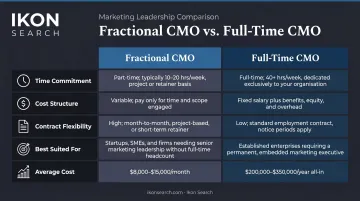
Fractional CMO vs. Full-Time CMO
Most business owners assume fractional is simply a cheaper version of full-time. That framing misses the point — they serve different organizational needs at different stages.
| Dimension | Fractional CMO | Full-Time CMO |
|---|---|---|
| Time commitment | Set hours per week or month | 40+ hours/week |
| Cost structure | Hourly, retainer, or project-based | Salary + benefits + equity |
| Contract flexibility | Short or long-term, adjustable | Permanent headcount |
| Best suited for | SMBs, startups, trigger events | Enterprise, complex orgs |
| Average US salary cost | Significantly lower | ~$373,841/year |
If your current volume of strategic marketing work doesn't justify a full-time executive's calendar, fractional is the smarter allocation — you get the same caliber of leadership at a fraction of the overhead.
Signs Your Business Is Ready to Hire a Fractional CMO
Research from Constant Contact found that 73% of small businesses lack confidence in the effectiveness of their marketing strategy. That statistic points to a leadership gap, not an effort gap.
Here are the clearest signals that a fractional CMO is what you actually need:
- Campaigns feel disconnected. Results are inconsistent, and no one owns the overall direction. Individual contributors are working hard — just without a unified plan.
- Growth has stalled despite an active team. Mid-level marketers execute tactics well. What they typically can't do is build a scalable strategy, make budget trade-off decisions, or align marketing with broader business objectives. Companies often assume this is a budget problem — it's usually a leadership problem.
A trigger event is approaching. These are the moments that create specific, time-bounded demand for senior marketing leadership:
- Product launch or new market entry
- Upcoming investment round or acquisition
- Rebrand or significant positioning shift
- Surge in competitive pressure
The business meets the prerequisites. A fractional CMO can only deliver if certain conditions are in place:
- Executional staff already exists (someone to lead)
- A meaningful marketing budget is committed
- Product-market fit and target customer are reasonably clear
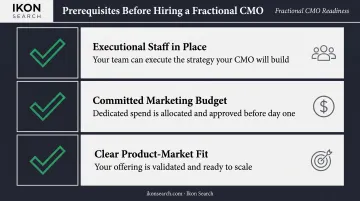
If these aren't in place yet, build the foundation first. Hiring a fractional CMO too early burns budget on strategy without the infrastructure to execute it. Once those conditions are met, the next step is knowing where to find the right person — and what to look for when you do.
How to Hire a Fractional CMO: Step-by-Step
Step 1 — Define Your Marketing Objectives
Before you post anything or reach out to anyone, get specific about the problem you're hiring to solve. "We need better marketing" is not a mandate. "We need to build a lead generation engine for our enterprise sales team ahead of a Q4 product launch" is.
Vague briefs lead to mismatched candidates and failed engagements. The clearer you are upfront, the faster a qualified candidate can assess whether they're genuinely the right fit.
Step 2 — Set a Realistic Budget
Fractional CMO engagements are typically structured as hourly rates, monthly retainers, or project-based fees. Rates vary by experience, industry, and scope — but the relevant comparison point is a full-time CMO salary that can approach $375,000 annually, before benefits and equity.
Even a senior fractional engagement at a meaningful retainer leaves budget to fund the execution team that actually carries out the strategy. Understand that trade-off before you anchor on a number.
Step 3 — Decide Where to Search
Three sourcing channels are worth using, and they're not equally effective:
- Professional networks (LinkedIn) — Good for initial research, less effective for finding senior candidates who aren't actively looking
- Referrals from trusted advisors — High signal, but limited by the size of your network
- Specialist executive search firms — The most reliable channel for accessing pre-vetted, passive senior talent
Passive candidates with real track records rarely surface through job postings. Boutique firms like Ikon Search maintain curated networks of senior marketing talent and typically present qualified candidates within days, not weeks. For urgent needs or niche industry requirements, that speed and curation become real advantages.
Step 4 — Evaluate Candidates Rigorously
Assessing a fractional hire is different from a full-time search. You have less runway to course-correct, so the evaluation needs to be sharper.
Focus on:
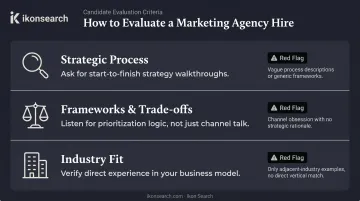
- Ask candidates to walk through how they've built marketing strategy in a comparable business context, start to finish — not just list titles and companies
- Listen for frameworks, trade-offs, and prioritization. Heavy focus on channels and deliverables signals an executional mindset, not a strategic one
- Verify industry fit specifically. A CMO with deep B2B SaaS experience may need real adjustment time to operate in financial services or insurance
Step 5 — Set Expectations Before Day One
Define the following before the engagement begins:
- Specific KPIs and how they'll be measured
- Reporting cadence (weekly check-ins, monthly reviews)
- What a successful first 90 days looks like
- Decision-making authority and reporting structure
Without this, even a highly skilled fractional CMO will spend their early weeks figuring out what success means instead of delivering it.
Step 6 — Structure a Productive Onboarding
A strong first 30 days should include:
- Map the existing marketing team: who's there, what they own, and where the gaps are
- Audit current and past campaigns to identify what's worked and what should be cut
- Provide real budget figures and performance data — not executive summaries
- Deliver a ranked action plan for the first quarter before week four
Give them access to stakeholders, honest performance data, and existing campaign metrics from day one. A fractional CMO kept out of the real picture can't deliver an accurate diagnosis.
What to Look for in a Fractional CMO
Proven Strategic Leadership (Not Just Execution Experience)
The candidate should be able to point to businesses they've scaled — not campaigns they've managed. Look for evidence of building marketing strategy, leading teams, and owning outcomes at the organizational level. HBR notes that effective fractional senior leaders blend strategic and functional leadership with a hands-on approach. Test candidates specifically for that combination — not just one or the other.
Relevant Industry or Business Model Experience
A fractional CMO who built their career in consumer packaged goods will face a genuine learning curve in B2B financial services. Buyer behavior, sales cycle length, regulatory constraints, and channel mix differ enough that relevant experience helps them contribute faster and with less ramp-up.
When evaluating candidates, prioritize those with direct experience in your business model — whether that's SaaS, ecommerce, fintech, or PE-backed growth — because generalist experience rarely transfers cleanly across these contexts.
A Defined Methodology
Strong fractional CMOs don't improvise. They bring a repeatable framework for diagnosing problems, setting priorities, and measuring progress. Ask candidates directly: "Walk me through your process for the first 60 days in a new engagement." If the answer is vague or campaign-focused, keep looking.
Cultural and Leadership Fit
A fractional CMO will need to earn trust quickly from your internal team. Assess:
- How they communicate under ambiguity
- Whether their decision-making style matches your organization's
- How they've handled friction with leadership in past engagements
Verifiable References
Always speak with prior clients. Ask three specific questions:
- What did they change that wasn't working before they arrived?
- What was measurably better after their engagement?
- Would you bring them back for the next stage?
Common Mistakes to Avoid When Hiring a Fractional CMO
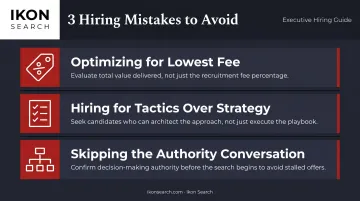
Most hiring missteps with fractional CMOs fall into three predictable traps. Knowing them upfront saves budget, time, and a lot of internal friction.
- Optimizing for the lowest fee. A cheaper engagement that lacks strategic depth costs more in wasted budget and missed growth than a well-scoped retainer with the right person. Fractional CMOs are high-impact investments — the wrong frame is asking how little you can spend.
- Hiring for tactics instead of strategy. If the candidate talks primarily about campaigns, channels, and deliverables — rather than how they diagnose problems, set priorities, and lead teams — you may be hiring a senior contractor, not an executive. Forbes notes that fractional CMOs shouldn't be overloaded with day-to-day operational tasks; that confusion sets the engagement up to fail.
- Skipping the authority conversation. Failing to align on reporting structure and decision-making rights before the engagement starts creates friction fast. A fractional CMO without direct access to leadership — and real authority to act on their recommendations — will spend their hours navigating internal politics instead of driving results.
Frequently Asked Questions
How much does a CMO cost?
A full-time CMO in the US averages $307,000–$374,000 annually in base salary, before benefits and equity. Fractional CMO engagements are structured as hourly rates, monthly retainers, or project fees —at a fraction of that cost — making senior marketing leadership viable for companies that can't justify full-time executive headcount.
When should you hire a CMO?
Key signals: growth has stalled despite an active marketing team, no one owns the overall marketing direction, or a trigger event is approaching (product launch, funding round, rebrand, market expansion). You should also have execution staff in place and a committed marketing budget before the hire will pay off.
How do you hire a CMO?
Start by defining your marketing objectives and setting a realistic budget. Source candidates through professional networks, referrals, or a specialist search firm — vetting for strategic process and industry fit, not just titles. Lock in clear KPIs and a reporting structure before day one.
What's the difference between a fractional and a full-time CMO?
Time commitment and cost structure. A fractional CMO works a defined number of hours per week or month on a contract basis; a full-time CMO is a permanent headcount at executive salary. For businesses that need senior strategic leadership without permanent overhead, the fractional model is often the sharper fit.
How long does a fractional CMO engagement typically last?
Engagements range from a few months for a defined project to a year or more for ongoing strategic leadership. Some companies use fractional CMOs as a bridge while building toward a full-time hire; others maintain the arrangement long-term as the ongoing structure.