
A CFO is more than an accounting overseer. They lead financial planning and analysis (FP&A), manage investor relations, serve as the CEO's strategic counterpart, and build the financial infrastructure the business needs to scale or exit. Getting this hire right — timing, type, and candidate profile — can be the difference between controlled growth and costly chaos.
This article covers how to recognize the right moment to hire, how to choose between full-time and fractional arrangements, what to look for in candidates, how to run the search, and what it will cost.
Key Takeaways
- $10M–$25M ARR is the most commonly cited window for bringing on a first senior finance leader
- A VP of Finance is usually the right first hire; a full CFO title is typically warranted at $50M+ ARR
- Fractional CFOs work well for companies below $25M ARR or those navigating a near-term fundraise or M&A event
- FP&A backgrounds outperform pure accounting backgrounds for most growth-stage CFO roles
- Undefined success metrics and skipped reference checks are the fastest ways to derail a CFO hire
When Is the Right Time to Hire a CFO?
There's no single revenue threshold that triggers a CFO hire. Timing depends on complexity, growth rate, and what's actually keeping the founder up at night. That said, the data does point to common inflection points.
Bessemer Venture Partners' research shows that financial complexity typically surfaces around $5M–$10M ARR, with 37% of their CFO community identifying $10M–$25M ARR as the sweet spot for a first senior finance hire. SaaStr's guidance suggests a VP of Finance is sufficient from $2M to $20M ARR, with a full CFO often unnecessary until $50M+ ARR or IPO preparation.
Operational Signals That a CFO Is Needed
Revenue benchmarks are a starting point, not a decision framework. These operational signals are more reliable triggers:
- You're preparing for a fundraising round, Series A or beyond, and can't produce investor-ready models
- Accurate cash flow projections are no longer achievable with current resources
- You're entering new geographies, product lines, or managing multiple corporate entities
- An audit is imminent and your books aren't clean
- Your team is making capital allocation decisions based on gut, not data
The Cost of Waiting Too Long
The Theranos case remains the starkest example in CFO history. Theranos had only one CFO across its entire 15-year life — fired after just eight months for raising concerns about financial misrepresentation.
According to CFO Dive, investors went on to pour approximately $1.5 billion into the company despite the absence of a finance chief and revenue projections that bore no relation to reality. That's the measurable cost of a financial leadership gap — not a cautionary abstraction.
CFO vs. VP of Finance: Which Level Do You Actually Need?
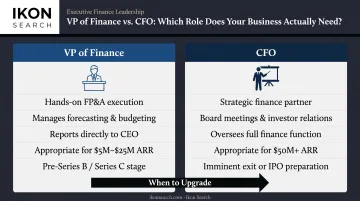
Many early-stage companies jump straight to the CFO title when a VP of Finance is the smarter first move.
| Role | Focus | When It's Right |
|---|---|---|
| VP of Finance | Hands-on FP&A, manages forecasting, reports to CEO, often has controller reporting in | $5M–$25M ARR, pre-Series B/C |
| CFO | Strategic partner, sits in board meetings, leads investor relations, oversees full finance function | $50M+ ARR, imminent exit, complex org structure |
CFOs also carry higher equity expectations and require larger supporting teams. Hiring that title prematurely leads to expensive underutilization and early turnover.
Full-Time CFO vs. Fractional CFO: Which Does Your Business Need?
A fractional CFO is a part-time or contract-based executive who provides C-suite financial leadership without the full-time cost. Engagements typically run 10–40 hours per month, billed hourly or on a monthly retainer.
Demand for this model has grown substantially. CFO Dive reports that by 2025, interim CFOs represented 51% of all C-suite leadership requests, with demand up 310% since 2020. This isn't a niche workaround — it's now a mainstream approach.
When Each Model Makes Sense
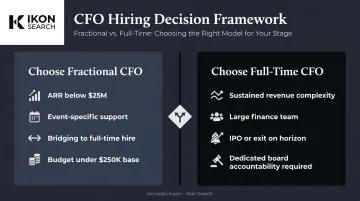
Choose a fractional CFO when:
- Annual recurring revenue is below $25M
- You need support for a specific event (fundraising round, M&A, audit preparation)
- You're bridging toward a full-time hire and need financial operations stable in the interim
- Budget doesn't support a $250K+ base salary
Choose a full-time CFO when:
- Revenue complexity is sustained and growing
- You have a large finance team that requires executive leadership
- An IPO, acquisition, or significant exit event is on the horizon
- Board accountability and investor relations demand a dedicated executive
The "Fractional First" Approach
One increasingly common approach: engage a fractional CFO during the search for a permanent hire. This keeps financial operations running, surfaces the gaps a full-time hire will need to address, and lets the incoming CFO inherit a cleaner financial infrastructure — rather than stepping into disorder.
Beyond operational continuity, contract and temp-to-hire arrangements let you evaluate a candidate's actual fit before committing to a permanent role. That flexibility reduces the risk of a costly mismatch.
What to Look for When Hiring a CFO
Accounting vs. FP&A Background: Which Matters More?
The finance function splits cleanly into two orientations:
- Controllership — backward-looking, accuracy-focused, accounting-oriented. Think closing the books, audit preparation, financial controls.
- FP&A — forward-looking, strategic, modeling-oriented. Think cash flow forecasting, scenario planning, board presentations.
For most growth-stage businesses, FP&A skills matter more in a first senior finance hire. Bessemer notes that candidates with pure accounting backgrounds often struggle with the ambiguity and imperfect-information decisions that define strategic finance. The most effective CFO backgrounds for growth-stage companies typically include investment banking, management consulting, or business operations (BizOps) — all roles that combine financial modeling with communicating insights to non-finance stakeholders.
Key Traits and Competencies to Evaluate
Those background patterns translate into a concrete set of skills worth evaluating in every candidate. Hard skills — non-negotiable:
- Financial forecasting and multi-scenario modeling
- Cash flow management and working capital optimization
- Budgeting and resource allocation
- Risk analysis and compliance awareness
- Investor relations and board communication
- Familiarity with ERP systems and financial technology
Soft skills and leadership traits:
According to Wharton Executive Education research, CEOs and boards consistently rank these traits above technical credentials:
- Synthesizes data across the business to build a credible long-term path forward
- Challenges leadership with data-driven perspectives, not just reporting
- Translates financial complexity clearly for non-finance audiences
- Maintains integrity under pressure and board scrutiny
Industry-specific experience matters more than most hiring teams realize. A CFO who has operated in financial services, insurance, or technology will understand sector-specific unit economics, regulatory constraints, and investor expectations better than a generalist.
For PE-backed companies especially, that difference often determines whether the first year goes smoothly. Russell Reynolds data shows PE portfolio CFO average tenure is just 2.5 years versus 5.6 years for public-company CFOs — a gap that stems largely from poor fit and misaligned expectations at hire.
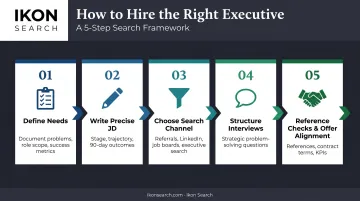
How to Run Your CFO Search: A Step-by-Step Process
Step 1 — Define needs before searching
Document the specific problems you need solved. What's broken or missing? What does the role own in year one? Is industry experience mandatory or preferred? What's the reporting structure, and what does success look like at 90 days?
Step 2 — Write a precise job description
Go beyond listing duties. Specify the company's stage, growth trajectory, team the CFO will oversee, and concrete 90-day outcomes. Vague job descriptions attract generalists. Precision attracts the right candidate and repels poor fits before they apply.
Step 3 — Choose your search channel
Options include:
- Peer and investor referrals (highest signal, slowest reach)
- LinkedIn and professional networks (broad, requires heavy filtering)
- Finance-focused job boards
- Executive search firms specializing in finance placements
For PE-backed firms or companies with specialized sector needs, an executive search firm with deep industry networks shortens time-to-shortlist and reduces the risk of a costly mis-hire. Firms like Ikon Search — whose founding team brings 25+ years of executive search experience across financial services, insurance, and technology — offer engagement models ranging from retained search and full-time permanent to contract and temp-to-hire, so clients can match the search structure to their actual situation.
Once the channel is set, how you run the interviews determines whether you identify the right person or simply the most polished one.
Step 4 — Structure interviews around strategic problem-solving
Avoid résumé walkthroughs. Instead, ask:
- "Walk me through how you improved cash flow at a previous company."
- "Describe a time you challenged a CEO or board with data that contradicted their assumptions."
- "How have you prepared a company for an investment round or exit?"
If evaluating fractional candidates, probe specifically on how they manage multiple client relationships and prioritize when demands conflict.
Step 5 — Conduct thorough reference checks and align on expectations before signing
Call references with focused questions about how the candidate worked with non-finance executives, how they handled disagreement, and whether they delivered on commitments. Before extending an offer, lock in contract length, reporting structure, scope, equity terms if applicable, and measurable success metrics for the first 90 days.
How Much Does It Cost to Hire a CFO?
Full-Time CFO Compensation
Robert Half's 2026 Salary Guide projects U.S. CFO base salaries ranging from $195,500 to $321,750, with a midpoint of approximately $269,750. This excludes bonus and equity.
For PE-backed companies, compensation scales significantly. Vardis research on PE portfolio companies reports CFO mean base salaries ranging from $286,000 (companies under $100M revenue) to approximately $471,000 (companies over $1B revenue), with target bonuses of 40%–70% of base.
CFOs also expect meaningful equity participation — factor this into your total package budget before extending an offer.
Fractional CFO Cost
Fractional CFO engagements typically look like this:
- Hourly rate: $175–$450, depending on experience and scope
- Monthly hours: 10–40, varying by intensity of involvement
- Annual cost: A fraction of a full-time package — often under $100K
For companies generating under $10M in revenue or not yet ready to justify a $300K+ executive salary, a fractional CFO delivers strategic finance leadership at a manageable cost.
Cost as Investment, Not Expense
A CFO who prevents a poor capital allocation decision, tightens cash flow management before a fundraising round, or surfaces a cost-saving opportunity can generate returns that dwarf their compensation within the first year.
A CFO who prevents a poor capital allocation decision, tightens cash flow management before a fundraising round, or surfaces a cost-saving opportunity can generate returns that dwarf their compensation within the first year.
Deloitte's research on capital allocation confirms that companies allocating capital well are long-term value creators — and that most CFOs have more room to improve in this area than they currently use.
Common Mistakes to Avoid When Hiring a CFO
Three mistakes account for the majority of failed CFO hires — and all three are avoidable.
Hiring on cost rather than fit. The cheapest option or the fastest hire under pressure rarely works out. Cultural alignment, industry experience, and strategic mindset matter as much as credentials. A mismatched CFO who exits after 18 months costs far more than a deliberate search process.
Overloading the CFO with controller-level work. Assigning a CFO to close the books, manage payroll, or handle basic compliance reporting wastes expensive strategic capacity and leads directly to turnover. If your business needs someone to manage the books, hire a controller or bookkeeper — then bring in the CFO to lead strategy.
Skipping reference checks or failing to define success upfront. Without clear KPIs, defined scope, and agreed-upon reporting expectations, even a strong CFO can underperform. Russell Reynolds notes that first-year CFOs often struggle when they arrive with preconceived assumptions and no structured onboarding to calibrate against reality.
Frequently Asked Questions
How much does it cost to hire a CFO?
Full-time CFO base salaries in the US typically range from $195,500 to $321,750, plus bonus and equity. Fractional CFOs generally bill $175–$450 per hour, with most engagements running 10–40 hours per month. Costs vary by company stage, industry, and scope.
How do you hire a good CFO?
Define your needs precisely before searching, prioritize FP&A and strategic finance skills alongside relevant industry experience, and conduct structured problem-solving interviews rather than résumé reviews. Executive search firms or strong referral networks significantly improve access to qualified passive candidates.
Is a CFO worth it for a small company?
Yes — fractional arrangements make CFO-level expertise accessible without the full-time cost. Even at early stages, financial leadership helps avoid costly mistakes, tighten cash flow management, and prepare the business for investment or growth.
What is the difference between a CFO and a VP of Finance?
A VP of Finance owns FP&A and day-to-day financial reporting directly. A CFO is a strategic executive who runs board meetings, manages investor relations, and oversees the entire finance function — a role most companies grow into after establishing VP-level finance leadership.
Should I hire a full-time or fractional CFO?
Below roughly $25M ARR — or with a near-term need like fundraising or M&A — a fractional CFO is usually the right call. Companies with sustained operational complexity, a large finance team, or an imminent exit event warrant a full-time hire.
What background should a CFO candidate have?
For growth-stage companies, prioritize FP&A-oriented backgrounds — investment banking, management consulting, or BizOps — over pure accounting profiles. Industry-specific experience matters most in financial services, insurance, and technology, where regulatory and business-model nuance runs deep.