Introduction
Most recruitment agencies approach social media the same way: post a few job listings, go quiet for two weeks, share a company milestone, repeat. Then wonder why nobody's calling.
The problem isn't effort — it's the absence of strategy. Clients and candidates are evaluating your agency on social media before they ever pick up the phone. A sparse, inconsistent profile signals exactly what you don't want it to: that you're not the expert they need.
According to the 2024 Employ Recruiter Nation Report, 71% of recruiters and talent acquisition teams use or plan to use LinkedIn as a social recruiting channel, with Facebook at 65% and Instagram at 43%. Social media is no longer a secondary channel. It's where the market already is.
This guide walks through what it actually takes to turn your agency's social presence into a consistent source of client inquiries and candidate engagement — from choosing the right platforms to measuring what's working.
Key Takeaways
- LinkedIn is the primary platform for recruitment agencies in financial services, insurance, and technology
- Follow the 80/20 rule: 80% value-driven content, 20% promotional posts
- Individual recruiter profiles consistently outperform company pages on LinkedIn
- Passive candidate nurturing depends on sustained consistency, not sporadic activity
- Track inbound leads and referral traffic — not just likes and follower counts
Why Recruitment Agencies Can't Afford to Ignore Social Media
The Way Buyers Evaluate Agencies Has Changed
Before a CFO at a PE-backed firm or a Head of Talent at an insurance carrier reaches out to a recruitment agency, they've already looked at the agency's social presence. Content quality, posting consistency, and the depth of commentary on industry-specific topics all factor into that first impression.
Research from MarketingProfs found that 60% of professional services buyers use social media to research potential providers before engaging them. That research predates the current social media environment — meaning the actual percentage today is almost certainly higher.
Agencies that post nothing, or only job listings, are invisible during that evaluation phase.
The Two-Sided Value Proposition
Social media works both sides of a recruitment agency's business simultaneously:
- Client side: Thought leadership content positions your agency as a sector expert, attracting inbound inquiries from companies actively looking for a hiring partner
- Candidate side: Consistent, niche-relevant content builds a warm pipeline of active and passive talent who recognize your firm when outreach lands in their inbox
Cold outreach is a 1:1 activity. A strong social media presence compounds — a post that performs well today can generate profile visits, connection requests, and inbound messages for weeks.
The Competitive Risk of Inaction
That compounding effect is precisely what creates a competitive gap. Agencies that consistently publish valuable, sector-specific content become the default choice in their audience's mind — particularly in verticals like insurance, financial services, and risk and compliance, where clients respond to demonstrated expertise rather than generic recruitment content.
Agencies without a social presence compete on price alone. When buyers can't evaluate your expertise through content, the only differentiator left is your fee.
Choosing the Right Platforms for Your Recruitment Agency
LinkedIn First — Always
LinkedIn has 1.3 billion members across 200+ countries, and it remains the dominant platform for professional recruitment. For agencies placing mid-to-senior talent in financial services, insurance, technology, or compliance, there's no closer second.
LinkedIn serves three functions for a recruitment agency:
- Client acquisition through thought leadership and company visibility
- Candidate sourcing through direct search and outreach
- Brand building that differentiates the agency from generalist competitors
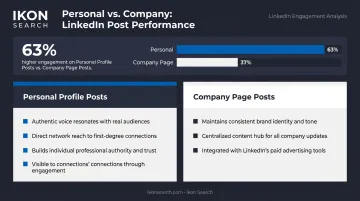
One critical point: Metricool's 2026 LinkedIn study found that personal profiles generate 63% higher engagement than Company Pages, based on analysis of over 673,000 posts. For Ikon Search, this means Connor Brown posting about the MGA market or Kristin Lutz sharing insights on contract workforce trends will outperform the company page alone. Both should be active.
Secondary Platforms Worth Considering
| Platform | Best Use Case for Recruitment Agencies |
|---|---|
| Instagram / Reels | Employer branding, agency culture, team content |
| TikTok | Reaching Gen Z talent; 46% of Gen Z has secured a job via the platform (SHRM, 2025) |
| X (Twitter) | Real-time industry commentary, market trends |
| Niche communities | Slack groups, Reddit, professional associations for specialist verticals |
Avoid the Spray-and-Pray Trap
Each of these platforms has a place — but only if you can maintain it. Creating accounts on every platform and posting inconsistently signals an unfocused brand. Start with one or two platforms, establish a rhythm, and expand once performance data justifies it.
For specialist agencies, LinkedIn's audience concentration is too strong to dilute by spreading effort across platforms your target clients don't use.
How to Build a Social Media Strategy for Recruitment Agencies
A strategy isn't a content calendar. It starts with understanding your current position, defining what success looks like, and then building the framework that gets you there.
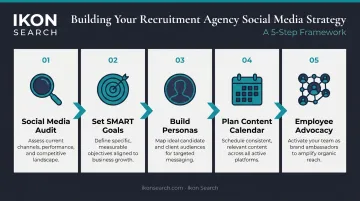
Step 1 — Conduct a Social Media Audit
Before creating anything new, assess what already exists:
- Which platforms are you currently active on?
- What content has generated the most engagement historically?
- Who is actually following you — and does that match your target audience?
- Is branding consistent across all profiles?
This baseline prevents wasted effort and reveals quick wins — like a high-performing post format you've abandoned, or a platform where your target audience is already engaged.
Step 2 — Set SMART Goals Tied to Business Outcomes
Social media goals must connect to real business results. "More followers" is not a goal.
Better examples:
- Generate 5 inbound client inquiries per quarter via LinkedIn
- Grow candidate pipeline in the Risk & Compliance vertical by 20%
- Increase LinkedIn Company Page followers by 50 per month while expanding into a new sector
Each goal should tie back to a specific agency priority — whether that's entering a new vertical, increasing contract placements, or deepening market share in financial services.
Step 3 — Build Candidate and Client Personas
Every content decision flows from knowing your audience — so build personas using CRM data, LinkedIn profile research, post-placement surveys, and recruiter knowledge. Each persona should capture:
- Job title and seniority level
- Industry and company type
- Core pain points (time-to-hire, candidate quality, market access)
- Platform preferences and content consumption habits
A Head of Talent at an investment bank and a senior insurance underwriter exploring options quietly need completely different messaging. Without that distinction, content defaults to generic — and generic gets ignored.
Step 4 — Plan a Content Calendar
With personas defined, you know who you're speaking to. A content calendar determines how often and where. Map content types to platforms, audiences, and business goals — and remove the daily decision of what to post.
Recommended posting frequency:
- LinkedIn: 3-5 times per week for strong results; weekly at minimum
- Instagram: 3-5 posts per week
- X: Daily or near-daily for commentary-driven engagement
LinkedIn's own data shows pages posting weekly have 5x more followers and 7x faster follower growth than monthly posters — a meaningful gap for agencies building an audience in competitive verticals.
Tools like Buffer, Hootsuite, and Later allow batch scheduling, so content can be prepared weekly rather than managed daily.
Step 5 — Build an Employee Advocacy Program
Individual recruiters' networks dwarf the reach of a company page. LinkedIn's employee advocacy research found that employee networks are at least 10x larger than company follower bases, and employee-shared content typically earns 2x higher click-through rates — numbers that haven't been structurally challenged by more recent platform behavior data.
In practice, this means:
- Training recruiters on LinkedIn best practices
- Making it easy to reshare company content with minimal friction
- Encouraging consultants to post their own placement wins, market observations, and candidate advice
- Using LinkedIn's built-in employee notification feature (available to Page admins, once per week per post)
The key is keeping it voluntary and genuine. A recruiter sharing a real observation about the compliance talent market carries more credibility than any company post.
Social Media Content Ideas That Drive Results for Recruitment Agencies
The 80/20 Content Rule
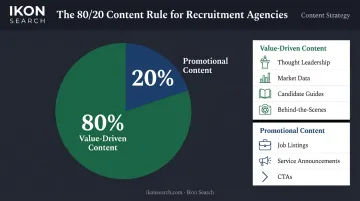
80% of content should deliver value. 20% can be promotional.
That means 80% of posts are insights, advice, market data, and commentary — content your audience would want to read even if they weren't actively looking to hire or be placed. The remaining 20% covers job listings, service announcements, and direct calls to action.
Agencies that invert this ratio — posting mostly job listings with occasional value content — see their engagement drop and their audiences disengage. Trust built through value-first content is what eventually drives inbound inquiries.
Content Formats That Actually Perform
Thought leadership posts are the highest-value content type for specialist agencies. A recruiter at Ikon Search posting observations about demand for AML compliance professionals in the current regulatory environment, or trends in MGA underwriting compensation, is producing content no generalist firm can replicate.
Other high-performing formats:
- Placement success stories — anonymized or with permission, framed around the challenge solved, not the self-congratulation
- Practical candidate guides — interview prep for insurance underwriters, what PE-backed SaaS firms look for in a CMO, how compliance professionals should position their regulatory experience
- Behind-the-scenes team content — brief, authentic posts that humanize the agency and attract top recruiter talent as much as clients and candidates
- Market data posts — compensation benchmarks, time-to-fill trends, talent availability by sector
Job Posts Done Right
Raw job listings rarely perform on social media. Add context:
- What's driving demand for this role right now?
- What makes this company an exceptional place to work?
- What does this opportunity solve for a candidate who's passively content in their current role?
A job post framed around a specific candidate pain point outperforms a copied-and-pasted job description every time. "If you're a compliance director who's been stuck in a process-heavy environment, this is the role to look at" speaks directly to someone — a generic listing speaks to no one.
Visual Content and Video
LinkedIn's own data shows video generates 5x more engagement than standard posts. Instagram Reels also consistently outperform static images — according to Socialinsider's 2024 benchmarks, median engagement runs 0.50% vs. 0.35% for static posts.
Authenticity matters more than production quality for recruitment content specifically. A recruiter sharing a genuine 60-second observation to camera about what they're seeing in the insurance hiring market will outperform a scripted brand video.
Content Repurposing
Once you've produced strong video or visual content, don't let it live on one platform. A single compensation benchmark or market observation can become:
- A LinkedIn long-form post
- An Instagram carousel
- A short video clip
- An X thread
One insight, four pieces of content. For lean specialist teams managing multiple verticals, this approach keeps output consistent without requiring a dedicated content department.
Using Social Media to Attract and Nurture Passive Candidates
Why Passive Candidates Matter Most
Passive candidates — professionals not actively job-searching but open to the right opportunity — represent the most valuable segment of the talent market. Typically employed, high-performing, and selective — they're also not browsing job boards.
LinkedIn data shows that 36% of workers are actively looking for new roles — meaning the majority of the workforce can only be reached through channels they're already using professionally, not job application flows.
For Ikon Search's verticals — senior underwriters at carriers, compliance directors at hedge funds, IT infrastructure leads at Series B firms — passive candidates are the norm, not the exception.
The Nurturing Model
The goal isn't to convert a passive candidate with a single post. It's to be recognizable when they're ready to move.
A consistent content strategy does this by keeping your agency top-of-mind through repeated, relevant touchpoints. When a senior insurance professional sees your commentary on MGA market dynamics every week for three months, and then receives a personalized connection request with a relevant insight attached, the response rate climbs sharply compared to cold outreach with no prior relationship.
Practical tactics:
- Comment meaningfully on passive candidates' posts (don't just like)
- Send connection requests with a specific, relevant observation — not a generic template
- Share content that speaks directly to career-stage concerns (advancement, compensation, market timing)
Paid Social for Passive Candidate Reach
Organic touchpoints build familiarity — but for hard-to-source roles, paid reach accelerates that process. LinkedIn Sponsored Content allows targeting by job title, seniority, industry, company, and years of experience — meaning a campaign for a Risk Director role can reach exactly the right audience, even if they're not actively searching.
Meta's employment ad category applies targeting restrictions for job-related ads in the US and Canada, making LinkedIn the more practical choice for specialist role campaigns in the US.
Measuring Social Media ROI for Your Recruitment Agency
Vanity Metrics vs. Meaningful KPIs
Likes and follower counts are easy to track — but they rarely connect to revenue. Focus on metrics that reflect actual business outcomes.
Meaningful KPIs to track:
| Metric | What It Tells You |
|---|---|
| Website referral traffic from social | Whether content is driving interest in your full service offering |
| Inbound client inquiries attributable to social | Direct revenue impact |
| Candidate applications via social | Pipeline contribution |
| Engagement rate by content type | Which formats and topics resonate |
| Profile views after specific posts | Whether content is driving discovery |
Set up UTM parameters on all links in social posts so Google Analytics can attribute website visits and conversions to specific platforms and campaigns.
Review Cadence
- Monthly: Post-level performance review — identify which content types, topics, and formats are working, then prioritize those going forward.
- Quarterly: Goal-level KPI review — assess inbound lead targets and candidate pipeline growth by vertical, then adjust strategy accordingly.
The goal is continuous iteration. If your content mix isn't changing based on what the data shows, it will plateau.
Analytics Tools
- Native analytics: LinkedIn Analytics, Meta Business Suite, Instagram Insights for post-level performance
- Third-party tools: Buffer Analyze, Hootsuite Analytics, Sprout Social for cross-platform reporting and competitor benchmarking
- Google Analytics: For attributing website traffic and conversions back to social referral sources
Frequently Asked Questions
Which social media platform is best for recruitment agencies?
LinkedIn is the strongest platform for most agencies given its professional user base and its ability to target by job title, seniority, and industry. The right choice ultimately depends on your specialty — Instagram works well for employer branding, and niche communities (Slack groups, sector forums) are worth exploring for highly specialized verticals.
How often should a recruitment agency post on social media?
On LinkedIn, aim for at least 3-5 times per week — LinkedIn's own data shows pages posting weekly grow followers 7x faster than monthly posters. Consistency matters more than volume. One substantive post beats five filler posts every time.
What type of content works best for recruiting on social media?
Value-driven content — market insights, compensation data, sector-specific career advice — consistently outperforms promotional posts. Authentic testimonials and behind-the-scenes team content also perform well. Job listings should make up no more than 20% of your content mix.
How can recruitment agencies use social media to attract passive candidates?
Consistent, niche-specific content keeps your agency visible to professionals who aren't actively searching. Proactive engagement helps too: comment on their posts, send personalized connection requests, and run targeted LinkedIn campaigns that reach specific job titles and seniority levels.
Should recruitment agencies invest in paid social media advertising?
Yes, especially for specialist roles where the passive candidate pool is narrow. LinkedIn's targeting by job title, seniority, and industry makes it the most effective paid channel for professional recruitment. For hard-to-source positions, organic reach alone rarely moves the needle.
How do you measure social media ROI for a recruitment agency?
Track inbound lead inquiries, website referral traffic from social, and candidate applications generated via social — not just engagement metrics. Add UTM parameters to all social links and connect them to Google Analytics to tie results back to specific platforms and campaigns.