

Headhunter fees for a CMO search are a real investment. Most companies have a rough sense of the percentage range but underestimate the total dollar figure, misread the fee models, or choose a firm based on price alone. All three mistakes are expensive.
This article covers what CMO headhunter fees actually look like in 2025, the three fee models in play, the factors that move costs up or down, and what most companies overlook when building their search budget.
Key Takeaways
- CMO headhunter fees typically range from 20% to 35% of first-year total compensation, with retained searches for senior roles landing toward the higher end
- The fee model — retained, contingency, or container — determines your upfront cost, firm commitment, and search depth
- Total compensation (not just base salary) is the fee calculation base, often adding $50,000–$100,000+ to the final fee
- A failed C-suite hire costs 3–5× annual salary, making the search fee an investment in getting it right the first time
How Much Does a CMO Headhunter Charge?
CMO headhunter fees don't follow a fixed price. They vary based on the firm type, the CMO's compensation structure, and the complexity of the search. That variability is wide enough to meaningfully change your budget — so it's worth understanding before you engage anyone.
Typical Fee Ranges
Here's how the market breaks down across three tiers:
| Search Type | Typical CMO Package | Fee % | Approximate Fee Range |
|---|---|---|---|
| Contingency / entry-level | $150K–$200K base | 20–25% | $30K–$50K |
| Mid-range / boutique retained | $200K–$300K total comp | 25–30% | $50K–$90K |
| High-end / large firm retained | $350K–$500K+ total comp | 30–35% | $105K–$175K+ |
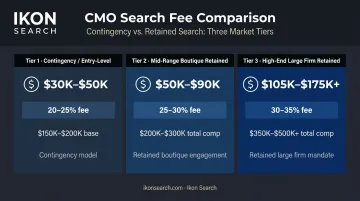
Contingency searches carry no upfront cost, which is appealing — but you pay for it in recruiter attention. Firms running contingency work multiple roles simultaneously, so yours competes for time alongside others in the queue.
Mid-range retained search is the most common model for growth-stage companies and PE-backed firms placing their first or second CMO. The firm works exclusively on your role — no competing assignments — which typically produces a stronger shortlist faster than contingency.
High-end retained searches are built for enterprise CMO roles with complex equity or bonus structures. You're paying for the deepest talent networks and the most rigorous candidate screening, which is appropriate when the cost of a bad hire runs into the millions.
Beyond the tier you choose, knowing exactly what those fees include — and don't — prevents budget surprises once you're mid-search.
What These Fees Typically Cover (and What They Don't)
Usually included:
- Role definition and needs analysis
- Talent mapping and market research
- Proactive outreach to passive, non-job-seeking candidates
- Candidate assessment (skills, leadership style, cultural fit)
- Shortlist presentation with candidate profiles
- Interview coordination
Often billed separately or excluded:
- Psychometric or third-party leadership assessments
- Relocation-related costs
- Job board advertising (where applicable)
- Extended post-placement onboarding support
Ask explicitly what's in scope before signing any engagement letter. Firms vary on these line items — confirm the full scope in writing before you commit.
The Three CMO Headhunter Fee Models
The fee model shapes the firm's commitment, urgency, and accountability — not just the price. Here's how each works in practice.
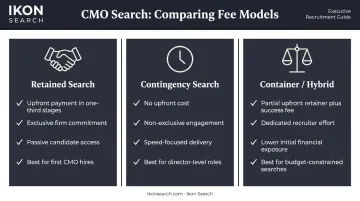
Retained Search
With retained search, you pay a portion of the fee upfront — typically one-third at engagement, one-third when qualified candidates are presented (usually 30–60 days in), and the final third at offer acceptance. The firm works exclusively on your role.
This model gives you dedicated recruiter time and, critically, access to passive candidates who aren't browsing job boards. According to the AESC, executive search consultants focus specifically on accessing senior executives who may not be actively looking — which is exactly where most strong CMO candidates sit.
Best for: Companies hiring their first CMO, PE-backed portfolio companies with a defined growth mandate, or any situation where the role is strategic and urgency is high.
Contingency Search
No upfront cost. The firm is paid only when a candidate is successfully placed. The appeal is obvious — but contingency-model firms are typically running multiple searches at once, which means your role doesn't get exclusive attention.
The incentive structure also favors speed over depth. That can work for director-level roles with a broad, active candidate pool. It's a poor fit for senior CMO searches where passive candidate outreach is essential.
Best for: Director-level marketing roles or situations where the talent pool is active and well-documented.
Container (Hybrid) Model
A smaller upfront retainer combined with a success-based fee at placement. Both parties have financial skin in the game, but the client's upfront exposure is lower than a full retained engagement. Companies that want dedicated effort without committing to full retained terms get the structure of retained search at a lower initial cost.
The right engagement model depends on both budget and urgency. The calculus is different for a Series B company making its first CMO hire than for an established enterprise running a defined replacement search — and a good search firm will help you think through that distinction before structuring the engagement.
Best for: Companies that want dedicated search effort but have upfront cost constraints, or where the search parameters are still being defined.
Key Factors That Affect CMO Headhunter Fees
The 20%–35% range is a starting point, not a fixed number. Several variables move the needle significantly.
CMO Compensation Package Size
Most firms calculate their fee on total first-year compensation — not base salary alone. That includes base, annual bonus targets, and signing bonuses.
A CMO with a $250K base, a 20% target bonus, and a $25K signing bonus represents a $325K compensation package for fee calculation purposes. At 30%, that's a $97,500 fee — versus $75,000 if you'd calculated only on base. That $22,500 difference shows up as a surprise if you didn't read the engagement letter carefully.
Always clarify what "total comp" means in writing before you engage a firm.
Role Complexity and Seniority
The more strategic the role — board-level interface, digital transformation mandate, large team ownership — the smaller the qualified candidate pool. Fewer qualified candidates means more outreach hours and a higher placement fee. A VP of Marketing search and a CMO search are not the same engagement, and the fee structure reflects that.
Firm Type: Specialist vs. Generalist
Boutique firms with a dedicated marketing or C-suite practice often charge comparable rates to large generalists — but the work looks different in practice:
- Specialist firms map the relevant candidate pool before the first call, assess compensation norms for the specific role, and evaluate cultural fit against your actual org structure
- Generalist firms may quote slightly lower rates but typically need more education on the CMO role's nuances, which typically slows the search and raises the odds of a misaligned shortlist
Industry and Geography
CMO searches in competitive talent markets — technology, fintech, SaaS, consumer brands — require more outreach effort. Salary.com reports the average U.S. CMO salary at $373,841, but that figure doesn't tell the full story. In SaaS or fintech, top-quartile CMO packages regularly exceed $500K in total comp — and thin talent pools in secondary markets can add weeks to the search timeline, increasing the scope (and cost) of the engagement.
Budgeting for a CMO Search: What Most Companies Overlook
The search fee is a bounded, known cost. But companies routinely underestimate the full budget picture. Here are the most common errors.
Calculating the fee on base salary only. As illustrated above, the difference between base-only and total-comp fee calculation on a typical CMO package can exceed $20,000. Read the engagement letter definition of "total compensation" before you sign.
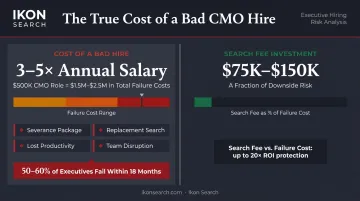
Ignoring the cost of a bad hire. SPMB estimates a failed executive hire costs 3 to 5 times annual salary — on a $500,000 executive, that's $1.5M to $2.5M in severance, replacement search costs, lost productivity, and team disruption. Meanwhile, Harvard Business Review reports that 50–60% of executives fail within 18 months of being hired or promoted. That context reframes a $75,000–$150,000 search fee as risk mitigation, not overhead.
Underestimating vacancy cost. An empty CMO seat stalls campaigns, delays product launches, and creates sales pipeline gaps. Every week that role sits open has a measurable cost. Firms with specialist marketing networks — Ikon Search, for example, targets a 2–3 day time-to-qualified-shortlist for senior marketing leadership roles — can close that gap far faster than a generalist firm building a candidate list from scratch.
Choosing on price, not fit. The lowest-fee firm isn't the best-value firm. Before committing, ask:
- How is the fee calculated, and on what compensation components?
- Who runs the search day-to-day?
- What does the vetting process include beyond resume review?
- What replacement protection is offered if the hire doesn't work out?
- How deep is the firm's network of passive marketing candidates specifically?
The right answers to those questions will tell you more about a firm's value than any fee comparison will.
Frequently Asked Questions
How much does a CMO headhunter charge?
CMO headhunter fees typically range from 20% to 35% of first-year total compensation. On a $250,000 total comp package, that's $50,000–$87,500. On a $400,000 package, it's $80,000–$140,000. Retained searches for senior CMO roles land toward the higher end of that range.
Is a retained or contingency model better for a CMO search?
Retained is generally the right model for CMO-level searches. It gives the firm exclusive commitment, access to passive candidates, and the time to run a thorough vetting process. Contingency works better for lower-seniority or high-volume roles where the candidate pool is active and broad.
What is included in a CMO headhunter's fee?
A full-service retained search covers role definition, talent mapping, outreach to passive candidates, structured vetting, and shortlist delivery. Add-ons like psychometric assessments or post-placement support are often billed separately — confirm scope before signing.
How long does a CMO executive search typically take?
Most CMO searches take 8–16 weeks, though specialist firms move faster. Ikon Search targets a qualified shortlist within 2–3 days of engagement and completes full CMO placements in as little as six weeks.
What is the real cost of a bad CMO hire?
A failed C-suite hire typically runs 3–5x annual salary — severance, a replacement search, lost productivity, and organizational disruption add up fast. On a $400,000 CMO role, that's $1.2M to $2M. The search fee is a small fraction of that downside.
Should I use a boutique or large executive search firm for a CMO search?
Boutique firms with a dedicated marketing or C-suite practice tend to deliver faster shortlists and stronger cultural alignment; large firms bring broader geographic reach. The deciding factor is usually how much deep marketing sector expertise matters for the role.