Introduction
Hiring the wrong person for a permanent role is expensive — and not just financially. According to SHRM, the cost of recruiting, hiring, and onboarding a single employee can reach $240,000. Beyond the dollars, a poor fit in a specialized or leadership position can damage team morale, disrupt client relationships, and trigger a costly restart of the entire search.
The stakes are highest for permanent hires, where the expectation is long-term commitment, deep expertise, and cultural alignment. A rushed or reactive process rarely delivers all three.
This guide breaks down how direct hire recruiting works, why it outperforms reactive hiring for permanent roles, and what to look for when choosing a recruiting partner — so you can make the right hire the first time.
Key Takeaways
- Direct hire recruiting places candidates as permanent employees on your payroll from day one — not the agency's
- Specialized recruiting firms access passive candidates that job postings never reach
- Replacing an employee costs 50% to 200% of their annual salary — direct hire done right reduces that cost significantly
- Direct hire fees are typically a one-time percentage of first-year salary, not an ongoing markup
- Sector-specialized firms fill niche roles faster and with stronger retention than generalist agencies
What Is Direct Hire Recruiting?
Direct hire recruiting is the process of filling a full-time, permanent position — either through internal efforts or a specialized recruiting firm — where the candidate joins the hiring company's payroll directly. From their first day, they are your employee, not the agency's.
This is the key structural distinction separating direct hire from temporary or contract staffing. In a temp arrangement, the worker is technically employed by the staffing agency for the duration of the assignment — the client company directs the work, but the agency handles payroll, benefits, and employment taxes.
In direct hire, those obligations transfer to the employer immediately upon placement.
When Companies Use Direct Hire
Direct hire is the right model when a role demands:
- Long-term commitment — the position needs someone invested in the company's future
- Specialized expertise — compliance, underwriting, financial risk, software engineering, or executive leadership
- Cultural alignment — where fit matters as much as technical skill
- Confidential outreach — replacing a sitting employee or filling a sensitive leadership role without signaling to competitors
Filling these roles often requires reaching candidates who aren't actively job hunting. A recruiting firm accesses passive talent pools — professionals who won't respond to a job board post but will engage with the right direct approach. That's a segment internal HR teams and general postings can't reliably reach.
How the Direct Hire Recruiting Process Works
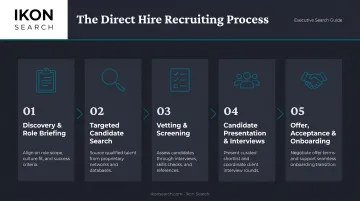
Step 1 — Discovery and Role Briefing
Every quality search starts with a detailed consultation. The recruiting firm needs to understand the role's technical requirements, compensation range, team structure, reporting lines, and company culture. This upfront investment is what separates a targeted search from a generic candidate dump.
Ikon Search, for example, conducts deep intake sessions with key stakeholders — including founders, GCs, and CPOs depending on the role — before activating their candidate network. The quality of the briefing directly determines the quality of candidates surfaced.
Step 2 — Targeted Candidate Search
Once the search parameters are set, the recruiting firm moves into active outreach — not just posting and waiting. This includes:
- Direct sourcing from proprietary candidate databases
- Competitor targeting and market mapping
- Outreach to passive candidates through existing professional relationships
- Industry network activation within specific verticals
This reach is what separates specialized recruiting firms from job board postings. Passive candidates — those currently employed and not actively looking — represent a significant portion of the most qualified talent in any field. That's precisely why most organizations turn to professional sourcing channels rather than relying on inbound applications alone.
Step 3 — Vetting and Screening
Rigorous screening keeps unqualified candidates off your interview calendar. A thorough vetting process includes:
- Resume and credentials review
- Skills and competency-based interviews
- Technical assessments where relevant
- Reference checks
For specialized roles, skipping any of these steps transfers the risk directly to you — resulting in bad hires that cost more to unwind than the search itself.
Step 4 — Candidate Presentation and Interviews
Rather than flooding clients with resumes, qualified recruiting firms present a curated shortlist — candidates who have already been vetted for both technical fit and cultural alignment. Firms with deep sector networks can move quickly. Ikon Search is built to present qualified candidates within 2–3 days for the right roles, backed by an active candidate network of 3,000–5,000+ professionals.
Step 5 — Offer, Acceptance, and Onboarding Transition
The recruiting firm supports offer negotiation, manages candidate communication through acceptance, and manages the handoff. From day one, the employee is on your payroll — not the agency's. Most direct hire agreements include a replacement guarantee period (commonly 60–90 days) that protects the employer if the placement doesn't work out within that window.
Key Benefits of Direct Hire Recruiting for Employers
Long-Term Workforce Stability
Permanent employees build institutional knowledge that contractors and temps simply don't accumulate at the same rate. They develop loyalty, understand organizational nuance, and deliver continuity — especially important in client-facing or operationally critical roles.
The financial case for getting this right is clear. Gallup estimates that replacing an employee costs one-half to two times their annual salary — and that voluntary turnover costs U.S. businesses $1 trillion annually. A durable placement isn't just a people win; it's a financial one.
Access to Passive Talent
The highest-caliber candidates in most professional fields are already employed. They're not refreshing job boards or updating their resumes — but they will respond to a compelling, well-targeted approach from a recruiter with a strong reputation and relevant opportunity.
Internal HR teams running job postings reach the active candidate pool. Specialized recruiting firms reach everyone else — and that access is where the real value lies.
Reduced Internal Hiring Burden
Running a rigorous search involves more work than most hiring managers anticipate:
- Sourcing and outreach across active and passive candidate pools
- Initial screening and skills qualification
- Coordinating interview schedules across stakeholders
- Managing candidate communication throughout the process
For companies without a dedicated recruiting function — or whose internal teams are already stretched — outsourcing this preserves bandwidth for the work that actually requires it.
Stronger Cultural and Long-Term Fit
Because direct hire searches are thorough and targeted, placements tend to align better with both the role and the organization's culture. That translates to lower early attrition — a common cost of rushed temp-to-hire conversions or reactive job-posting hires.
Confidentiality When Needed
Recruiting firms can conduct discreet searches when the situation requires it — replacing a sitting employee, filling a sensitive executive role, or when a company doesn't want to signal strategic moves publicly. This is difficult to achieve with job postings and nearly impossible with internal HR processes alone.
Direct Hire vs. Temporary Staffing: Key Differences
The structural difference starts with who holds the employment relationship. In temporary staffing, the agency is the W-2 employer — as the American Staffing Association confirms, agencies pay wages, withhold employment taxes, and handle benefits for assigned workers. The client receives labor services without a direct employment obligation.
In direct hire, those obligations transfer immediately to the hiring company. The IRS is clear that direct employees require the employer to withhold and deposit income taxes, Social Security, and Medicare — a responsibility that begins on day one.
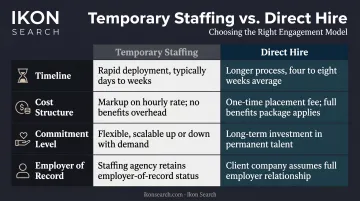
The table below compares both models across four key dimensions:
| Dimension | Temporary Staffing | Direct Hire |
|---|---|---|
| Timeline | Faster deployment | More thorough, better long-term results |
| Cost Structure | Ongoing agency markup on hours | One-time placement fee |
| Commitment Level | Flexible, short-term | Long-term organizational investment |
| Employer of Record | Staffing agency | Hiring company from day one |
The Temp-to-Hire Middle Ground
Temp-to-hire lets a company evaluate a contractor before committing to permanent employment — a sensible hedge when the fit is uncertain. The trade-off is real, though. High-caliber passive candidates — especially at the senior or specialist level — typically expect a direct offer. A contract-first arrangement can narrow the talent pool when other employers are competing with permanent positions from the start.
Key considerations when evaluating temp-to-hire:
- Candidate quality: Top passive talent often declines contract roles in favor of immediate permanent offers
- Role seniority: The more specialized the position, the more a contract-first structure may deter strong applicants
- Time sensitivity: Extended evaluation periods can cost you candidates who accept competing offers during the trial window
- Cultural fit risk: Delayed commitment can signal uncertainty to candidates, affecting early engagement and retention
When to Choose Direct Hire Recruiting
Clear Signals That Direct Hire Is the Right Call
- Internal recruiting capacity is stretched or absent
- Job postings are generating unqualified applicants
- A role has experienced repeated turnover
- The position requires specialized expertise — compliance, risk, financial analysis, underwriting, technology
- Confidential candidate outreach is required
Roles Best Suited for Direct Hire
Direct hire works best for:
- Executive and C-suite leadership — CEO, CFO, CRO, CCO, CTO, COO
- Financial services specialists — compliance officers, risk analysts, quantitative analysts, AML/financial crimes professionals
- Insurance professionals — underwriters (all levels), claims managers, program managers, CUOs
- Technology roles — software engineers, cybersecurity professionals, DevOps, cloud architects
- Communications and marketing leadership — CMOs, PR directors, digital marketing directors
High-Stakes Industries Where Direct Hire Matters Most
For companies in financial services, insurance, broker-dealers, PE-backed firms, and fintech, the cost of a wrong hire extends well beyond salary replacement. FINRA's Regulatory Notice 21-09 established specific rules addressing brokers with significant misconduct histories — confirming that hiring decisions in regulated environments carry direct compliance risk.
In compliance, risk, or supervision roles, a poor placement can trigger regulatory exposure, not just operational disruption. Direct hire gives organizations the vetting depth to avoid that outcome.
How to Choose the Right Direct Hire Recruiting Partner
Industry Expertise Matters
A generalist staffing firm can post to job boards and review resumes. A firm with vertical expertise in your sector can identify the right candidate before that person even considers looking. For specialized roles in insurance, financial services, or technology, sector depth determines the quality of the shortlist, not just its speed.
Ikon Search operates six specialized divisions, each led by practitioners with direct industry experience. The Insurance division, for example, has placed Chief Underwriting Officers, Senior Underwriters, GL Program Managers, and claims specialists across carriers, MGAs, and reinsurers — placements made through existing relationships, not retrofitted generalist profiles.
Evaluate Vetting Rigor
Ask every prospective recruiting partner the same questions:
- How many rounds of interviews do you conduct before presenting a candidate?
- Do you perform reference checks on every candidate?
- What technical or competency assessments are part of your process?
- How do you screen for cultural fit, not just credentials?
The quality of a firm's shortlist reflects the rigor of their screening. If they can't answer these questions specifically, the vetting isn't happening.
Understand Fee Structure and Guarantees
Direct hire recruiting fees are typically a percentage of the placed candidate's first-year salary. According to Staffing Industry Analysts, the most common direct hire fee is 20% of salary, with professional staffing firms ranging from 18% to 22% and dedicated direct hire firms typically charging 20% to 25%.
Most firms also include a replacement guarantee. Industry surveys suggest 90-day replacement guarantees are the most common, covering situations where a candidate departs or is terminated within that window due to fit, skills, or performance — not role eliminations or organizational restructuring.
Boutique vs. Large Agency
Understanding fee structure brings the agency-type decision into focus. The firm you choose shapes not just cost, but the quality of attention your search receives.
| Boutique Firm | Large Generalist Agency | |
|---|---|---|
| Attention per search | Senior recruiters on every role | Volume-driven, variable attention |
| Sector depth | Deep networks in specific verticals | Broad but shallow across industries |
| Candidate quality | Curated, vetted shortlists | Larger pipelines, less filtered |
| Relationship model | Consultative, long-term partnership | Often transactional |
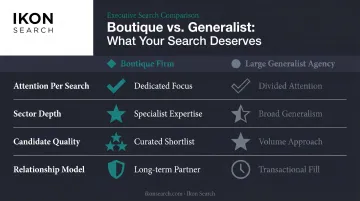
For specialized industries, the boutique model produces stronger results. Ikon Search's direct hire practice reflects this: division heads with 40+ combined years of experience, each running searches within their specific market rather than rotating across job categories.
Frequently Asked Questions
What does direct hire mean in recruiting?
Direct hire means a company brings on a candidate as a permanent, full-time employee — either through internal recruiting or via a recruiting firm — where the employee is on the hiring company's payroll from day one. The agency handles sourcing and screening but is not the employer of record at any point.
Which is better, direct hire or staffing agency?
Neither is universally better — it depends on the role. Direct hire suits permanent positions requiring long-term commitment, specialized expertise, or cultural alignment. Staffing agencies are better suited for temporary, seasonal, or short-term capacity needs. The right choice follows the nature of the work, not a default preference.
What is the 70/30 rule in hiring?
The 70/30 rule appears in two informal contexts: a passive-to-active candidate split (70% passive, 30% actively searching), or a framework weighting skills and experience at 70% against cultural fit at 30%. Neither has a single authoritative source, but both reflect legitimate considerations in professional hiring.
How much does direct hire recruiting cost?
Direct hire fees are charged as a one-time percentage of the placed candidate's first-year compensation — most commonly around 20%, with professional and specialized firms typically ranging from 18% to 25%. Most agreements include a 60–90 day replacement guarantee to protect the employer's investment if the placement doesn't succeed.
How long does the direct hire recruiting process take?
SHRM reports the average time to fill a role fell to 41 days in 2024, down from 48 days in 2023. Timelines vary by role complexity, seniority, and market availability. Firms with strong sector networks — including Ikon Search, which typically delivers qualified candidates within days of engagement — can compress this considerably.
What types of roles are best suited for direct hire recruiting?
Direct hire works best for permanent leadership positions, specialized roles in finance, compliance, insurance, and technology, executive-level searches, and any position where turnover has been a recurring problem. If long-term continuity and deep domain knowledge matter to the outcome, direct hire is the right model.