
Introduction
You're in back-to-back meetings until 4 PM. Your inbox has 200 unread emails. Three strategic priorities haven't moved in six weeks because every time you sit down to work on them, something more urgent pulls you away.
You've already hired a second executive assistant. You've added department heads. Nothing has fixed the core problem — every decision, every escalation, every cross-functional coordination still runs through you.
This is the moment most executives start asking about a Chief of Staff. According to McKinsey, about 75% of chiefs of staff support CEOs directly — a figure that reflects mounting pressure on senior leaders to execute at scale without losing strategic focus.
This guide covers everything you need to make a smart hire: what the role actually entails, when the timing is right, how it differs from an Executive Assistant, and how to run a process that surfaces the right person for your specific situation.
Key Takeaways
- A Chief of Staff extends executive capacity through strategic execution, not administrative support
- The right trigger isn't headcount — it's consistent bottlenecking on priorities that matter
- Define outcomes before writing the job description; vague roles attract the wrong candidates
- Evaluate transferable competencies; strong CoS candidates rarely carry the exact title
- Plan for a 2–3 year tenure from day one — build the role with a natural progression path in mind
What Does a Chief of Staff Actually Do?
The simplest way to frame the role: a Chief of Staff is a force multiplier. Their job is to extend your capacity by absorbing the strategic work that would otherwise pile up at your desk.
McKinsey's research shows the average CoS brings over 12 years of professional experience to the role — this isn't a junior position or an admin upgrade. It's a senior operator who works across the organization on your behalf.
Core Responsibilities
A well-scoped Chief of Staff typically handles:
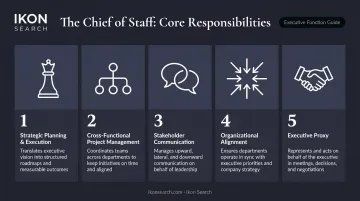
- Strategic planning and execution — translating priorities into actionable plans and tracking progress across teams
- Cross-functional project management — owning initiatives that cut across departments and don't naturally fit one functional owner
- Stakeholder communication — preparing the executive for key meetings, synthesizing information, and following up on decisions
- Organizational alignment — ensuring departments are moving in the same direction and flagging misalignment early
- Executive proxy — representing the CEO in select meetings or communications when presence isn't required
What a CoS Is NOT
Scope confusion is one of the most common reasons CoS hires fail. Be clear on these boundaries before you post the role:
- Not a glorified EA. Administrative tasks should represent less than 20% of the role. If the majority of your needs are scheduling and correspondence, an Executive Assistant is the right hire.
- Not a functional leader substitute. A CoS is not a Head of Operations, VP of Finance, or Chief People Officer. If you need someone to own a function, hire for that function.
- Not a catch-all for special projects. Without a clear mandate, the role becomes reactive and the CoS burns out fast.
How the Role Scales With Company Stage
The CoS role looks different depending on where your organization is:
| Company Stage | CoS Focus |
|---|---|
| Early-stage (20–75 employees) | Direct executive support, filling operational gaps |
| Scaling / hypergrowth | Org-wide strategy, cross-functional alignment, stealth COO |
| Enterprise | Specialized function within the Office of the CEO |
A Note on Tenure
McKinsey reports a median CoS tenure of 2.3 years — and approximately two-thirds are promoted after the role, often by more than one level. The CoS position is designed to be a developmental assignment, not a permanent seat.
Plan for this from the start. If your CoS moves into a functional leadership role in 2–3 years, that's the role working as intended — provided you build the succession plan into the original mandate.
When Should You Hire a Chief of Staff?
The core trigger isn't a headcount milestone. It's a consistent pattern of the executive being bottlenecked on work that actually matters.
Signals You're Ready
Ask yourself whether any of these are true right now:
- High-priority initiatives consistently miss deadlines because you haven't had time to unblock them
- Proposals and decisions sit in your queue for weeks without action
- Leadership meetings feel unfocused or unproductive — and no one is fixing that
- Cross-functional teams lack coordination because there's no connective tissue between them
- You're doing work you shouldn't be doing and you know it
If three or more of these describe your current situation, the problem is structural — and a Chief of Staff addresses the structure.
When It's the Wrong Move
Hiring a CoS is also the wrong decision in certain situations:
- Administrative gaps belong to an EA. Scheduling, travel, inbox management, and logistics don't require a CoS — they require an Executive Assistant.
- Functional gaps need functional leaders. If the work is ops or strategy execution at scale, a Head of Business Operations or VP of Strategy is the more direct hire.
- Vague scope produces a bad hire. Before posting the role, answer one question: What specific outcomes should this person achieve in the first 90 days? If the answer isn't clear, the role isn't ready.
Skipping that question has real consequences — a vague search attracts the wrong candidates, leads to a misaligned hire, and leaves a capable person without any clear mandate to succeed.
Chief of Staff vs. Executive Assistant: Knowing the Difference
This distinction gets blurred more often than it should, and the consequences are real — the wrong hire in the wrong role will underperform and likely leave.
The Core Difference
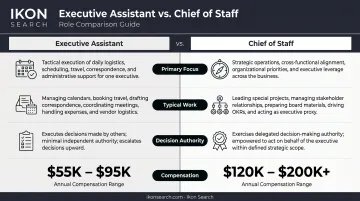
| Dimension | Executive Assistant | Chief of Staff |
|---|---|---|
| Primary focus | Logistics and administration | Strategy and execution |
| Typical work | Scheduling, travel, correspondence | Project ownership, cross-functional coordination |
| Decision authority | Manages information flow | Makes and communicates decisions |
| Compensation | $58K–$87K (Robert Half, 2026) | $167K–$229K+ (CoS Network / Salary.com, 2025–2026) |
A Practical Decision Rule
The table above clarifies the gap in scope — now apply it directly to your situation.
If 70% or more of the support you need is administrative, hire an Executive Assistant.
If 70% or more is strategic or operational, hire a Chief of Staff.
Some organizations need both — an EA for logistics and a CoS for strategy. Making this distinction before you start searching prevents scope creep and ensures each person can actually succeed in their role.
How to Define the Role and Write the Job Description
The CoS role is inherently fluid, which makes defining it before you hire critical. Without a clear mandate, you'll attract candidates who are wrong for what you actually need.
Use a Mission, Outcomes, and Competencies (MOC) Framework
Before writing the job description, answer three questions:
- Mission: What is this role ultimately responsible for achieving?
- Outcomes: What must this person accomplish in the first 12–18 months for the hire to be considered successful?
- Competencies: What skills, experiences, and ways of working are non-negotiable?
This framework, recommended by practitioners including a16z's operating team, anchors the job description in outcomes rather than activities. That distinction attracts stronger candidates and gives you a concrete evaluation rubric during interviews.
What a Strong Job Description Includes
- Clarifies reporting structure: the CoS reports to one executive (ambiguity here creates political problems fast)
- Defines Year 1 outcomes that are specific and measurable, not a generic list of duties
- States qualifications directly — most organizations require 7+ years in consulting, investment banking, operations, or business management
- Describes cultural and interpersonal fit: what does working closely with this executive actually require?
On Titles and Alternatives
"Chief of Staff" isn't the only option. Depending on your culture, consider:
- Executive Business Partner
- Special Assistant to the CEO
- Director of Business Operations
- Head of Strategic Operations
Getting the title right matters more than it sounds. Ikon Search works with financial services firms, PE-backed companies, and growth-stage organizations to benchmark CoS titles, validate role scope, and shape job descriptions that attract the right candidate pool from the start.
How to Source, Assess, and Interview Chief of Staff Candidates
Sourcing the Right Candidate
The most effective sourcing channels for a CoS search are:
- Internal development — nearly two-thirds of CoS hires come from within the organization, per McKinsey's data; high-potential employees with cross-functional exposure are strong candidates
- Trusted networks and referrals — the CoS hire is a high-trust relationship; warm introductions carry more signal than cold applications
- Boutique executive search firms — the right choice when you need access to candidates who aren't actively looking; firms like Ikon Search that focus on senior placements for financial services, PE-backed portfolios, and growth-stage companies bring pre-vetted networks that compress the search timeline significantly
- Specialized job boards — the Chief of Staff Network's job board and similar platforms attract candidates who actively identify with the function
Common CoS Candidate Archetypes
Don't anchor too hard on a specific background. Strong candidates come from varied paths:
- Consulting, investment banking, or PE — fast ramp, strategic thinking, comfortable with senior leadership
- Multi-role generalists with non-linear careers — breadth of exposure is an asset, not a red flag
- Former executive assistants or office managers — operational proximity to leadership, strong follow-through, underestimated in this market
- First operational hires at startups — startup fluency, high comfort with ambiguity
- Military, government, or public service — high emotional intelligence, disciplined execution, strong at building trust

Assessing Candidates
Because candidates come from such varied backgrounds, the title on the resume matters less than what's underneath it. Evaluate based on transferable competencies:
- Strategic thinking across complex, multi-stakeholder problems
- Cross-functional execution without direct authority
- Communication that works at every level of the organization
- Organizational savvy and political awareness
- Comfort operating in ambiguity with incomplete information
Structure your interview process around the outcomes defined in your mandate of clarity (MOC). Each stage should assess a specific competency — don't let conversations drift into generic territory.
Include at least one working session or case study. Watching a candidate think through a real problem under time pressure reveals more than any behavioral question. Use a consistent scorecard across all interviewers; without one, you end up comparing gut reactions rather than actual evidence.
On Chemistry and Trust
Treat this as a non-negotiable filter. The CoS will handle sensitive information, act as your proxy, and work at an unusually high level of proximity to your decision-making. If the dynamic doesn't feel right after a few conversations, resist the urge to rationalize past it. At this level, cultural fit is as predictive as competency.
Setting Your Chief of Staff Up for Success
A strong hire can still fail without a strong start. The first 90 days are where CoS relationships either take root or begin to fracture.
From day one:
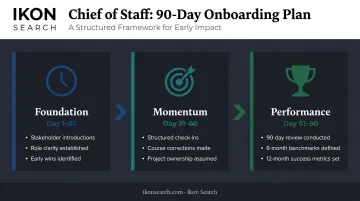
- Share a 30/60/90 plan that defines clear milestones, early wins, and appropriate guardrails
- Schedule structured check-ins — not just reactive meetings — so the CoS gets consistent feedback and early course-correction
- Define what success looks like at 6 and 12 months, tied directly to the scope of commitment outcomes established during hiring
The operational side is only half the picture. The relational groundwork matters just as much:
- Introduce the CoS to key stakeholders early and be explicit about their role and authority — a CoS who spends the first month re-justifying their involvement to every department head is burning critical momentum
- Begin planning the transition from day one — whether that's an eventual move into functional leadership or supporting the hiring of their successor, building this into the conversation early avoids surprises and keeps the CoS engaged
Onboarding a CoS well takes deliberate effort upfront. It also pays back quickly — in cleaner execution, faster decisions, and a leader who can hit the ground running rather than spending months finding their footing.
Frequently Asked Questions
How much does it cost to hire a Chief of Staff?
Compensation varies by company size, industry, and experience level. The Chief of Staff Network reports an average base salary of $167,954, while Salary.com's 2026 benchmark places the US average at $228,698, with a 25th–75th percentile range of $196K–$257K. Total compensation typically includes a cash bonus on top of base.
How do I hire a Chief of Staff?
Start by defining outcomes, then work through the process in sequence:
- Define the role's deliverables before writing a job description
- Build the JD around a clear mandate-outcomes-competencies (MOC) framework
- Source through networks and search firms alongside internal candidates
- Run a structured process that includes a case study or working session
- Onboard with a defined 30/60/90-day plan
What exactly does a Chief of Staff do?
A CoS extends the executive's capacity by managing strategic projects, driving cross-functional alignment, and serving as a trusted thought partner and proxy. Unlike an EA, the role is operational and strategic in scope — not administrative. Unlike a functional leader, the CoS acts across the organization rather than owning a single domain.
When should you hire a Chief of Staff?
Hire a CoS when the executive is consistently bottlenecked by operational demands and strategic priorities are stalling — and neither a department head nor an EA would solve the problem. The clearest test: can you articulate what this person should deliver in their first 90 days?
What's the difference between a Chief of Staff and an Executive Assistant?
An EA provides administrative and logistical support — scheduling, travel, correspondence. A CoS drives strategic execution and organizational alignment. If administrative needs dominate, an EA is the right hire. If strategic and operational needs dominate, hire a CoS.
What background should a Chief of Staff have?
Strong candidates come from consulting, investment banking, private equity, operations, or senior EA roles. What matters most is strong generalist thinking, clear communication across all levels, and the ability to operate decisively with incomplete information.