
The problem most CEOs and founders face isn't a lack of options. It's a lack of clarity. When should you hire? What background actually matters? How do you run the search without losing months to the wrong process?
This guide covers everything: what a GC actually does day-to-day, the signals that tell you it's time to hire, how to define the right candidate profile for your specific situation, and a step-by-step hiring process that works.
Key Takeaways
- 44% of CLOs rank advising the CEO as their single greatest organizational impact — the GC is a strategic partner, not a gatekeeper
- Timing is driven by legal complexity, not headcount — regulated industries and M&A activity accelerate the decision
- Define your GC archetype before sourcing — the right fit depends on your stage and biggest legal challenges
- 79% of CLOs globally report directly to the CEO — CFO reporting creates measurable governance risk
- A typical GC search takes 4 to 6 months; retained search consistently compresses that window
What Does a General Counsel Do?
The General Counsel (GC) is the company's most senior in-house attorney — principal legal adviser to the CEO, board, and executive team, and the owner of the company's overall legal strategy.
That last part matters. According to the ACC's 2025 CLO Survey, 44% of Chief Legal Officers identify advising the CEO and shaping business strategy as their greatest organizational impact. A further 70% manage at least two functions beyond legal — often risk, compliance, or ethics. This isn't a back-office role.
Day-to-Day Responsibilities
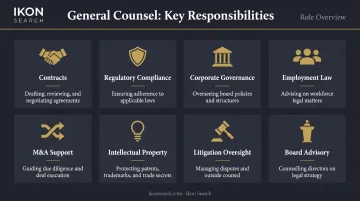
A GC's workload spans a wide range of functions:
- Contracts — drafting, negotiating, and managing commercial agreements
- Regulatory compliance — keeping the business on the right side of applicable law
- Corporate governance — supporting board processes and fiduciary duties
- Employment law — advising on HR matters, disputes, and policy
- M&A support — due diligence, deal structuring, and integration (58% of CLOs report heavy M&A involvement)
- Intellectual property — protecting proprietary assets and managing licensing
- Litigation oversight — managing outside counsel on disputes and claims
- Board advisory — 98% of senior in-house counsel carry formal board responsibilities
GC vs. Outside Counsel
The distinction is straightforward but critical. Outside counsel is reactive — you call them when something specific needs attention, and you pay by the hour.
An in-house GC is embedded. They know your business, your risk appetite, your contracts, and your team — and they're giving you continuous, proactive guidance that catches problems before they surface, not after. That's the difference between legal as a cost center and legal as a strategic function.
When Is the Right Time to Hire a General Counsel?
There's no universal employee-count trigger. Some companies bring in a GC at 50 employees; others wait until 200 or beyond. The decision hinges on the type, scale, and complexity of legal work your business generates — not the size of your headcount.
Key Inflection Points
Watch for these signals:
- Outside counsel costs are compounding. ACC benchmarking data shows average total legal spend running at 1.64% of revenue, with outside counsel accounting for 0.86%. When that outside spend becomes a recurring, growing line item, the ROI case for an in-house GC starts to close.
- Contract volume is accelerating. Enterprise SaaS companies closing complex deals with large customers, or any business managing dozens of vendor, partner, and employment agreements simultaneously, need continuous legal involvement — not ad hoc support.
- A major milestone is on the horizon. Series B or C fundraises, IPOs, acquisitions, and international market entry all require sustained legal engagement over months, not a few discrete conversations with outside counsel.
- You operate in a regulated industry. Fintech, insurance, biotech, and healthcare companies carry regulatory risk that must be embedded in strategy from an early stage. For these businesses, a GC often makes sense earlier than it would for a less regulated company.
If you recognize several of these signals but aren't yet ready to commit to a full-time hire, there's a middle path worth considering.
The Interim Option: Fractional GC
A fractional or outsourced GC provides senior legal counsel on a part-time basis, bridging the gap until the volume and complexity of work warrants a permanent role. Once outside counsel costs consistently exceed what a fractional arrangement would cost, or legal involvement becomes daily rather than weekly, that's typically the trigger to convert to full-time.
How to Define the Right General Counsel Profile
Before you source a single candidate, you need to define what kind of GC you actually need. The right fit depends entirely on your company's stage, industry, and most pressing legal challenges. Hiring the wrong archetype — even a highly credentialed one — is a costly mistake.
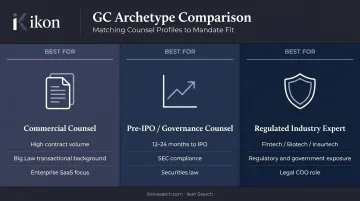
The Three GC Archetypes
The Commercial Counsel Best for enterprise companies with high contract volume and complex licensing arrangements. Typically comes from Big Law with a strong transactional background. Thrives building deal processes alongside finance teams and creating the contract infrastructure that scales with revenue growth.
The Pre-IPO / Corporate Governance Counsel Best for companies 12–24 months from a public offering. Brings experience with SEC compliance, securities law, and the governance infrastructure a public company requires. If you're on an IPO track, this is the archetype you need well before the roadshow.
The Regulated Industry Expert Best for fintech, insurtech, biotech, crypto, or defense companies. Often combines law firm experience with direct regulatory or government exposure. Acts as a legal COO, deeply embedded in the company's operational and regulatory strategy rather than sitting at arm's length from it.
Identifying the right archetype narrows the field — but it doesn't complete the picture. Every GC candidate, regardless of type, should clear the same baseline bar.
Core Competencies Every Candidate Should Have
Regardless of archetype, evaluate these universal qualities:
- Pragmatic risk tolerance : growth-stage companies can't afford a GC who treats every risk as a stop sign
- Business acumen : the ability to advise the CEO and board as a peer, not just as a legal technician
- Experience building or managing a legal function : a first GC hire who has never built a legal function from scratch will struggle to build yours
- Outside counsel network : the GC can't be an expert in everything, and their ability to pull in the right specialists at the right moment matters
According to ACC's Chief Legal Officer Survey, 59% of CLOs cite business acumen as a top skill gap on their teams — which tells you something about how often it's underweighted in the hiring process.
Communication skills deserve the same scrutiny as technical credentials. The ability to deliver honest, sometimes unwelcome legal guidance without derailing business momentum is non-negotiable. A GC who can't explain risk in plain terms loses the room. One who always says yes to avoid friction becomes a liability.
The Step-by-Step Process to Hire Your General Counsel
Step 1: Write a Mission–Outcomes–Competencies Document
Start by defining exactly what this GC is being hired to accomplish. Outline their mandate for the first 12–18 months — build a contracts function, prepare for IPO, manage a regulatory filing backlog — and define what success looks like in concrete terms.
Identify the non-negotiable competencies before you talk to a single candidate. This document drives every decision in the search. Without it, you're interviewing blind.
Step 2: Decide on Your Sourcing Strategy
You have several options:
- Internal referrals from board members and investors
- Legal-specific job boards and professional networks
- Retained executive search firms with demonstrated GC search experience
For senior legal hires, retained search typically produces a more targeted and confidential candidate pipeline than posting publicly. A firm like Ikon Search — with dedicated networks across financial services, technology, and insurance — typically delivers a qualified shortlist within 2–3 days, rather than the weeks most public searches require.
Step 3: Screen for Legal Expertise and Business Judgment
Assess whether candidates have actually advised C-suite leaders, managed outside counsel relationships, and navigated the specific legal challenges relevant to your industry. A polished resume won't tell you this. A strong legal background with no business-facing experience isn't the right fit for a GC seat.
Step 4: Structure the Interview Process Correctly
The CEO should lead, but loop in:
- 1–2 active board members — the GC will work with them directly
- The CFO — especially for financial compliance and M&A-related matters
- Head of HR — given the GC's role in employment matters and policy
Use scenario-based questions that probe risk tolerance, business prioritization, and how they've handled conflict between legal advice and business pressure. How someone navigates that tension tells you more than their credentials.
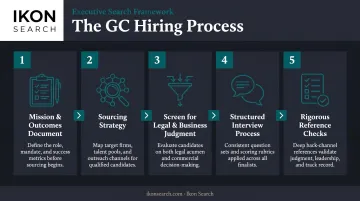
Step 5: Conduct Rigorous Reference Checks
Probe specifically for:
- How they handled delivering bad news to leadership
- How they managed board relationships
- Whether the legal function they built actually scaled with the business
Polished answers in an interview don't reveal the same things a candid reference will.
How Much Does a General Counsel Cost?
GC compensation includes three components:
- Base salary — the fixed cash component
- Performance bonus — annual cash tied to company or individual targets
- Long-term incentive or equity — stock, options, or phantom equity
The balance between these shifts significantly by company stage.
For context on the market: Equilar's 2025 report shows median GC compensation at large public companies rose from $2.8M in 2020 to $3.4M in 2024 — a 20.5% increase. BarkerGilmore's 2025 data puts top private-company GC pay near $3.3M and portfolio-company GC top pay at $2.8M.
These are large-company and top-of-market figures. For growth-stage and mid-market companies, the numbers are considerably lower — and equity becomes a larger share of the package as cash compensation decreases.
The Make-vs.-Buy Calculation
The right cost question is whether a full-time GC is cheaper than your current outside counsel spend. Using ACC's benchmark of 1.64% of revenue in total legal spend, companies can model what they currently pay in outside counsel fees against the fully loaded cost of an in-house hire (salary, benefits, equity).
When outside counsel costs are already significant and growing, the in-house ROI case becomes compelling faster than most founders expect.
Fractional GC arrangements offer a lower-cost entry point for companies not yet at that inflection point — run the numbers against your current legal spend before assuming a full-time hire is the only path forward.
Setting Your New General Counsel Up for Success
Get the Reporting Structure Right
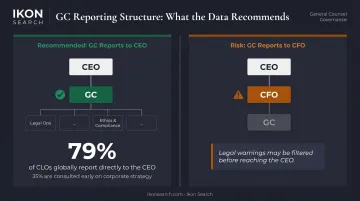
The GC should report directly to the CEO — not the CFO. ACC data shows 79% of CLOs globally (and 83% in the US) report to the CEO. The Harvard Law School Forum on Corporate Governance notes that when GCs report to CFOs, critical legal warnings can get filtered or deprioritized in favor of financial considerations.
Board access matters too. Research shows that GCs with formal board reporting relationships are significantly more likely to be consulted early on strategic decisions — 35% are almost always consulted early versus just 16.6% without board access.
Position the GC as a Strategic Partner from Day One
The GC can't do their job if they're only called in after something has gone wrong. Communicate clearly to the executive team that legal is a proactive resource — not a department you route paperwork through after decisions are already made. 66% of senior in-house counsel report being brought into business strategy decisions early; that number should be close to 100% for the decisions that matter most.
Plan for the Legal Team Build That Follows
Your GC search won't be your last legal hire. As the company grows, the GC will need to build out the function, typically adding:
Your GC search won't be your last legal hire. As the company grows, the GC will need to build out the function, typically adding:
- Associate and junior counsel to handle day-to-day legal volume
- Compliance professionals as regulatory obligations increase
- Legal operations staff to manage contracts, vendors, and internal workflows
If you used an executive search firm for the GC search, maintain that relationship. A firm that already understands your culture and legal function can shortlist qualified candidates days faster when you're ready to expand the team.
Frequently Asked Questions
Frequently Asked Questions
How much does a general counsel cost?
GC compensation varies by company stage and market, combining base salary, performance bonus, and equity or long-term incentives — with early-stage companies leaning more on equity and established ones weighting cash higher. The most useful benchmark: compare total GC cost against your current annualized outside counsel spend.
What does a general counsel do?
A GC is the company's chief legal officer: advising the CEO and board, managing contracts and regulatory compliance, overseeing litigation, and serving as a strategic partner on major corporate decisions. Most modern GCs also own at least one non-legal function, typically compliance or enterprise risk.
Should a general counsel report to the CEO or CFO?
The GC should report directly to the CEO. This is both the norm — 79% of CLOs globally follow this structure — and the better governance practice. CFO reporting risks filtering or deprioritizing legal concerns in favor of financial considerations.
When should a startup hire its first general counsel?
Common triggers include rising outside counsel costs, accelerating contract volume, preparation for a major fundraise or IPO, and operating in a regulated industry where legal strategy needs to be embedded — not bolted on later.
What is the difference between a general counsel and outside counsel?
Outside counsel is an external law firm engaged for specific matters on an hourly basis. A GC is an in-house executive embedded in the business — providing continuous, proactive guidance aligned with the company's day-to-day operations and long-term strategy.
How long does it take to hire a general counsel?
According to Spencer Stuart, a typical GC search takes 4 to 6 months from first meeting to accepted offer. Working with a retained search firm that already has an established legal network can compress that timeline considerably.