
Introduction
Most e-commerce startups don't stall because of a weak product. They stall because they hired the wrong person for the wrong role at the wrong time — and in a lean startup, that mistake compounds fast.
According to CareerBuilder data, a single bad hire costs an average of $14,900, and 74% of employers admit they've made at least one. For an early-stage team operating on a tight runway, that's a financial hit, weeks of lost momentum, a gap in a revenue-critical function, and the drain of starting the search over.
E-commerce hiring is especially unforgiving. Roles require platform-specific skills across tools like Shopify, Klaviyo, and Meta Ads. Demand spikes sharply around launches and peak seasons. And a vacant ops or marketing seat doesn't just slow growth — it can directly suppress revenue.
This guide covers which roles to hire first, how your strategy should shift by growth stage, how to vet candidates properly, and when bringing in a specialist recruiter is the faster, smarter path forward.
Key Takeaways
- Prioritize operations and performance marketing hires first — they protect revenue directly
- Match your hiring model — contract, temp-to-hire, or full-time — to your current growth stage
- Write specific job descriptions and use practical assessments — resumes overstate platform skills regularly
- Retained search becomes cost-effective once you're filling leadership roles where a wrong hire is catastrophic
- When recruiting exceeds 10 hours of founder time per week, bring in outside recruiting support
Why Hiring Looks Different for E-Commerce Startups
Unique Pressures on Early-Stage E-Commerce Teams
E-commerce hires aren't just marketing or operations generalists. They need to be platform-literate across an interconnected stack. A mis-hire in any of these areas means weeks of ramp time — and benchmarks that never get hit:
- A performance marketer who can't navigate Meta Ads Manager
- A Shopify developer who's never worked with Liquid templates
- An email hire with no Klaviyo experience
The talent gap is real. A report from the Economist Group and Digital Marketing Institute found that 74% of marketing executives believe their organizations face a critical talent shortage due to insufficient digital skills. Almost half planned to increase recruitment efforts as a direct response.
Then there's the volatility problem. Shopify merchants generated $14.6 billion in Black Friday/Cyber Monday sales in 2025, up 27% year-over-year. That kind of spike doesn't give you time to hire — it punishes you for not hiring ahead of it.
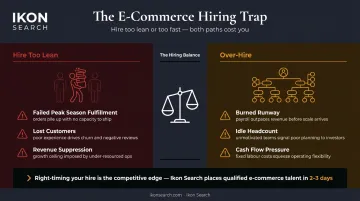
This is the central tension: hire too lean and you fail customers during peaks. Over-hire and you burn runway in the quiet months. That's why timing and hiring model — permanent, contract, or temp-to-hire — matter as much as candidate quality.
The Roles E-Commerce Startups Need to Fill First
The guiding principle here is sequenced hiring — fill roles that directly unblock revenue before filling anything else. Administrative, redundant, or nice-to-have roles come later.
Operations and Fulfillment
Operations is the first bottleneck as order volume grows. An early ops hire owns inventory management, 3PL coordination, order accuracy, and the fulfillment process end-to-end.
project44 research found that 84% of shoppers won't return after a single bad delivery experience. An unfilled ops seat doesn't just slow growth: it destroys the customer relationships your marketing spend built.
Digital Marketing and Acquisition
Performance marketing hires — paid social, email/CRM, SEO — drive revenue directly, which makes them high-priority early on. The catch: platform-specific knowledge is non-negotiable.
Klaviyo's own data shows automated email flows generate nearly 41% of total email revenue while accounting for only 5.3% of send volume — and that's only accessible to someone who already knows the platform. The same specificity applies to paid social. Look for hands-on experience with:
- Klaviyo automation (flows, segmentation, lifecycle sequences)
- Meta Ads (Advantage+ campaigns, creative testing, audience structure)
- SEO fundamentals relevant to your product category
Technology and Platform Management
Without a technically fluent hire, every storefront update, integration bug, or checkout issue becomes a bottleneck — often hitting ops and marketing simultaneously. On Shopify specifically, site speed data shows that every 100 milliseconds of added load time correlates with ~3.5% lower conversion. Those losses accumulate quietly when there's no one technically capable to address them.
A senior engineer isn't necessary at this stage. A platform-savvy generalist who can manage Shopify, handle basic integrations, and troubleshoot issues covers most early-stage needs.
Customer Experience
CX protects the revenue you've already earned. A strong early CX hire reduces churn, improves repeat purchase rates, and generates the reviews and referrals that reduce acquisition costs over time.
This role is a natural fit for a contract or temp-to-hire arrangement early on. Volume may not justify a full-time salary yet, but you can't leave the function unattended. Scale to permanent once order volume makes the cost obvious.
Hiring Strategies by Growth Stage
Pre-Revenue to Early Traction
At this stage, depth beats headcount. One strong e-commerce operator who can manage paid acquisition, oversee basic ops, and handle platform issues is more valuable than three narrow specialists who each own only 20% of what you need covered.
What to look for in this profile:
- Built processes from scratch, not just inherited them
- Can move between paid media, CRM, and ops without losing effectiveness
- Comfortable making decisions without a manager or clear playbook
Recommended model: Contract or temp-to-hire. Committing to full-time salaries before product-market fit creates both financial and operational risk — if the business pivots or growth stalls, fixed headcount costs become a liability fast.
Growth Stage
Once you've found traction, specialization should begin. Marketing, ops, and technology should separate into distinct roles with defined ownership and measurable KPIs. Keeping one person across all three functions limits all three.
Build performance benchmarks into early employment from day one. Effective 30/60/90-day goals for e-commerce hires look like:
- 30 days: Platform access set up, baseline metrics documented, first campaigns or processes running
- 60 days: Initial performance improvements measurable (conversion rate lift, fulfillment accuracy, email revenue per subscriber)
- 90 days: Ownership of the function clear, recommendations for next priorities in hand
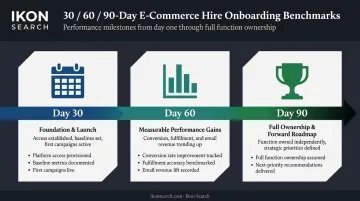
Hiring without these benchmarks makes it difficult to distinguish between a slow ramp and a wrong hire.
Scaling Stage
At scale, you're hiring leaders, not just individual contributors. VP of Operations, Head of Marketing, Director of Growth — these hires don't just execute, they build teams and set the trajectory for the next 2-3 years. The vetting bar rises.
This is where retained search becomes appropriate. The cost of a wrong leadership hire — in severance, lost time, team disruption, and re-hire costs — dwarfs any search fee. Founder time at this stage is better spent running the business than conducting an executive search.
Employer Branding for Startups
Without a recognizable brand name, early-stage startups compete on mission, trajectory, and opportunity. Job postings that lead with growth metrics, equity, and genuine culture tend to outperform those that lead with perks or generic descriptions of "collaborative environments."
Be specific and honest. Each job post should clearly answer:
- What stage the company is at and where it's heading
- What success in this role looks like at the 12-month mark
- Why a strong candidate should choose this over a more established company
Candidates who can answer those questions after reading your post are already self-selecting in the right direction.
How to Vet and Interview E-Commerce Candidates
Writing Job Descriptions That Attract the Right Applicants
Specific job descriptions filter out candidates who would apply anywhere — and surface those who've done this exact work before.
An effective e-commerce job description includes:
- Exact platforms required (Shopify, Klaviyo, Google Ads, Meta Ads Manager)
- Expected scope ("manage a $50K/month ad budget," "own email revenue growth from X to Y")
- Team structure and who the role reports to
- Stage of the business and what "building from scratch" means in practice
This level of specificity removes candidates who would apply to any marketing job and surfaces those who have done this specific work before.
Platform and Skills Assessments
Resume claims and actual platform proficiency often don't match. SHRM research found that 36% of applicants openly admitted lying on resumes, and 70% of workers have done so in some form.
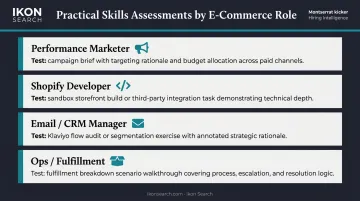
Practical assessments by role:
| Role | Assessment Type |
|---|---|
| Performance Marketer | Test campaign brief with targeting rationale and budget allocation |
| Shopify Developer | Storefront task or integration challenge in a sandbox environment |
| Email/CRM Manager | Klaviyo flow audit or list segmentation exercise |
| Ops/Fulfillment | Scenario walkthrough covering a fulfillment breakdown |
Note: Shopify offers verified skills certifications through Shopify Academy, and Meta offers its own Media Buying Professional certification — both useful reference points when evaluating candidate credentials.
Culture Fit and Startup Adaptability
Platform skills show up on assessments. Self-direction only reveals itself through conversation — and at an early-stage e-commerce startup, it's a baseline requirement for every hire.
Behavioral questions that surface this:
- "Tell me about a process you built from scratch — what did you start with and where did it end up?"
- "Describe a time you had to learn a new tool under deadline pressure."
- "Walk me through how you've managed competing priorities during a product launch or peak season."
Candidates who struggle to answer these questions specifically are often candidates who haven't done the work without structure.
Reference Checks as a Vetting Tool
Reference checks get skipped more often than they should — and when done properly, they're one of the most useful signals in the process. For e-commerce hires, ask former managers:
- How did this person perform during a peak demand period (Black Friday, a product launch)?
- Did they proactively improve systems, or did they maintain existing ones?
- Were there process breakdowns they owned and resolved?
A candidate who interviews well but gets vague references on peak performance is a meaningful signal. The best references are specific — they remember actual outcomes.
Contract, Temp-to-Hire, or Full-Time: Choosing the Right Model
Each model has a clear use case. The wrong choice isn't just a budget decision — it affects ramp-up time, institutional knowledge, and team cohesion.
| Model | Best For | Trade-offs |
|---|---|---|
| Full-time | Platform developers, marketing leadership, senior ops | Stability and continuity; fixed cost burden |
| Contract | Seasonal fulfillment, project-based work, maternity/leave cover | Speed and flexibility; limited integration |
| Temp-to-hire | CX, admin-adjacent roles, first-time hires in new functions | Reduces commitment risk; slower to full productivity |
A few principles to guide the decision:
- Roles that take 6+ months to ramp — Shopify developers, Heads of Marketing — are poor fits for short-term contracting even when budget pressure makes it tempting. The onboarding cost doesn't amortize.
- Customer support and seasonal fulfillment roles suit contract and temp arrangements well. Volume fluctuates and the skills transfer quickly.
- Leadership roles almost always warrant full-time from the start. A contract CMO or VP of Ops won't build the team culture or institutional knowledge those seats require.
If you're unsure which model fits a specific role, Ikon Search's Digital Media & Performance Marketing division works through exactly this decision with e-commerce clients regularly — placing ECommerce Directors, Lifecycle Marketing Managers, and performance marketers on full-time, contract, and temp-to-hire terms depending on the stage and scope of the need.
When to Work With a Specialized Staffing Partner
Signals That It's Time
Three indicators that founder-led hiring has become a liability:
- Three or more roles open simultaneously — managing multiple searches at once without a dedicated recruiter means all of them slow down
- A key position vacant for 30+ days — average time to fill a marketing manager role is roughly 55 days according to Workable benchmarks; specialized help cuts that significantly
- Recruiting consuming more than 10 hours of founder time per week — SaaStr guidance recommends startups hire an internal recruiter once hiring velocity exceeds one role per month; below that, external search is more efficient
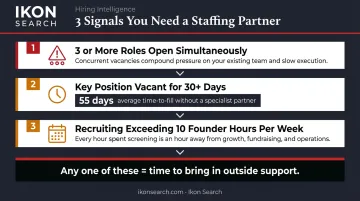
The opportunity cost of founder recruiting is real. Every hour spent screening resumes is an hour not spent on product, customers, or revenue.
What a Specialized Partner Does Differently
A generalist recruiter sends you candidates who match a keyword list. A specialized partner understands what "good" actually looks like for the role.
For e-commerce, that means knowing:
- Which Klaviyo certifications indicate genuine expertise vs. completion theater
- What ROAS benchmarks are realistic for a startup's ad spend level
- Whether a candidate's Shopify experience is storefront-level or integration-level
Ikon Search's Digital Media & Performance Marketing division vets candidates on platform proficiency across Shopify, Klaviyo, Meta Ads, Google Ads, and programmatic tools before they reach the client. The intake process captures culture fit, growth stage, and role-specific requirements upfront — which is why their time-to-qualified-shortlist typically runs 2-3 days.
For e-commerce startups that can't absorb the disruption of repeated mis-hires, that speed matters most when a revenue-driving role sits empty.
Frequently Asked Questions
What does staffing mean?
Staffing is the process of identifying, recruiting, hiring, and retaining people to fill roles within an organization. It covers the full cycle — from defining what a role requires to ensuring the hire integrates effectively and stays.
What is the purpose of staffing?
The purpose is to align human capital with business objectives: getting the right people into the right functions at the right time to drive productivity and support growth without unnecessary cost or risk.
What are the most important first hires for an e-commerce startup?
Operations/fulfillment and performance marketing are typically the highest-priority hires. Both directly impact revenue and customer experience from day one, making them the clearest place to start before filling any other function.
Should e-commerce startups hire contractors or full-time employees?
Early-stage startups generally benefit from contract or temp-to-hire flexibility. Roles with long ramp-up times — Shopify developers, marketing leadership — are better filled as full-time from the start to protect continuity.
How do you hire for e-commerce roles quickly without sacrificing quality?
Write job descriptions that name specific platforms and expected KPIs, use skills assessments before interviews, and work with a staffing partner who maintains pre-vetted e-commerce candidates. Vague process is what causes both speed and quality to suffer — specificity fixes both.
When should an e-commerce startup use a staffing agency?
When three or more roles are open simultaneously, when a critical position has been vacant for more than 30 days, or when recruiting is consuming time that should go toward running the business. Any one of those conditions is a strong case for outside support.