
Yet many companies walk into an executive search engagement without understanding how fees work, what they cover, or what different fee models signal about the quality of the search.
This guide breaks down the three core fee models, what drives fees up or down, what you're actually paying for, and how to decide whether the investment makes sense for your specific search.
Key Takeaways
- Executive search fees typically range from 20% to 35% of the placed executive's first-year compensation
- Three models exist: retained, contingency, and container (engaged) — each with different cost structures and firm commitment levels
- Most retained firms calculate fees on total first-year compensation (base + bonus + equity), not base salary alone — which materially shifts the final number
- The fee model you choose directly signals how prioritized your search will be
- Knowing what's included vs. billed separately is what separates a well-managed engagement from an expensive surprise
How Much Do Executive Search Firms Charge?
Executive search fees don't follow a fixed-price model. They vary based on fee structure, role seniority, industry, and firm type. The percentage alone doesn't tell the full story — a 25% contingency fee and a 25% retained fee look identical on paper but deliver fundamentally different levels of service and candidate access.
Here's how the three main models break down.
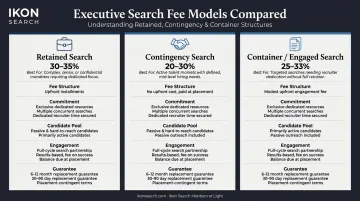
Retained Search
Best for: C-suite and senior leadership roles (CEO, CFO, CHRO, CRO) where the qualified candidate pool is narrow, discretion matters, and a failed hire carries significant organizational risk.
Typical fee range: 30–35% of total first-year compensation, paid in three installments.
What's typically included:
- Exclusive, dedicated search — the firm works your role only
- Installment-based payments (one-third upfront, one-third at 60 days, one-third at placement)
- Deep candidate vetting including behavioral and competency-based interviews
- Proactive outreach to passive candidates not actively job searching
- Competitive talent landscape mapping
According to SPMB's published fee guidance, CEO and CFO searches are commonly priced at one-third (33.3%) of first-year guaranteed cash compensation, with some premier firms establishing minimum fees to ensure full resource allocation.
Contingency Search
Best for: Director-level and below, or roles with broad candidate pools and widely available skill sets.
Typical fee range: 20–30% of first-year base or total compensation — no upfront cost; the firm is paid only upon successful placement.
What to know:
- No upfront financial commitment from your organization
- Firms typically run multiple client searches simultaneously, meaning your role competes for recruiter attention
- Candidate sourcing often skews toward active job seekers and existing databases
- The absence of upfront cost also means less dedicated focus on your search
Container (Engaged) Search
Best for: Specialized mid-to-senior roles where you want proactive outreach to passive candidates and dedicated attention, but prefer a lower-risk structure than full retained search.
How it works: A modest upfront engagement fee — typically in the range of $8,000–$15,000 according to The Good Search's published pricing — secures dedicated recruiter time, with the balance due upon placement. Total fees generally run 25–33% of first-year compensation.
For organizations weighing cost control against search quality, container search often hits the right balance — particularly for specialized roles where passive candidate outreach makes a measurable difference in shortlist quality.
Key Factors That Drive Executive Search Fees Up or Down
The 20–35% range is a starting point, not a fixed rate. Several variables move the needle — knowing them in advance allows for more accurate budgeting before any engagement letter is signed.
Role Seniority and Candidate Pool Size
C-suite searches command higher fees because the universe of qualified, available candidates is far smaller. A VP-level search and a CEO search are fundamentally different in practice, even when their fee percentages look similar on paper.
CEO searches require more outreach rounds, more time, and deeper assessments — fewer people have done the job at that level.
Some firms establish minimum fee floors for C-suite work. The Good Search, for example, lists minimums starting at $75,000 for C-suite and board searches, regardless of compensation level.
Total Compensation vs. Base Salary
This distinction matters more than most clients realize. Retained firms typically calculate fees on total first-year compensation — base salary, target bonus, signing bonus, and sometimes equity — not just base.
A practical example: a role with a $250,000 base and a 20% target bonus has a fee basis of $300,000. At 33%, that's a $99,000 fee — not the $82,500 a base-salary-only calculation would produce. Always clarify exactly which compensation components are included in the fee basis before signing.
Industry and Market Competitiveness
Searches in talent-constrained sectors require more sourcing effort and time. The insurance industry faces a well-documented leadership gap driven by demographic attrition and growing demand for analytics skills. Technology roles are similarly competitive — Deloitte projects US tech job demand to reach 7.1 million by 2034, with 70% of technical workers receiving multiple offers when they accept a new role.
Firms with dedicated vertical expertise — like Ikon Search's Insurance and Technology divisions — typically maintain stronger passive candidate networks in those niches, and that specialized access is reflected in how engagements are structured.
Search Complexity and Scope
These factors push fees toward the upper end of the range:
- Confidential replacement of a sitting executive — requires discretion and indirect outreach channels
- Multi-location searches with simultaneous geographic sourcing requirements
- Roles requiring SEC, FINRA, or state insurance regulatory backgrounds, which narrow the candidate pool considerably
- Highly technical functions such as CTO searches in niche infrastructure areas
What's Actually Included in an Executive Search Fee
The search fee is not a simple commission for delivering a name. It represents a bundle of services, time, and institutional knowledge. Understanding what's covered — and what may be billed separately — prevents scope disputes and helps you compare proposals accurately.
Candidate Sourcing and Market Mapping
This phase goes well beyond job board postings. A qualified search firm should deliver:
- Proactive outreach to passive candidates not actively job hunting
- Direct sourcing from competitor and adjacent organizations
- Competitive talent landscape and compensation analysis
- A qualified pipeline built specifically around your role requirements
Firms with deep vertical networks — like Ikon Search in insurance, financial services, technology, and risk and compliance — consistently surface candidates that generalist recruiters simply don't have access to.
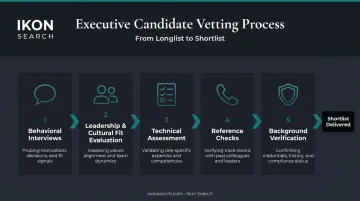
Assessment and Vetting
Rigorous executive-level vetting includes:
- Structured behavioral and competency-based interviews
- Leadership and cultural fit evaluation
- Technical or functional assessments where relevant
- Reference checks from direct supervisors (typically at the shortlist stage)
- Background checks at the final stage
Done properly, this vetting process means a client receives a shortlist of candidates who have already been screened for competency, fit, and verifiable track record — not just availability. The AESC's candidate standards set behavior-based interviews, structured reference checks, and transparent candidate communication as baseline expectations.
Placement Guarantee and Replacement Terms
Most firms include a replacement guarantee. For contingency placements, this typically runs 30–90 days. Retained engagements generally offer longer protection — often 6 to 12 months — because the upfront vetting is more thorough and the firm's accountability is higher.
Worth asking: A short guarantee on a high-stakes retained search is a yellow flag. Press the firm on what they stand behind before signing.
What's typically NOT included in the base fee:
- Candidate travel expenses for in-person interviews
- Background check and screening costs
- Assessment tool licensing fees
Always confirm: These costs are billed separately by most firms. Ask for explicit line-item estimates in the engagement letter before signing.
Retained vs. Contingency: More Than Just a Price Difference
The fee percentages between retained and contingency searches often look similar on paper. The real difference lies in how each model structures incentives — and that directly affects candidate quality, search depth, and placement success.
| Factor | Retained | Contingency |
|---|---|---|
| Commitment structure | Exclusive; dedicated resources; defined timeline | Multiple concurrent searches; your role competes for attention |
| Candidate access | Passive candidates actively sourced | Primarily active candidates and existing databases |
| Firm incentive | Depth of fit and long-term success | Speed of submission |
| Fee trigger | Installments at defined milestones | Only upon successful placement |
| Typical guarantee | 6–12 months | 30–90 days |
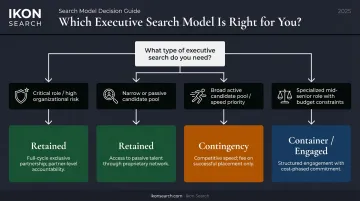
Use this to guide your decision:
- Role is critical to company direction, or a bad hire carries significant organizational risk → retained
- Candidate pool is narrow, passive, or in a talent-constrained sector → retained
- Speed matters most and the candidate pool is broad and active → contingency may fit
- Mid-to-senior specialized role with budget constraints → contained/engaged search is worth exploring
How to Budget Accurately for an Executive Search
Accurate budgeting requires more inputs than just the fee percentage. Organizations that only calculate the search fee routinely underestimate total search-related spend.
Practical budgeting framework:
- Determine total compensation, not just base salary — include base, target bonus, signing bonus, and equity as applicable
- Identify the right search model based on role seniority and organizational risk
- Request itemization of expenses billed outside the placement fee (travel, screening, assessments)
- Ask about the replacement guarantee — what triggers it and what the replacement process looks like
- Factor in vacancy cost — for revenue-generating or operationally critical roles, each week a senior seat sits empty represents delayed decisions, team instability, and measurable productivity loss
The search fee is often the smaller number in the equation. A three-month executive vacancy in a revenue-critical or risk-sensitive function frequently costs more in lost momentum than the search fee itself.
That's why firm selection directly affects the total cost equation. Ikon Search — with specialized divisions in insurance, technology, risk and compliance, and financial services — delivers a qualified shortlist in an average of 2–3 days, which compresses vacancy duration and lowers the risk of a failed placement that triggers a second search.
Common Mistakes Companies Make When Evaluating Search Fees
Choosing Based on Fee Percentage Alone
Selecting the lowest percentage offer without examining the firm's specialization, methodology, and candidate access often leads to a longer search, weaker candidates, or a failed placement — and a second engagement fee on top of the first. In executive search, the cheapest option upfront frequently produces the most expensive outcome overall.
Ignoring the Fee Basis
Many organizations budget against base salary and are caught off-guard when the final fee is calculated on total compensation including bonus and equity. Always confirm in writing — before signing — exactly which compensation components are included in the fee calculation.
Underweighting the Cost of a Bad Hire
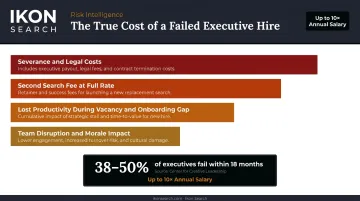
The Center for Creative Leadership estimates that 38% to over 50% of executives fail within the first 18 months. When you tally the full fallout, the cost of a failed executive hire dwarfs the original search fee many times over. The typical components include:
- Severance and legal costs for the departing executive
- A second search fee (often at full rate)
- Lost productivity during the vacancy and onboarding gap
- Team disruption and morale impact on direct reports
Viewed through that lens, the added cost of a retained engagement with rigorous cultural fit assessment is almost never the higher-risk number.
Frequently Asked Questions
What percentage do executive search firms typically charge?
Retained search fees generally run 30–35% of total first-year compensation. Contingency fees range from 20–30% of base or total comp depending on the firm. Container/engaged models sit in the 25–33% range, combining an upfront engagement fee with a success fee at placement.
What is the difference between retained and contingency executive search?
Retained search requires upfront payment and gives the client exclusive, dedicated search resources focused on passive candidates. Contingency search has no upfront cost but the firm works multiple searches simultaneously and is paid only upon placement, which shifts incentives toward speed of submission over quality of fit.
Is the executive search fee calculated on base salary or total compensation?
Most retained firms calculate fees on total first-year compensation — base, target bonus, signing bonus, and sometimes equity. Always clarify the exact scope in the engagement letter before signing, as large bonuses or equity components can materially shift the final fee.
What is a container or engaged search, and how does it differ from retained?
A container search is a hybrid model: a modest upfront engagement fee secures dedicated recruiter time, with a success fee due at placement. It offers more commitment and passive candidate access than contingency, without the full three-installment structure of a traditional retained engagement.
Can executive search firm fees be negotiated?
The percentage is sometimes negotiable, particularly for long-term relationships or volume searches. More practical levers are the fee basis definition, expense billing terms, payment schedule, and the replacement guarantee terms — these often move more easily than the headline rate.
What replacement guarantee should an executive search firm offer?
Contingency placements typically carry a 30–90 day guarantee. Retained engagements generally offer longer protection — often 6 to 12 months. Push back on any retained guarantee shorter than 6 months — the length reflects the firm's confidence in its assessment and cultural fit process.