
Project-based staffing has emerged as a direct response to this reality. Rather than adding permanent headcount for temporary needs, businesses bring in professionals scoped to a specific initiative — and disengage cleanly when the work is done.
This article goes beyond the basic definition. It covers the operational advantages that matter to business leaders — cost, speed, quality, and risk — along with the conditions where this model delivers its highest return, and what organizations sacrifice by ignoring it.
Key Takeaways
- Project-based staffing means hiring professionals for a specific initiative, not a permanent role
- It eliminates long-term salary and benefits overhead for time-bound work
- Businesses gain access to specialized professionals in days, not months
- Clearly scoped engagements reduce both financial and compliance exposure
- Getting full value depends on defined deliverables, active oversight, and a staffing partner who understands your industry
What Is Project-Based Staffing?
Project-based staffing means bringing in professionals to execute a specific initiative — a regulatory rollout, system migration, financial analysis, or claims surge — with a defined scope, timeline, and set of deliverables. When the work is complete, the engagement ends. No permanent role, no ongoing obligation.
This model applies across a wide range of scenarios:
- Financial services firms running regulatory compliance projects
- Technology teams launching products or migrating infrastructure
- Insurance companies handling claims volume spikes or compliance programs
- Marketing teams executing campaigns or product launches
The key distinction from traditional hiring is outcome orientation. Project-based staffing is structured around a defined result — specific deliverables, a fixed timeline, expertise matched to the work — rather than an open-ended headcount addition.
According to Deloitte, contingent workforces now constitute 30% to 50% of the overall workforce at many organizations — a signal that project-based and contingent models have become a standard tool for managing workforce capacity, not a workaround.
Key Advantages of Project-Based Staffing for Businesses
The advantages below focus on measurable, operational outcomes — the metrics business leaders actually track. Each one connects directly to cost, speed, quality, or risk.
Advantage 1: Workforce Flexibility Without Long-Term Overhead
Project-based staffing lets businesses scale headcount up or down in direct response to project demand — without touching permanent payroll.
In practice: a company hires pre-vetted contract professionals for the duration of a specific initiative, then concludes the engagement cleanly. No severance negotiations, no ongoing benefits costs, no underutilized staff once the project wraps.
Why this matters financially:
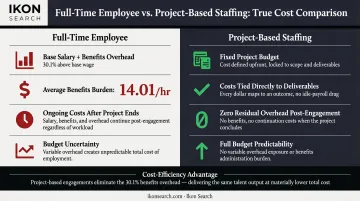
Benefits alone represent a significant portion of full-time employment costs. BLS data from March 2026 shows that for private industry workers, benefits averaged $14.01 per hour — 30.1% of total compensation. That cost persists whether or not the work justifies it.
Project-based staffing eliminates that mismatch. Businesses allocate a fixed project budget, tie staffing costs directly to deliverables, and avoid the budget overruns that come from idle headcount after a project closes.
KPIs this affects:
- Cost per project
- Total workforce overhead ratio
- Budget variance
- Headcount utilization rate
When this matters most:
This advantage is sharpest for startups managing investor capital carefully, PE-backed firms operating between permanent hires, and established companies running one-time initiatives like market entries or infrastructure overhauls. The financial discipline of a time-bound engagement simply can't be replicated by adding a full-time employee.
Advantage 2: Fast Access to Specialized, Hard-to-Find Talent
Some skill sets are too niche to justify a full-time role but too critical to go without. Project-based staffing solves this directly — it gives businesses on-demand access to specialized professionals who can be deployed for a specific engagement and disengaged when it's done.
The speed difference is substantial. SHRM data shows traditional hiring averaged 41 days to fill in 2024. For professional temporary staffing, SIA benchmarks put the median time-to-start at 14 days — with candidates typically reaching offer acceptance in just 9 days.
That 27-day gap is the difference between hitting a project deadline and missing it.
Why speed translates to quality, not just convenience:
When professionals are scoped to a defined deliverable, accountability is clear. They're not generalists plugged into ambiguous roles — they're specialists brought in to produce a specific output. That clarity tends to drive better results than fitting a permanent hire into a temporary problem.
Firms like Ikon Search, which maintain active talent networks across financial services, insurance, and technology, can typically present qualified candidates within 2–3 days — significantly compressing the window between identifying a need and putting the right person to work.
KPIs this affects:
- Time-to-fill
- Time-to-productivity
- Project delivery timeline
- Output quality
Best-fit scenarios:
This advantage is most valuable when the skill is highly specific (a niche regulatory compliance expert, a specialized data engineer for a one-time build), when the timeline is non-negotiable, or when internal teams are already at capacity and can't absorb another priority.
Advantage 3: Reduced Financial and Compliance Risk
Project-based staffing reduces two categories of risk simultaneously: financial exposure from open-ended employment commitments, and compliance exposure from poorly structured workforce arrangements.
How the structure protects businesses:
Engagements are defined from the start — scope, timeline, compensation terms, and deliverables. There are no ambiguous expectations, no severance obligations, and when managed through a qualified staffing partner, no misclassification risk.
That last point carries real weight. Two regulatory frameworks make the stakes concrete:
- DOL classification rule (effective March 2024): A 1099 label or written contractor agreement alone doesn't determine worker status under the FLSA. Businesses that build ad hoc contractor arrangements under pressure — without proper structure — remain exposed.
- IRS Section 3509 penalties: Under IRC Section 3509, if an employer fails to withhold and reporting requirements weren't met, liability rises to 3% of wages for withholding and 40% of employee Social Security tax — penalties that compound quickly across multiple misclassified workers.
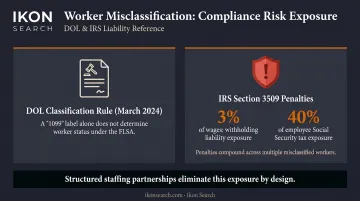
Structuring engagements through a qualified staffing partner avoids this exposure by design.
KPIs this affects:
- Compliance incident rate
- Payroll liability exposure
- Severance costs avoided
- Cost-of-bad-hire
Who carries the most risk:
Financial services firms, insurance carriers, and PE-backed portfolio companies face the sharpest exposure here — regulatory compliance is non-negotiable in those environments. The risk is also acute during organizational restructuring or rapid scaling, where urgency to hire fast routinely produces shortcuts with long-term consequences.
What Happens When Project-Based Staffing Is Overlooked
Businesses that default to full-time hiring for every need — including temporary, specialized, or surge-driven ones — tend to hit the same predictable problems:
- Ballooning overhead: Permanent staff hired for time-limited work create payroll costs that outlast the project's value
- Delivery delays: Without on-demand access to specialized talent, timelines slip while traditional recruitment catches up — at an average of 41 days per role
- Reactive hiring patterns: Teams repeatedly scramble to fill urgent gaps instead of building a flexible workforce model that anticipates them
- Compliance exposure: Ad hoc contractor arrangements made under pressure often lack the structure needed to avoid misclassification risk
- Lost competitive ground: Organizations that can't flex their workforce quickly miss time-sensitive opportunities to competitors who can
The Deloitte research puts this gap in sharp relief: 86% of executives say that effectively managing external contributors is critical to organizational performance. Only 33% say their organization is sufficiently prepared to do it.
That gap translates directly into slower project delivery, higher costs, and preventable risk exposure — a structural disadvantage for any organization still treating contingent workforce management as an afterthought.
How to Get the Most Value from Project-Based Staffing
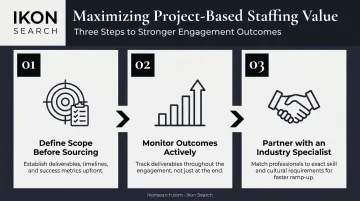
Project-based staffing performs best when treated as a deliberate workforce strategy — not an emergency workaround. Three conditions make the difference:
Define scope before sourcing talent. Clear deliverables, timelines, and success metrics should exist before a search begins. Ambiguous scope creates drift, rework, and cost creep — the exact problems the model is designed to prevent.
Monitor outcomes actively during the engagement. Track progress against deliverables throughout, not just at the end. Project-based staffing is outcome-driven by design; the management approach should match.
Work with a partner who knows your industry. Ikon Search specializes in financial services, insurance, risk & compliance, and technology, matching project professionals to exact skill and cultural requirements. That industry specificity reduces ramp-up time and improves output quality from day one.
Conclusion
Project-based staffing delivers measurable value when applied with the right structure: workforce flexibility that keeps overhead aligned to actual work, faster access to specialized talent that keeps projects on schedule, and compliance-sound engagements that reduce financial and legal risk.
Organizations that build project-based staffing into their workforce strategy — rather than reaching for it only in emergencies — compound these advantages over time. They become faster to execute, leaner on overhead, and better positioned to scale without defaulting to permanent headcount for every need.
Frequently Asked Questions
What does project-based staffing mean?
Project-based staffing means hiring professionals for a defined initiative, deliverable, or timeline — not a permanent role. Businesses get the right expertise for the right duration without long-term employment commitments or ongoing overhead.
What is an example of a project-based industry?
Several industries depend on project-based staffing for time-bound, specialized work:
- Financial services — regulatory rollouts, audits
- Technology — system migrations, product launches
- Insurance — claims processing surges, compliance programs
- Marketing — campaign execution, go-to-market launches
How is project-based staffing different from temporary staffing?
Temp staffing typically fills short-term vacancies or covers absenteeism. Project-based staffing is outcome-driven — it's tied to specific deliverables and defined timelines. Businesses use it to bring in specialized talent for a scoped initiative, then conclude the engagement once the work is done.
What are the cost benefits of project-based staffing?
Businesses pay only for the work being done within a defined project window, avoiding the full overhead of permanent employment — benefits, equipment, training, and severance. BLS data shows benefits alone represent 30% of total compensation for full-time employees.
When should a business consider project-based staffing?
Key triggers: a non-negotiable project deadline, a highly specialized skill gap, internal teams already at capacity, organizational transitions, or a need to scale quickly without inflating permanent headcount.
How quickly can project-based staff be deployed?
Specialized boutique firms with active talent networks can present qualified candidates within days. SIA benchmarks place professional temporary staffing at a median of 9 days to offer acceptance — far ahead of the 41-day average for traditional full-time hiring.