
Introduction
Hiring a CMO is one of the most consequential decisions a B2B SaaS founder or CEO will make, and one of the riskiest. According to Spencer Stuart's 2025 CMO Tenure Study, average Fortune 500 CMO tenure sits at just 4.3 years, already the shortest in the C-suite. For technology companies, Korn Ferry's research puts that number closer to 3.0 years.
The cost of a bad hire goes well beyond severance. A misaligned CMO creates pipeline gaps, strategic drift, and team disruption at precisely the moment when execution speed matters most. You're not just refilling a seat. You're rebuilding trust, pipeline momentum, and your positioning in the market.
This guide walks through how to run a rigorous CMO search: defining the role for your growth stage, identifying the competencies that actually predict success, structuring the interview process, and avoiding the mistakes that end tenures early.
Key Takeaways
- Define the CMO archetype before recruiting — demand gen driver, brand strategist, or P&L owner — or you'll attract the wrong candidates
- Prioritize "T-shaped" marketers: broad across digital, content, product marketing, and brand — with depth where your growth stage needs it most
- Run a structured process: define the role first, source second, then evaluate in phases with early reference checks
- Expect most CMO failures to stem from misaligned expectations and weak onboarding — not candidate incompetence
- Specialized executive search firms reduce time-to-hire and mismatch risk, especially when placing a first-time C-suite marketing leader
What Does a B2B SaaS CMO Actually Do?
The title is consistent. The job description rarely is.
A B2B SaaS CMO owns the full marketing function — strategy through execution — and is ultimately accountable for revenue-generating pipeline and brand equity. What that looks like day-to-day depends heavily on company stage.
A Series A CMO is often hands-on across demand generation and positioning. A Series C+ CMO leads a team, drives GTM strategy, and spends significant time on cross-functional alignment with sales and product.
Understanding which version of the role you're hiring for is the first decision, not an afterthought.
Revenue and Demand Generation Ownership
In B2B SaaS, the CMO doesn't just "support" sales — they're directly accountable for MQL and pipeline targets. That means owning the full funnel from brand awareness to sales-qualified lead handoff.
Key areas of ownership include:
- Paid media, SEO, content, ABM, and marketing operations
- Funnel metrics: CAC, MQL-to-SQL conversion rate, and LTV:CAC ratios
- Pipeline forecasting and marketing-sourced revenue reporting
Forrester's 2025 B2B research notes that 73% of B2B revenue comes from existing customers — which means the CMO's remit increasingly extends into retention and expansion, not just acquisition.
Brand, Positioning, and Category Creation
Pipeline ownership is only part of the picture. The CMO also shapes how the market perceives the product — and that perception is what makes demand gen work in the first place. This includes messaging architecture, competitive differentiation, and how the company positions itself against adjacent categories.
In competitive SaaS markets, category creation — owning a narrative before competitors do — is a distinct CMO function. It's harder to measure than pipeline, but companies that own their category narrative typically face less price pressure and shorter sales cycles as a result.
Cross-Functional Leadership
The CMO operates as a bridge between marketing, sales, and product. That means maintaining GTM alignment, sharing revenue accountability with the CRO, and ensuring product launches are supported by market-ready positioning.
McKinsey research found that CEOs who place marketing at the core of growth strategy are twice as likely to exceed 5% annual growth. Communicating marketing ROI clearly to the board and C-suite is, accordingly, a core qualification — not a secondary consideration.
Key Competencies to Look for in a B2B SaaS CMO
Build an Ideal Candidate Profile (ICP) for the CMO role with the same rigor you'd apply to sales prospecting. Evaluate competencies at two levels:
- Filters — non-negotiables that eliminate unfit candidates early
- Signals — differentiators that predict success in your specific context
T-Shaped Marketing Expertise
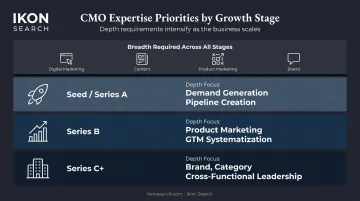
A strong B2B SaaS CMO has functional breadth across digital marketing, content, product marketing, and brand — but deep expertise in the area most critical to your stage.
| Growth Stage | Depth Priority |
|---|---|
| Seed / Series A | Demand generation and pipeline creation |
| Series B | Product marketing and GTM systematization |
| Series C+ | Brand, category, and cross-functional leadership |
For smaller SaaS companies that can't split the role, breadth matters as much as depth. Over-indexing on a single-strength CMO is one of the fastest ways to end up with a tenure measured in months.
Data Fluency and Revenue Accountability
Top SaaS CMOs make decisions grounded in data. They build and interpret marketing dashboards, model funnel projections, and connect spend to pipeline outcomes.
Probe for these signals in interviews:
- Can they articulate CAC, LTV:CAC, and MQL-to-opportunity conversion as marketing levers?
- Do they own pipeline targets, or just activity metrics?
- Have they presented marketing ROI to a board or CFO?
If a candidate struggles to describe their dashboard, they're likely not operating at the level your role requires.
SaaS GTM and AI Fluency
Prior B2B SaaS experience matters because the GTM motions — inbound, outbound, PLG, ABM, channel — are distinct from other industries. Candidates should have navigated at least one full go-to-market cycle from positioning through launch to optimization.
AI proficiency is no longer optional at this level. Gartner's 2024 research found 65% of CMOs say AI advances will dramatically change their role within two years. Candidates who aren't already using AI tools across content, analytics, or campaign workflows are entering the role at a disadvantage.
Leadership Style and Culture Fit
The leadership behaviors that predict CMO longevity:
- Adaptability to fast-changing market conditions
- Ability to drive change while maintaining team trust
- Ability to manage competing priorities across Sales, Product, and CS without losing team alignment — a constant pressure in scaling SaaS organizations
Those behavioral traits set the floor. The ceiling is determined by personal attributes that don't show up on a resume: honesty, curiosity, analytical thinking, proactivity, and follow-through. Build structured interview questions specifically designed to surface these — they're what separate a 12-month CMO from one who's still driving growth three years in.
How to Structure the B2B SaaS CMO Hiring Process
You're racing against two clocks simultaneously: move fast enough not to lose top candidates (who are often evaluating multiple roles), while moving deliberately enough to avoid a costly mismatch. The best hiring outcomes start before the job is posted — which means your process design is as important as your candidate pool.
Step 1 — Define the CMO Archetype and Success Criteria
Three CMO archetypes exist in the market. Choose the right one before sourcing begins:
- P&L Owner — accountable for revenue, product, and distribution
- Strategic Leader — innovation and customer insight without P&L ownership
- Commercialization Leader — demand gen and marketing communications execution
Before drafting the job description, every CEO should answer:
- What specific business challenge does this role solve?
- What are the top 3–5 time-bound, measurable outcomes we need from this CMO in year one?
- What authority will this person actually have — over budget, headcount, and strategy?
That last question matters more than most founders realize.
Step 2 — Build and Source Your Candidate Pipeline
Use a combination of approaches:
- Inbound job postings to capture actively searching candidates
- Proactive outbound search targeting passive candidates with relevant track records
- Referrals from your board, investors, and trusted advisors
Bay Area candidates move fast and expect accelerated offer timelines. East Coast markets — where Ikon Search maintains deep networks across NYC, Chicago, and Philadelphia — often have different pace expectations. Build your timeline to match the geography you're sourcing from.
Step 3 — Evaluate Candidates Rigorously but Efficiently
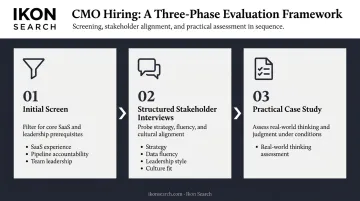
A three-phase evaluation framework keeps the process moving without cutting corners:
- Initial screen — filter against non-negotiable criteria (SaaS experience, pipeline accountability, team leadership)
- Structured stakeholder interviews — cover strategy, data fluency, leadership style, and culture fit
- Practical assignment or case study — assess real-world thinking, not just interview performance
High-signal interview questions to include:
- "Walk me through your 30-60-90 day plan for this role."
- "What KPIs live on your marketing dashboard right now?"
- "What would you change about our current positioning, and why?"
- "Describe a time you disagreed with the CEO on GTM strategy. What happened?"
Listen for structured thinking, comfort with ambiguity, and whether their instincts align with your stage — not just polished delivery.
Step 4 — Reference Check Early and Onboard Intentionally
Shift reference checks earlier in the process — after the second interview, not after the offer. Use them to probe genuinely for:
- Leadership style under pressure
- How they handle underperforming team members
- Whether they deliver on commitments
Once hired, the first 100 days function as a retention tool, not just an orientation period. Structure them deliberately:
- Set 3–5 ambitious but achievable goals tied to year-one success criteria
- Schedule 1:1s with all C-suite peers in week one — before the CMO forms assumptions
- Give explicit air cover to make early decisions without internal friction
The goal is momentum. Familiarity alone won't keep a high-performing CMO engaged past the six-month mark.
Common Mistakes That Lead to Short CMO Tenures
The most common root cause of CMO failure in B2B SaaS isn't incompetence. It's misalignment between the job description, CEO expectations, and the actual authority granted to the CMO after they start.
HBR's research on CMO turnover argues that the problem is often structural: jobs are poorly designed, and candidates who look right on paper walk into roles with unclear mandates and insufficient support. Explicit role clarity before day one prevents the performance management spiral that follows.
Three patterns consistently shorten CMO tenures:
- Over-evaluating, under-selling: The best CMO candidates have options. Companies so focused on scrutinizing candidates that they forget to pitch the role lose top talent before extending an offer. Your recruiting process is a brand-building exercise.
- Mismatched timelines: Sustainable pipeline and brand results take 6-12 months to materialize. Define 30/60/90-day evaluation milestones and communicate them explicitly before the hire is made — otherwise the only outcome is failure.
- Shallow C-suite integration: A CMO not embedded into the leadership team within the first 60 days rarely recovers. Role clarity and structured onboarding matter more than most CEOs assume.
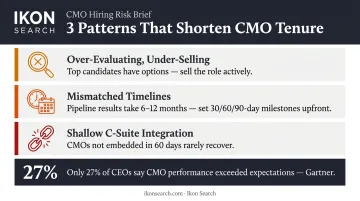
Gartner's research puts a number on this: only 27% of CEOs and CFOs say CMO performance exceeded expectations — a gap that reflects poor onboarding and unclear success criteria far more often than actual underperformance.
How Ikon Search Can Help
Ikon Search is a boutique executive search firm founded by recruiters with 25+ years of combined experience, with a dedicated practice for Digital Media & Performance Marketing leadership. Our CMO search practice places Marketing Directors, VPs of Marketing, and Chief Marketing Officers across SaaS, Fin-Tech, Mar-Tech, and PE-backed growth companies.
What sets our approach apart:
- Compensation benchmarking, candidate availability signals, and talent-market mapping delivered before and during each search — so you're never hiring blind
- Qualified candidate shortlists typically delivered within 2–3 days, compared to the industry standard of several weeks
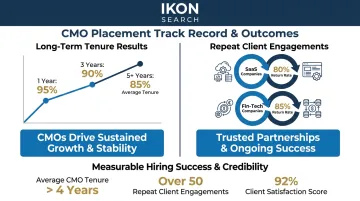
- Active practice placing Series A–C CMOs and PE-backed SaaS marketing leaders, with documented placements producing 4+ year tenures
One example: when a prop-tech startup in NYC needed their first CMO, Ikon worked directly with senior leadership to define what the role needed to accomplish over one, two, and five years. The placement is still in seat four years later. A separate Series B Fin-Tech SaaS client has made 15+ placements through Ikon across marketing and product functions over three years.
Ikon offers three engagement models:
| Engagement Type | Best For |
|---|---|
| Retained Search | C-suite roles requiring deep market mapping and confidential outreach |
| Full-time Permanent | Defined roles with clear specs and an active candidate market |
| Contract / Temp-to-Hire | Interim CMO coverage while the permanent search runs |
Frequently Asked Questions
What is a SaaS recruiter?
A SaaS recruiter is a specialized talent acquisition professional who focuses on sourcing and placing candidates within software-as-a-service companies. They bring deep knowledge of SaaS-specific roles, compensation norms, GTM org structures, and the unique demands of growth-stage hiring.
What skills should a B2B SaaS CMO have?
Core competencies include demand generation expertise, data fluency, SaaS GTM experience, brand and positioning skills, and cross-functional leadership. The specific mix should be weighted toward your current growth stage — pipeline-building at early stages, brand and category leadership at scale.
What is the average tenure of a B2B SaaS CMO?
Spencer Stuart's 2025 study puts average Fortune 500 CMO tenure at 4.3 years, already the shortest in the C-suite. Technology CMOs average closer to 3.0 years per Korn Ferry's data. Role clarity, onboarding quality, and C-suite integration are the strongest predictors of longer tenure.
What's the difference between a CMO and a VP of Marketing in B2B SaaS?
A CMO holds C-suite authority over the full marketing function with direct board accountability and often P&L responsibility. A VP of Marketing typically reports to the CMO or CEO with a more operational and execution-focused scope — responsible for running programs rather than setting the overall strategy.
How long does it take to hire a CMO for a SaaS company?
A thorough CMO search typically takes 60–120 days from kickoff to accepted offer, depending on role clarity, candidate pool depth, and process efficiency. A specialized executive search firm can compress this timeline considerably. Ikon Search typically delivers a qualified shortlist within 2–3 days of search initiation.
How do you evaluate whether a CMO candidate is the right fit?
Evaluate candidates across three layers: structured interviews probing GTM strategy and data fluency, a practical case study, and early reference checks. Map all three against a predefined Ideal Candidate Profile and success scorecard built before sourcing begins.