Introduction
Choosing the wrong staffing model doesn't just slow things down — it burns budget, strains teams, and sometimes means starting the search over entirely. For hiring managers in financial services, insurance, technology, and marketing, where roles are specialized and talent is competitive, that cost compounds fast.
That cost compounds because direct hire and contract staffing are not interchangeable — each is built for a different business situation. Using one when the other is called for creates friction at every stage, from candidate expectations to onboarding to long-term retention.
SHRM reports that replacing an employee can cost anywhere from 50% to 200% of their annual salary. Getting the model right the first time is a real financial priority.
This article breaks down the core definitions, a side-by-side comparison, use cases for each model, and clear criteria for deciding which approach fits your situation — so you can move forward with confidence rather than guesswork.
Key Takeaways
- Direct hire places a candidate on your payroll permanently from day one — best for strategic, long-term roles
- Contract staffing engages workers through a staffing agency for a set period — ideal for project-based or short-term capacity needs
- Contract-to-hire is a trial period with conversion potential — best when both sides want to evaluate fit before committing
- Choosing the right model hinges on role criticality, timeline, budget, and your organization's risk tolerance
- Getting the model right before the search starts saves time, money, and a bad hire
Direct Hire vs. Contract: Quick Comparison
Before going into the mechanics of each model, here's a reference view across five decision dimensions:
| Dimension | Direct Hire | Contract Staffing |
|---|---|---|
| Employment relationship | Worker joins employer's payroll immediately and permanently | Worker remains on the staffing agency's payroll for the engagement |
| Fee / cost structure | One-time placement fee (% of first-year salary) | Ongoing bill rate (worker pay + agency markup) |
| Time to fill | Longer — thorough screening for long-term fit | Faster — days to weeks from pre-vetted pools |
| Flexibility | Low after placement | High — scale, extend, or end based on need |
| Benefits & compliance | Employer assumes full responsibility | Staffing agency manages payroll, taxes, and compliance |
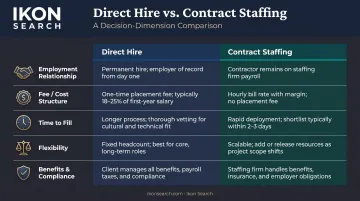
The table captures the surface-level tradeoffs, but the right choice depends on what the role is actually solving for — a permanent capability gap or a time-bound need. The sections below break down each model in detail.
What Is Direct Hire?
The American Staffing Association defines Direct Placement Services as a staffing firm finding qualified job candidates and bringing them together with employers to establish a permanent employment relationship. In practice: the staffing firm recruits and vets, but the worker joins the client company's payroll directly from day one — no trial period, no conversion step.
How the Fee Structure Works
Direct hire fees are paid by the employer to the staffing firm upon a successful placement. According to Staffing Industry Analysts, the most common fee is 20% of the placed candidate's first-year base salary, with 42% of staffing firms reporting that level. Ranges by segment:
- Commercial staffing: 15–20%
- Professional staffing: 18–22%
- Dedicated direct-hire firms: 20–25%
It's a one-time fee — not ongoing — which makes it predictable once a placement is made.
What the Employer Takes On After Placement
Once placed, the employer owns the full employment relationship:
- Onboarding and training
- Compensation and benefits administration
- Payroll taxes and compliance
- Long-term development and retention
That's why the staffing firm's job is to protect the employer's investment before the offer goes out — thorough vetting at the front end prevents costly mis-hires down the line.
What Good Vetting Looks Like
Given how much an employer inherits at placement, the quality of pre-search groundwork determines everything. Ikon Search begins each direct hire engagement with a structured intake process — working with key stakeholders to map technical requirements, cultural expectations, and the strategic purpose of the role before any outreach begins. That foundation is what separates a shortlist of five credible candidates from a pile of résumés that don't move the needle.
Use Cases for Direct Hire
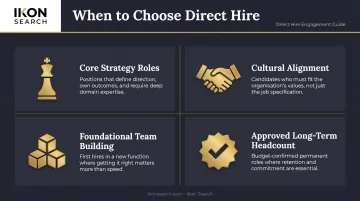
Direct hire is the right model when:
- The role is core to long-term strategy — leadership, senior compliance, underwriting, financial analysis, or senior technology functions
- Cultural alignment is non-negotiable — client-facing financial services or insurance roles where trust and consistency matter
- You're building a foundational team — PE-backed companies scaling post-acquisition, or startups that need durable early hires
- Long-term headcount is already approved — this isn't a budget exploration; the position has organizational commitment behind it
It's a poor fit when you need someone in two weeks, when the scope may change, or when the role has a defined end date.
What Is Contract Staffing?
Contract staffing engages a worker for a specific period or project scope through a staffing agency. The agency — not the client — is the employer of record. The agency handles compensation, payroll taxes, compliance, and often benefits. The client directs the work day to day.
The primary advantage is speed and flexibility. Contract talent is often pre-vetted and immediately available. Engagements can start within days, and the client avoids long-term compensation commitments, paying only for the hours or duration of the engagement.
How the Cost Structure Works
Instead of a one-time fee, clients pay a bill rate — the worker's pay rate plus the agency's markup. That markup covers:
- Payroll taxes (employer-side FICA, FUTA, SUTA)
- Workers' compensation and liability insurance
- Benefits administration (if applicable)
- Agency margin
No authoritative public benchmark exists for exact professional markup ranges — figures vary by role type, engagement length, and market. The key point: the bill rate is an all-in number that reflects the agency absorbing overhead the client would otherwise carry.
Contract-to-Hire: The Hybrid Worth Understanding
Contract-to-hire (also called temp-to-hire) starts as a contract engagement with a built-in evaluation period — typically 90 to 180 days — after which the employer can:
- Convert the worker to a full-time permanent employee (a conversion fee typically applies)
- Extend the contract
- End the engagement
The strategic value is risk reduction: both parties evaluate performance, culture fit, and role scope before committing permanently. That evaluation window is especially useful when:
- A role is newly created and scope may evolve
- The employer is uncertain about long-term headcount
- A candidate is making a significant career transition and both sides benefit from a structured evaluation window
Use Cases for Contract Staffing
Setting aside the hybrid model, pure contract is the right fit when:
- Work has a defined timeline — systems migrations, regulatory projects, product launches, campaign cycles
- Demand is seasonal — insurance claims volume spikes, tax season support, year-end operations
- You need gap coverage — parental leave, extended medical leave, unexpected departures
- Specialized skills are needed for a finite window — a data engineer for a one-time infrastructure build, a compliance analyst for a specific regulatory initiative
Industries where contract models are especially common:
- Technology — software development, data engineering, DevOps, IT infrastructure support
- Financial services — trading desk support, risk and compliance projects, finance and accounting coverage
- Marketing — campaign-specific digital roles, demand generation, content and programmatic
Ikon Search's Contract / Corporate Services division covers all three of these areas, placing professionals from accounting and finance support to Executive Assistants, Chief of Staff, HR, legal support, and hospitality — across both short and long-term engagements.
Which Model Is Right for Your Business?
Neither model wins universally. The right choice depends on the specific role, timeline, budget, and how much hiring risk your organization can absorb right now. Here's a practical framework.
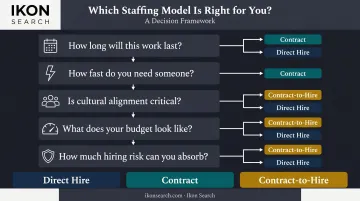
Five Questions to Ask Before Every Search
1. How long will this work last?
- Ongoing core function → direct hire
- Defined project or seasonal spike → contract
- Uncertain but potentially permanent → contract-to-hire
2. How fast do you need someone?
- Willing to invest several weeks for the right long-term fit → direct hire
- Need someone within days → contract
3. Is cultural alignment critical?
- Non-negotiable → direct hire
- Skills matter most for a defined period → contract
- Want to evaluate both before committing → contract-to-hire
4. What does your budget look like?
- Long-term headcount approved → direct hire
- Project-based or variable budget → contract
- Flexible with potential conversion → contract-to-hire
5. How much hiring risk can you absorb?
- Confident in the vetting process and the long-term fit → direct hire
- Need proven output with minimal long-term downside → contract
- Want to reduce full-time risk before committing → contract-to-hire
Situational Recommendations
These scenarios illustrate how the framework applies across common client situations:
PE-backed financial services firm building a compliance function: Direct hire for leadership and senior analysts where institutional knowledge matters; contract for project-specific regulatory work. Deloitte found that 86% of organizations consider management of external contributors critical to performance — yet only 33% are sufficiently prepared to do it. Getting the model right from the start matters disproportionately here.
Insurance carrier managing seasonal claims volume: Contract staffing covers the spike without creating permanent headcount that becomes a liability once volume normalizes.
Fintech startup building its first marketing team: Contract-to-hire lets both sides validate fit across culture, pace, and scope before committing to permanent headcount — particularly useful when the team is still defining what "good" looks like.
Candidate Pool: Who Each Model Attracts
The model choice affects who you can realistically attract. Direct hire draws candidates seeking stability — including passive talent who aren't actively looking but are open to the right permanent opportunity. Contract roles attract professionals who prioritize flexibility, are between permanent roles, or prefer project-based work.
Ikon Search starts every engagement with a deep intake conversation — understanding company culture, team dynamics, and long-term hiring goals before recommending a model. That conversation determines which candidate pool to target, how the role is positioned in the market, and which sourcing channels will yield the strongest candidates for that specific engagement.
Conclusion
Direct hire is built for permanence. Contract staffing gives you flexibility when the scope, timeline, or budget doesn't support a full-time commitment. Contract-to-hire sits between them — useful when both sides need time to validate the fit before locking in. None of these is universally better. Each is a tool, and the wrong one for the job creates problems that surface later: re-hires, wasted onboarding spend, missed business outcomes.
The model matters as much as the candidate. Choosing the right engagement structure upfront is what separates a hire that holds from one that sends you back to square one.
If you're not sure which model fits your current situation, Ikon Search can help you work through it. The team regularly advises clients on structuring the engagement before the search begins — whether that's a retained permanent search, a short-term contract, or a contract-to-hire arrangement. Reach out at ikonsearch.com to talk through the role and timeline.
Frequently Asked Questions
What is the difference between direct hire and contract?
Direct hire places a candidate directly on the employer's payroll as a permanent full-time employee from day one. Contract staffing engages a worker for a defined period through a staffing agency, which handles payroll and compliance ; the employer directs the work but is not the employer of record.
Who pays the fees in a direct hire?
The employer (client company) pays the placement fee to the staffing firm. It's structured as a one-time fee — typically 18–22% of the placed candidate's first-year base salary for professional roles — paid upon successful placement.
Which is better, direct hire or agency?
These aren't opposites. Staffing agencies facilitate both direct hire and contract placements, so the real question is whether you need a permanent hire or a flexible arrangement. A specialized agency helps you identify which model fits the role and executes accordingly.
What is contract-to-hire and how does it differ from a straight contract?
Contract-to-hire includes a built-in evaluation period (typically 90–180 days) with the mutual intention that the role may convert to permanent employment, and a conversion fee is typically charged at that point. A standard contract has a defined end date with no expectation of conversion.
Is direct hire more expensive than contract staffing?
Direct hire carries a larger one-time placement fee, while contract staffing spreads cost through bill rates over time. For short engagements, contract is typically less expensive overall, but cumulative bill rates on longer contracts can exceed a direct hire fee. The right answer depends on expected duration and role.
How long does the direct hire process typically take compared to contract?
Direct hire searches take several weeks given the thoroughness required to vet for permanent fit; contract staffing can place pre-vetted talent within days. When speed is the priority, contract is faster — but when fit matters more than urgency, direct hire is worth the additional time.