
Getting the distinction wrong has real consequences. Hire an administrator when you need a manager, and you'll have compliance gaps and no strategic oversight. Hire a manager when you only need execution support, and you've overpaid for capabilities the organization can't yet use.
This article lays out exactly what separates these two roles — with salary benchmarks, core responsibilities, and a practical framework for deciding which one your organization actually needs right now.
Key Takeaways
- A Contract Administrator handles day-to-day contract execution: drafting, tracking, compliance, and renewals.
- A Contract Administration Manager owns the full contract function: the team, the processes, and governance.
- The salary gap is meaningful: administrators average around $70K–$77K; managers average $115K–$133K.
- Smaller organizations often combine both functions; larger firms need them separate.
- Hiring at the right level from the start prevents costly mismatches in scope and expectations.
Quick Comparison: Contract Administration Manager vs. Contract Administrator
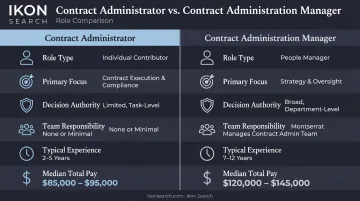
| Factor | Contract Administrator | Contract Administration Manager |
|---|---|---|
| Role Type | Individual contributor | People manager |
| Primary Focus | Execution | Oversight and strategy |
| Decision Authority | Operational (within set guidelines) | Departmental (sets the guidelines) |
| Team Responsibility | None | Manages contract admin staff |
| Typical Experience | 1–5 years | 6–10+ years |
| Median Total Pay (US) | ~$77K (Glassdoor) | ~$115K–$133K (Glassdoor/Salary.com) |
What Is a Contract Administrator?
The Contract Administrator is the operational engine of the contract lifecycle — keeping agreements moving from drafting through execution, monitoring, and closeout, within the parameters set by legal, procurement, or management.
Core Responsibilities
Day-to-day tasks typically include:
- Drafting and reviewing contracts using approved templates
- Tracking key dates, renewal deadlines, and compliance milestones
- Maintaining the contract repository and document version control
- Flagging compliance issues and processing amendments
- Coordinating with internal stakeholders in legal, finance, and procurement
The role is task-oriented and contract-specific. A Contract Administrator might own a single agreement from end to end, or manage a defined portfolio of lower-complexity contracts — but they operate within a framework someone else designed.
Skills and Qualifications
The skill set is precise and practical:
- Exceptional attention to detail and organizational discipline
- Solid understanding of contract law fundamentals
- Proficiency with CLM software — DocuSign, Ariba, Ironclad, Coupa, and Agiloft are among the most commonly requested tools in job postings
- Clear written communication, especially when flagging issues to legal or finance
On the education side, according to Franklin University's analysis of job postings, 53% of Contract Administrator postings require a bachelor's degree, with 2–3 years of experience appearing most often as the baseline. Fields like business, legal studies, and supply chain are common. NCMA's entry-level CCMA certification — which requires no prior experience and is aligned with the ANSI-approved Contract Management Standard — can strengthen a candidate's profile, particularly for organizations that prioritize structured contract governance.
Where This Role Fits
Contract Administrators are the right hire for organizations with moderate contract volume that need dedicated execution and compliance support — without requiring strategic oversight. Common employers include:
- Financial services firms managing vendor agreements
- Insurance carriers processing policy-related contracts
- Consulting firms handling client engagements
- Mid-size technology companies with active procurement needs
In smaller organizations, the role may expand to include process documentation or vendor onboarding. That's where the distinction from a Contract Administration Manager becomes important — a distinction worth understanding before you hire.
What Is a Contract Administration Manager?
The Contract Administration Manager owns the contract administration function rather than executing within it — responsible not just for processing contracts, but for the people, processes, and governance structures that make contract administration work at scale.
Core Responsibilities
The manager's scope extends well beyond any individual agreement:
- Managing and mentoring a team of contract administrators
- Designing and enforcing contract processes, templates, and escalation paths
- Serving as the decision point for disputes or complex contractual issues
- Reporting on contract portfolio health to senior leadership
- Collaborating directly with legal counsel, CFOs, and C-suite stakeholders on risk and governance
According to Salary.com's role definition, this is a true first-level manager with full authority for personnel actions, departmental budget responsibility, and a direct reporting line to a director. That classification matters when setting hiring expectations.
Skills and Qualifications
The elevated scope demands a different capability set:
- Leadership and people management, including coaching and performance evaluation
- Strategic thinking and cross-functional influence
- Risk assessment at a program level, not just a contract level
- Financial acumen and experience presenting to senior leadership
- Familiarity with CLM platforms and legal tech tools
The NCMA career path framework sets the experience threshold at 8+ years with a bachelor's degree, and describes a master's in business as highly desirable.
Salary.com's data points to at least 5 years of individual-contributor experience plus 1–3 years of supervisory experience as a practical baseline. Senior NCMA certifications — the CCCM (commercial track) or CFCM (federal track) — are meaningful differentiators at this level.
Where This Role Fits
When contract volume grows, teams expand, or regulatory exposure increases, ad hoc coordination breaks down — and that's when a dedicated manager becomes necessary. Organizations where this threshold tends to arrive earliest include:
- Investment banks and financial advisory firms managing high-volume vendor and client contracts
- Insurance carriers and reinsurers where third-party agreements intersect with regulatory requirements
- PE-backed portfolio companies scaling operations quickly across multiple business units
- Any organization where contract governance gaps are creating leadership visibility problems
At that point, the manager role stops being optional. Someone has to own the function — not just execute within it.
Key Differences: Contract Administration Manager vs. Contract Administrator
Understanding the roles individually is useful. Seeing where they actually diverge is what matters for a hiring decision.
Seniority and Authority
The Contract Administrator operates within defined guidelines and escalates decisions upward. The Contract Administration Manager sets those guidelines, owns the escalation process, and is accountable for the team's outputs and contract governance outcomes. Put simply: one role operates inside the system; the other is responsible for whether the system works.
Scope of Work
Contract Administrators are contract-specific and task-oriented — focused on a single agreement, a deadline, a clause. Contract Administration Managers are function-wide, managing workflow standards and team capacity across the full contract portfolio. The scope gap is wide enough that these roles rarely compete for the same opening.
People Management
This is one of the clearest dividing lines. A Contract Administrator typically works independently or as part of a team without direct reports. A Contract Administration Manager leads, coaches, and evaluates a team of administrators. That single factor reshapes everything from how you write the job description to how you structure the interview.
Strategic Involvement
Contract Administrators are execution-focused — their job is to get contracts processed accurately and on time. The manager role operates at a different altitude. Typical strategic responsibilities include:
- Evaluating and selecting contract lifecycle management (CLM) technology
- Shaping vendor management policies and risk frameworks
- Presenting contract portfolio performance to senior leadership
- Advising on risk exposure and escalation thresholds
This kind of cross-functional visibility is built into the role, not reserved for special occasions.
Compensation Gap
The pay difference reflects the expanded scope and accountability. Based on current US market data:
| Source | Contract Administrator | Contract Administration Manager |
|---|---|---|
| Glassdoor (2026) | Median $77K; range $63K–$96K | Median $115K; range $90K–$148K |
| Salary.com (2026) | — | Average $133K; range $119K–$146K |
| PayScale (2026) | Average $71K; range $51K–$102K | — |
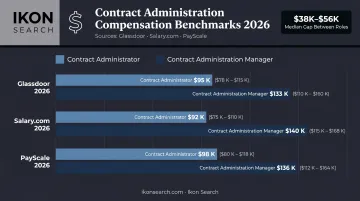
Financial services adds a premium on the administrator side — Glassdoor notes a financial services median of $89,516 for Contract Administrators, and at the manager level, firm-specific data shows Bank of America and Deloitte paying around $127K–$128K in median total compensation.
Which Role Does Your Organization Need?
The answer depends less on your organization's size and more on what you're actually asking the hire to do.
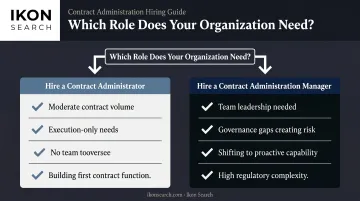
Start with a Contract Administrator if:
- Contract volume is moderate and manageable by one person
- The primary need is execution — drafting, tracking, renewals, compliance
- No existing team needs coordination or oversight
- You're building out a contract function for the first time
Move to a Contract Administration Manager when:
- You have (or are building) a team of administrators that needs leadership
- Contract governance gaps are creating risk or limiting leadership visibility
- The contract function needs to shift from reactive task management to proactive organizational capability
- Regulatory complexity demands structured oversight, particularly in financial services, insurance, and legal advisory. Frameworks like OCC Bulletin 2023-17 on third-party risk management set explicit expectations for how contract oversight should be structured
WorldCC's contract management research found that poor contract management erodes an average of 8.6% of contract value annually. That loss accelerates when there's no governance structure in place to catch it.
For companies in heavily regulated industries, getting this hire right from the start matters more than correcting it later. Ikon Search's Contract / Corporate Services division places contract professionals at both levels across financial services, insurance, and legal advisory, matching each candidate to where the organization actually is operationally, not just what sounds right on a job posting.
Conclusion
Choosing between a Contract Administrator and a Contract Administration Manager comes down to a structural question: does your organization need someone to execute contract processes, or someone to own and lead the function?
Both roles are essential. The question is sequence and scale. Hire the right level at the right moment, and you'll get a contract function that supports growth, manages risk, and keeps compliance on track. Hire at the wrong level, and you'll either overburden a coordinator with strategic responsibilities they weren't hired for — or bring in a manager with no function to lead.
Frequently Asked Questions
What is contract administration management?
Contract administration management is the oversight of an organization's entire contract function — covering the people, processes, systems, and standards that govern contracts from initiation through renewal. It's a leadership discipline, not a single transactional task.
What is the salary difference between a Contract Administrator and a Contract Administration Manager?
In the current US market, Contract Administrators earn a median of roughly $70K–$77K, while Contract Administration Managers earn $115K–$133K depending on the source. The gap reflects team leadership responsibility, strategic involvement, and industry specialization — particularly in financial services.
Can a Contract Administrator become a Contract Administration Manager?
Yes. NCMA's framework maps the path from administrator to senior administrator to manager — typically requiring 8+ years of experience, demonstrated leadership, and a professional certification such as the CCCM or CFCM.
Do small companies need both a Contract Administrator and a Contract Administration Manager?
Not initially. Smaller organizations often combine both functions in a single senior Contract Administrator role. A dedicated manager becomes necessary once contract volume, team size, or regulatory complexity outgrows what one person can handle.
What qualifications does a Contract Administration Manager need beyond a Contract Administrator?
Beyond core contract skills, the manager role demands leadership experience, strategic thinking, cross-functional stakeholder management, and familiarity with enterprise CLM systems. An MBA or senior NCMA certifications (CCCM or CFCM) are common differentiators.
What is the difference between a Contract Administration Manager and a Contract Manager?
A Contract Manager handles the strategic and commercial side of individual contracts — negotiation, risk, and commercial terms. A Contract Administration Manager runs the operational function, leading a team and the systems that keep the entire contract portfolio organized and compliant.