This scenario isn't unusual. Across financial services, insurance, and technology, urgent contract hiring is a recurring operational reality, not an exception. The good news: contract staffing is structurally built for speed. Unlike permanent hires, contract placements skip extended offer negotiations, benefits enrollment delays, and long notice periods.
What actually determines how fast a role gets filled? This article breaks down realistic timelines by role type, the factors that compress or extend those timelines, and what employers can do to move faster without cutting corners on quality.
Key Takeaways
- Specialized staffing partners can move from intake to first candidate submission in 24–72 hours for many contract roles
- Role complexity and talent pool depth matter more than agency effort alone
- A complete job brief and fast internal approvals are the single biggest factors employers control to reduce time-to-fill
- Boutique firms with pre-built, niche pipelines regularly deliver a qualified shortlist in 2–3 days — faster than generalist agencies on specialized roles
What "Urgent" Actually Means in Contract Staffing
There's a wide spectrum here. Same-day operational coverage is a different problem from "we need someone productive within two weeks." Most hiring managers who call a role urgent are working toward a start date within 5–10 business days — tight, but realistic when you cut out the friction points that slow permanent hires down.
That window is where contract staffing has a clear structural edge. SHRM's 2025 recruiting benchmarks put median time-to-fill at 44 days for non-executive and 45 days for executive full-time roles. Contract placements routinely happen in a fraction of that time — skipping offer negotiations, lengthy notice periods, and multi-round approval processes that drag permanent hires out.
How Long Does It Typically Take to Fill Urgent Contract Roles?
Timelines by Role Type and Seniority
There's no universal answer, but complexity bands are a useful framework:
| Role Type | Typical Sourcing Timeline |
|---|---|
| General administrative / operational | 1–3 business days |
| Specialized professional (analysts, compliance, underwriters, marketing managers) | 3–7 business days |
| Senior / niche (interim CFOs, risk managers, technology leads) | 7–14 business days |
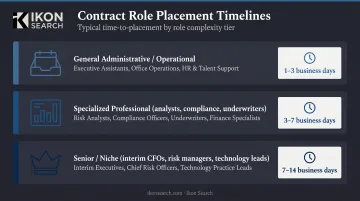
Administrative and operational roles fill fastest — candidate supply is broad, screening criteria are standardized, and an agency with an active network can often present options within 24–48 hours of intake.
Specialized professional roles take longer, not because of recruiter effort but because the talent pool is narrower. A compliance officer with insurance TPA experience or a financial analyst with PE-backed portfolio company background requires a tighter skills match and more targeted outreach.
Senior and niche roles are the most time-intensive. Interim CFOs, risk managers at investment banks, and specialized technology leads at hedge funds combine seniority with limited active candidate availability. Seven to fourteen business days is realistic when sourcing is done carefully.
One Timing Gap Employers Often Miss
The timeline above covers sourcing — not placement. Add 2–5 business days for internal approvals, interview scheduling, and onboarding paperwork after a candidate is identified. Employers who don't factor this in miss their own deadlines.
Industry-Specific Nuances
Regulated industries add another layer. FINRA Rule 3110 requires Form U4 verification within 30 calendar days of filing, with fingerprint submission required within the same window. State insurance licensing timelines vary significantly — Virginia's standard processing runs 15 business days, while California advises waiting at least 7 days after fingerprint submission before checking status.
The takeaway: flag compliance requirements at intake. Licensing and background check timelines are fixed by regulators, not by the agency — and they run parallel to sourcing, not after it.
Factors That Determine Your Hiring Timeline
Most employers assume the bottleneck is the recruiter's ability to find someone. Often, it isn't.
Role Clarity
A vague or shifting job description is the single most avoidable cause of delay. When recruiters receive an incomplete brief, they source against the wrong profile, burn time on mismatched candidates, and restart. A precise brief covering required skills, scope, duration, and rate accelerates every step that follows.
Talent Pool Conditions
A February 2026 Robert Half survey of 2,000 hiring managers found 62% report skills gaps are more pronounced than a year ago — and only 6% say they have the talent needed to complete priority projects. In specialized verticals like finance, compliance, and technology, active contract candidates are a genuinely constrained resource. Speed depends in part on what the market is offering, not just how hard anyone searches.
Internal Decision-Making Speed
This is where urgent hires most commonly break down. Slow feedback, delayed interview scheduling, and multi-layer approval chains add days — sometimes weeks — to a process that the recruiter completed on time.
Robert Half's 2025 research links slow internal hiring directly to operational damage:
- Employee burnout reported by 42% of managers
- Delayed project timelines cited by 39%
- Decreased productivity affecting 37%
The employer's internal clock matters as much as the agency's.
Compensation Competitiveness
Candidates with in-demand skills evaluate contract opportunities fast and decline non-competitive offers without negotiating. SHRM's 2023 pay transparency research found 70% of organizations that publish pay ranges attract more applicants, and 65% say it makes them more competitive. For urgent contract roles, this means approving a realistic rate range before sourcing begins — not after the first candidate declines.
Agency Pipeline Depth
The difference between candidate submission in 48 hours versus two weeks often comes down to whether the firm already has vetted professionals in an active network. Cold sourcing from scratch is slower, regardless of effort. Knowing which factors you can control — brief clarity, approval speed, rate approval — is where the timeline advantage is actually won.
How to Speed Up Your Contract Staffing Timeline
When urgency hits, most of the delay is controllable. Four actions consistently compress time-to-fill:
1. Write a complete job brief before engaging a recruiter
A strong brief includes:
- Required skills and preferred background
- Contract duration and work model
- Daily responsibilities and key deliverables
- A decided pay range (not a range you'll approve later)
- Start date and decision timeline
2. Pre-authorize the hiring decision at the manager level
When the right candidate is presented, an offer needs to move within 24 hours. Multi-layer approval chains built for permanent hires slow down short-term contract decisions unnecessarily. Identify one final decision-maker before the search begins.
3. Compress interviews to one structured round
A 30–45 minute structured interview is sufficient for most contract roles. Multi-round processes designed for permanent hires introduce delay without improving the decision — contract engagements are performance-based and time-bounded by definition.
4. Build the relationship before the urgency hits
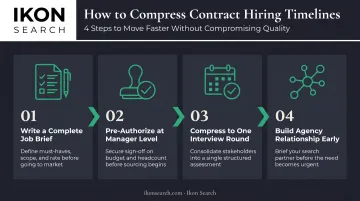
Employers who engage a specialized recruiter proactively — before a gap appears — see faster results when urgency strikes. The agency already understands the company's culture, standards, and typical role requirements. There's no onboarding curve eating into the search window.
Why a Specialized Boutique Agency Fills Roles Faster
Pre-Built Pipelines vs. Cold Sourcing
Boutique firms focused on specific industries maintain active relationships with contract professionals in those verticals. When a client calls with an urgent need, the recruiter isn't starting from scratch — they're reaching out to people they already know.
Ikon Search's contract services team, led by Kristin Lutz, works this way in practice across financial services, insurance, and technology. Qualified candidates are typically presented within 2–3 business days of intake — not because the process is rushed, but because the network already exists.
Fewer Submissions, Faster Decisions
Boutique firms tend to submit a smaller, curated slate — two or three well-matched professionals rather than a high-volume pile. A clean shortlist typically means one round of interviews and a fast decision — evaluation fatigue from reviewing fifteen marginally qualified profiles adds days to a process that should take hours. In practice, Ikon has presented a single precisely matched candidate in place of a volume list when the role called for it, compressing client decision time to under 24 hours.
Sector Knowledge Reduces Briefing Time
When a recruiter already understands the operational difference between an insurance TPA and a reinsurer, or knows what an interim finance role at a PE-backed portfolio company actually requires at close time, they spend less time translating the job spec. The intake conversation is shorter, and sourcing begins faster.
That's why Ikon's divisions — Insurance, Risk & Compliance, Technology, and Contract/Corporate Services — are kept separate rather than consolidated under a generalist team. A recruiter who lives in one vertical doesn't need a 30-minute briefing call to get oriented; they're already oriented.
Frequently Asked Questions
How fast can a staffing agency hire you?
For contract roles, specialized agencies can present pre-vetted candidates within 24–72 hours of intake. Start dates within one to two weeks are achievable for most professional roles, depending on complexity and how quickly the employer can move on a candidate.
What is the 3-month rule for jobs?
The "3-month rule" typically refers to the evaluation period in temp-to-hire or contract-to-perm engagements — roughly 90 days during which employers assess fit before extending the engagement or converting to a permanent role. It's a common contract term, not a universal industry standard.
What is the 70/30 rule in hiring?
The 70/30 rule is an informal guideline suggesting employers hire candidates who meet roughly 70% of stated requirements rather than waiting for a perfect match. In urgent contract staffing, waiting for a 100% match typically extends timelines by weeks — a trade-off most hiring managers can't afford.
Can urgent contract roles be filled in less than 48 hours?
For generalist or operational roles where an agency has an active bench, same-day or next-day placement is possible. For specialized professional roles, 48 hours is aggressive but achievable if the job brief is complete and the hiring manager can move immediately on a strong candidate.
What is the difference between urgent contract staffing and temp-to-hire?
Urgent contract staffing fills an immediate, defined-duration need with no expectation of permanent conversion. Temp-to-hire is a structured trial period — typically around 90 days — designed to evaluate a candidate before making a permanent offer.